Blog

What I Miss about Teaching

I know what many of you teachers–both former and current–are thinking. You don’t miss–or would not miss–anything about teaching.

Don’t get me wrong. I don’t miss getting up at 5:30 every day and getting to work so early. I don’t miss lesson plans (well, I really didn’t mind them once I learned how to do them), grading papers, useless in-service sessions (yes, I said it for you, teachers–most were not that beneficial, right?), and dealing with discipline issues. I’m glad I can take my time in the mornings.

But when 9:00 arrives, I am ready to do something productive. And I think about my days in education.

It will soon be seven years since I was forced to retire because of vision loss. I didn’t intend to retire at that age. I was in my most fun year of teaching I’d had my entire career. I had one class of French 2, two classes of French 1, two theater arts classes, and one study hall. My classes were no more than 20 students.

I was also the Drama Club sponsor. Give that assignment to the gal who was in plays in high school and even a play entirely in Spanish in college who always wished she had the time to participate in community theater, and you’ve made one gal very happy.

I loved the flexibility of teaching theater arts. Yes, there were standards, but they were very broad. So my class looked like this: Mondays: instruction and activities from a chapter in the book; Tuesdays–Tech Tuesdays when we went to the lab and researched things related to theater and performing or created something connected to what we were learning; Writing Wednesdays: the students were in groups and each Wednesday worked on a writing project. They had to write a short play the first semester, which they performed at the end of the semester, and they had to write a short movie the second semester which they recorded, and I played them for the class: Throwback Thursdays: review and quiz or test day; Fun Fridays–anything from improv to acting games to whatever.

Yes, an artsy theater teacher’s dream job.

But I had many other great years. I know some people cringe at the thought of teaching high school, but I loved high school students. Well, I did after the first couple of horrible years during which I had to learn what I was doing (I apologize to those students for my lack of experience). And, yes, occasionally there was that student who was disrespectful or hated me or hated my class or whatever, but the vast majority of students were well-behaved, respectful, and fun to teach.

It often makes my day to encounter a former student and catch up on what’s going on in their lives. I loved it when I stood in the hall during class changes and students spoke to me as they walked past or even stopped to chat. The words, “Hey, Mrs. Harris!” were always music to my ears. And it is gratifying to see how many have gone on to become successful, productive adults who are now seeing to my needs in the medical field and other areas.

So what do I miss about teaching? Planning lessons (see, I changed my mind from the beginning of this post) is one, although I did get tired of teaching the same thing year after year when I was teaching just Spanish or just French. I like variety. Working with other teachers and enjoying conversations with them is another.

But #1 is the students. They kept me busy, kept me laughing, sometimes kept me tutoring or even counseling, and kept me busy focusing on someone else rather than myself.

No, I don’t want to go back to the classroom, even if I could. I’m too old now to relate to them, and the truth is, I’d be so much older than most of my co-workers, I wouldn’t have a lot in common with them.

But I cherish the memories of the good times in education while conveniently forgetting the more difficult ones. So, to my former students, thank you for your part in enriching my life.And if you see me at Walmart or anywhere and I don’t see you, please say “Hey, Mrs. Harris!” It’s still music to my ears.

Embarrassing blind moments

Our dog and I have something in common. Read on to find out what it is.

If you read my book Learning to Live with Vision Loss, you understand what blindness is and what it isn’t. But in case you haven’t, I’ll share that 85% to 90% of people considered blind (i.e. legally blind) have some functional vision. Some may only see light and dark, but most of us have enough vision to do daily tasks using technology and other aids.

That means we sometimes think we are seeing more than we are.

In my book, I shared the funny story about the time I thought I’d killed a fly in the kitchen only to have my husband tell me, “You sure did. You definitely got that popcorn kernel.” It was a funny blind moment, not an embarrassing one.

Then there was the time we stopped at a rest area on the interstate. We have traveled I-40 in our state frequently, and when my husband parked at the rest area, he asked if I needed his help finding the facilities. I knew the area well and told him “no.” When I came back to the car, I opened the passenger door then stopped. A bag of chips was in the seat. “Wait a minute,” I thought. “I wasn’t eating any chips.” I glanced up and was shocked to see a man (fuzzy, blurry, not clear but definitely not my husband) sitting behind the steering wheel. He was speechless as he stared at me. I immediately began apologizing. “Oh, I’m so sorry! I’m visually impaired and thought this was our car!” I said it again as I backed away and closed the door. My husband was sitting in the next car watching the whole thing and unable to do anything about it. That vehicle, the same color and similar to ours, had not been in that parking spot when we pulled in.

“Well,” I told my husband when I got into our vehicle, “he’s got a story to tell for the rest of his life.” It was embarrassing but funny at the same time. Most of my VIP (visually impaired persons) friends have had similar experiences.

Recently, however, I had a blind moment that was not so funny.

I was helping serve the after-funeral meal of a dear neighbor and friend, and I was managing to recognize some people by their voices, height, and other clues I use to identify people. A young woman with long, dark hair came up to me as I was helping clear tables. She had already spoken to me in the kitchen, and at that time I wasn’t sure who she was but knew she knew me since she said, “Hi, Mrs. Pam.” After the meal, she was near the family, and I hugged her tightly, thinking I was hugging the daughter who had lost her father.

After a few words, however, she knew my mistake. “Mrs. Pam, I’m (name).” She is a close friend of the daughter, which is why she was there, and she was very understanding because she knows my situation, but still…it was embarrassing.

One of my many flaws is I am an extrovert to the extreme. I love people. I’m a hugger. (Sorry, germ phobes, it’s just an automatic reaction in many situations.) I always tell myself I’m going to change, that I will think before I speak and think before I hug, but somehow those tendencies overtake me. At my age, you’d think I would have figured it out, but obviously, I am still a work in progress.

I have countless other stories, and I guess despite the embarrassment, I have to laugh at myself. I did plenty of stupid things before vision loss, but the incidents have increased in number the past six years.

At the beginning of this post, I shared that our dog and I have a lot in common. No, he’s not blind. But he is extremely sociable. He loves people and loves other dogs. He’s excited when we take him to the kennel. When people come over, we have to restrain him at first until he calms down because he wants to be near them. As a matter of fact, he gets so excited about new people in the house, he shakes all over while his tail wags furiously.

He’s four years old, and we continue to try to train him to be calm and not want to jump up on people or bother them with begging to be petted. At least he doesn’t lick. He may never be trained completely.

I may not either. But I’m going to try. It’s the only way I can think of to avoid more embarrassing moments!

Cancer rears its ugly head–again.

As I write this, I have two cousins battling cancer. I have a good friend and neighbor in the hospital because of cancer. My daughter-in-law’s brother has been diagnosed with lymphoma. My niece has been battling cancer for over a year, and although she is cancer free, she has to continue her fight to keep it from coming back. A fellow church member was just diagnosed. All of these people, with the exception of my niece, are near my age. I guarantee we all know people much younger who have been diagnosed with this horrible disease.

So, with me being me, I did some research. According to the NIH records, I live in the heart of the area with the highest cancer mortality rates. Look it up. You’ll see most of the southern states plus Missouri, Indiana, Ohio, and Maine in the higher ranges. The highest? Oklahoma, Arkansas, Mississippi, Kentucky, and West Virginia. And maybe Maine if my color-distorted vision seeing a hugely magnified map is seeing correctly.

Why? Why these areas?

Is it genetics, with residents of these states going back for generations? Is it due to lifestyle? What we eat, whether we exercise or not, habits like tobacco use and drinking alcohol? Yes, sorry to disappoint, but research now shows that alcohol even consumed in moderation is a contributing factor to cancer. If you don’t believe me, look it up. Don’t take my word for it.

Is it because we did (and do) stupid things like sunbathe to get that golden tan without wearing sunscreen? I’m guilty. For years I spent time outdoors without sunscreen. Getting older and seeing the results of that bad choice plus having a precancerous squamous cell carcinoma removed from my nose was a wake-up call. A little late to gain some wisdom, but maybe not too late.

Let’s not forget about the warnings about eating processed foods, especially processed meat. Apparently, foods like bacon are a Group 1 carcinogen as well as deli meats and other foods we like.

I told my husband I didn’t think we Baby Boomers would live as long as our parents’ generation. He disagreed. He reminded me of how they ate foods fried in lard, ham, bacon, and other foods we are told are bad for us. True. But they didn’t grow up drinking soft drinks, eating bags and bags of potato chips, and as far as deli meat–well, bologna was a real treat, not a cheap food.

Their water was not as contaminated by chemicals. They grew their own food and got their water from wells that were not yet contaminated by ground water that contains harmful chemicals used in agriculture. Many ended up with heart disease in their older years, but medicines and surgeries prolonged their lives. My dad died three weeks before he would have turned 86. My mom died six weeks before she would have turned 94. Neither died because of cancer.

I honestly don’t know what the answers are. But if you’ve ever experienced chemo and other cancer treatments, you can tell the rest of us it is not a pleasant experience. You can tell us that cancer is always in the back of your mind.

But what is the purpose of this blog today? I don’t know. I guess it’s a way to express my dismay and my frustration. I wish I could fix it. I want to be more conscious of what I eat and lifestyle choices I make. I want to spread the word to others to make smarter choices. I want to encourage people, along with myself, to be smart.

I know President Trump addressing Congress last night is on a lot of people’s minds, and I get that. But you know what? However we feel about politics, there is little we can do. Yes, we can vote. Yes, we can share our views with our legislators. I have the privilege of living in a country in which I can express my viewpoints, and I feel I have an obligation to do so. But the truth is, my lone voice must be joined by many others to make any sort of a change. I can’t change anything on my own.

What, then, can I change? My lifestyle. My choices. True, genetics play a role. True, I can’t prevent everything. My vision loss has taught me that because there was nothing I could do to stop the condition other than see my doctor and have the eye injections and surgeries that served to delay the inevitable. But I’m trying to be smarter. Wear sunscreen. Swim only before 10:00 A.M. or after 2:00 P.M. Eat foods like blueberries, tomatoes, squash, and bell peppers which contain cancer-fighting nutrients. Watch my cholesterol. Eat heart-healthy foods to avoid heart disease.

Most people who see this blog won’t read it because…well, people just don’t have a lot of interest in blogs. Those who do read it will wonder why I wrote it and what business it is of mine. After all, can I really change anyone’s mindset about health issues? Probably not.

I can try, though. I can open the forum for discussion. I can donate to places like St. Jude and the American Cancer Society. I can try to educate others even though I’m not a health professional. What I am, by nature, is a teacher and a researcher. I want to share what I learn.

So I’ll raise a glass of FILTERED water and say “Cheers!” to those of you whose mindset is like mine. Let’s do what we can to end this horrible disease. And one more thing—

If you’re over 50, have you had a colonoscopy? This is Colorectal Cancer Awareness Month. If you have precancerous polyps, they are removed during the test. I have a friend who died because she never had a colonoscopy for screening purposes, and the cancer spread to her liver. She battled for about year and a half, if I remember correctly. She was only 62. As we know, that age doesn’t sound old anymore.

As always, if you took the time to read this entire blog, thank you. If it makes a difference in just one person’s life, my time is worth it.

Is Elvis stuff worth anything? Well, it depends.

Over 15 years ago, I met one of Elvis’s girlfriends at a conference. Her name is June Juanico, and they dated in the 1950s before his Army service and before Priscilla. I purchased her book and found it to be interesting. I gave the book away when I lost the ability to read regular books, and I wonder how she is doing all these years later or even if she is still alive.

A family friend who was 14 years older than I (yes, I’m using correct English there instead of colloquial English, but has that rule changed?) was a huge Elvis fan. She kept a scrapbook with all kinds of celebrity photos, but she had more Elvis clippings and photos than any. She brought parts of that scrapbook over a year before she passed away. She knew I’d appreciate them, and she didn’t want her treasures going to someone who wouldn’t care.

I’ve had those pages all this time, but because I have to use a wearable headset to look at that sort of thing, I kept putting off going through them because I knew my eyes would be very tired. But this weather forced me to find something to do in the house, so I pulled them out and spent over an hour examining them.

The cool thing about this is she had the original clippings from the Memphis newspaper, and the Memphis newspaper seemed to have constant photos and articles about Elvis. People in other parts of the country wouldn’t have had those photos. Among the photos are a clipping of the family gathered around Elvis’s mother’s grave (with the tent above the burial site) at her funeral in 1958. I had never seen that before. Another photo is the original newspaper clipping of the Million Dollar Quartet–Elvis, Johnny Cash, Jerry Lee Lewis, and Carl Perkins–at Sun Studio. Elvis’s girlfriend at the time is in the photo. If you’re unfamiliar with the story, one day Elvis stopped by Sun Studio and somehow the other three ended up being there. It was a historic moment in music, and a newspaper reporter got to the studio to take the photograph. Look it up online. It has been duplicated in posters, books, and blogs like mine. I couldn’t believe it when I picked it up. An original clipping, not a copy.

How cool.

And those two are just the beginning. As I went through them, I could imagine the 14-year-old devouring the teen magazines and newspapers as she selected which ones to keep in her special scrapbook. I had those celebrity scrapbooks. At that age, I was basically an only child because my brother was gone from home. We lived in a neighborhood with only older people, so no one to hang out with. I was skinny, awkward, wore thick glasses, and escaped my reality by reading books and teen magazines. My celebrity crushes were Kurt Russell, Bobby Sherman, David Soul, Michael Cole, and…no, not Elvis…Lee Majors. Well, the Lee Majors in “The Big Valley,” so maybe it’s more appropriate to say Heath Barkley. By the way, I love that name Heath. But I couldn’t bring myself to name my sons after a TV character. I did know a couple who named their children Rhett and Scarlett. Really.

I think I’ll hang on to those photos and clippings for quite a while. It will be fun to go down memory lane remembering those iconic figures of the past while at the same time remembering my friend. Fourteen years separated us, but she was a family friend who spent a lot of time with my mom and me. She was a part of my growing up years, as much or more than some of my relatives.

Yesterday Barry was watching a “Pawn Stars” episode, and a woman was trying to sell something that belonged to Frank Sinatra. She was disappointed the item wasn’t as valuable as she thought it it should be. But they explained that because there are no longer many Frank Sinatra fans, the memorabilia has gone down in value.

That may happen with Elvis memorabilia, but for me, the scrapbook items are worth a great deal. Maybe not financially but emotionally. I will close with a line that only those familiar with Elvis will get, and forgive the corniness. It’s true.

Memories, pressed between the pages of my mind.

Sweet memories.

Some viewing suggestions for you gals over 50

Snow is on the way in our part of the world, and if you’re looking for something new to fill the hours, maybe you’ll like one or more of my suggestions.

YouTube has several channels I subscribe to, and I’ve broken them down by category.

If you like artsy stuff, try Andrea-Nelson-Art for watercolor creations that are easy to do and fun to watch her create.

If you have concerns about flying or interest in learning about behind-the-scenes of a pilot’s life, check out CaptainSteeeve. That’s right, 3 e’s in a row. You’ll understand when you hear him sign off!

If you love dogs and haven’t yet discovered Teddy, search for aguyandagolden, all one word and lower case. The Teddy videos make me smile!

The next two suggestions are if you need hope in dealing with adversity or a wake-up call to realize how blessed your life is. I suggest Joni’s channel. Those of you near my age may remember Joni (pronounced Johnny) and the book she wrote about becoming a quadriplegic due to diving into a shallow lake and breaking her neck. If you remember the cover, it depicted a brown-haired girl holding a paintbrush in her mouth. Now she has a channel called JoniandFriendsVideo — well, maybe JoniandFriendsVideos–in which she talks about her condition but also shares her Christian faith and how it helps get her through. Her husband of 42 years joins her occasionally.

A woman who is a quad-amputee due to bacterial meningitis when she was 19 has a channel in which she demonstrates how she manages with prosthetics for hands and legs/feet. She drives and works as an occupational therapist. Find her by searching for glamputee-14V. She is amazing!

If you enjoy Bible study and are a fan of “The Chosen,” you might like three seasons of Drive-Thru History on Prime Video. They are free. The seasons are: The Gospels, Acts to Revelation, and To the Ends of the Earth. The host is very interesting as are the sites he visits. I’ll never travel to the Holy Lands, so this is the next-best thing.

If you are “of a certain age,” I recommend these shows: “Elsbeth” (I stream on Paramount Plus but it airs on Thursday nights on CBS); “Matlock,” the one with Kathy Bates on CBS and streaming on Paramount Plus; the movie “Mrs. Harris Goes to Paris,” which used to be on Netflix but not sure if it’s still there–look for it; the movie “A Dog’s Purpose” if you like dogs (it has a good ending, not a “Marley and Me” ending); and “A Man on the Inside” on Netflix (he is spying on a nursing home).

Let me know if you try any of these and like them. If you don’t, that’s okay. We’re all different, and I’m definitely different. I’m the weirdo who doesn’t love desserts and definitely does not love chocolate!

A review of Lisa Marie Presley’s memoir

I copied this photo from images on the Internet. When I look at it, I see an innocent young girl who had no idea of the life ahead of her. I see what appears to be a loving family. I see a girl who should have everything she wants in life and happiness as a result.

But Lisa’s recently published memoir depicts anything but happiness.

Lisa began writing her memoir but struggled to put it together. About a month before she passed away, she asked her oldest child, Riley Keogh, to help her write it, thereby giving her access to Lisa’s recordings as she described her life, her relationships, her emotional struggles, and her addictions. Because she died before the book was completed, Riley took it upon herself to fill in the gaps and have it published.

The audiobook is structured with Lisa’s actual voice recording at the beginning of each chapter. Julia Roberts reads the part of the book from Lisa’s perspective. Riley reads her own writing. Each chapter contains all three perspectives.

It is obvious that Lisa loved her father and her children more than anyone else in her life. Elvis spoiled her and gave her total freedom at Graceland, and that freedom plus his strong love for her made him the favorite parent. When you find out what happened to her while under Priscilla’s care, it is easy to understand why she loved him the best.

She is open about her own insecurities. She hated fame and was an introvert. She felt unattractive, untalented, and unloved after her father died. Her involvement with scientology had a positive impact on her life, but it didn’t last. Her first husband, Danny Keogh, was the one constant in her adult life despite their divorce and her marriages to Michael Jackson, Nicholas Cage, and Michael Lockwood.

Riley talks about her brother Ben–how he was Lisa’s favorite, how the two had a special connection like Elvis did with his mother, how Ben took his own life. Riley describes how loving Lisa was as a mother, but she is honest about Lisa’s emotional struggles and addictions.

It’s obvious from the book that Lisa never got over losing her father at the age of nine. She carried that grief with her until she died, and I wonder about that. Today is the anniversary of my own father’s death 13 years ago, but I don’t grieve. I was very much a daddy’s girl myself, but I cherish the memories of times with my dad and rejoice that his sufferings have ended. I believe he is in a better place, and I believe I’ll see him again.

Lisa didn’t have that faith. Nor did she have a normal family life.

I often think people without a purpose are the most unhappy people on earth. They have all the money they. need and no reason to work for anything, so that leaves too much time and money so they become bored, indulge their every desire, and fall into unhealthy lifestyles and habits. This book is proof of my belief.

Riley provides a good balance to Lisa’s perspective, and the book shows the good, the bad, and the ugly of their lives.

The book is worth the read. There is some strong language in it, which I don’t appreciate because I’m offended by it, but I realize that for many in the world these days, that’s the normal way of talking. I don’t like it, but my desire to read the book overcame my dislike. If strong language bothers you to the point you don’t want to read anything containing it, don’t read it.

I won’t read it again. Once was enough. But I’m that way with most books.

The title of the book is From Here to the Great Unknown, words taken from the gospel song Elvis recorded “Where No One Stands Alone.” Despite his many weaknesses and arrested development, Elvis loved gospel music above all others. He found solace in it for his own struggles.

Lisa, it seems, found no solace anywhere.

Casserole Crew, Mad Hatters, Esther Class…and more

One of the blessings of being retired is the time to do more for others. A blessing of being a part of a church family gives me more opportunities to do those things.

Civic groups are great, and no doubt there are multiple opportunities to help the community at large as well as individuals through those groups. I’m in three of them.

But our congregation, which normally has attendance in the upper 300’s most Sunday mornings, has multiple behind-the-scenes activities going on, things I’ve learned about and some of which I’ve become a part of, that I believe are worth sharing with people outside of our church family. Maybe you can get some ideas for your own church or be interested in sharing what your congregation does.

The Mad Hatters is a group of women that began years ago with just a few, maybe five or six, who got together monthly to crochet caps to distribute to hospitals for premature babies, children, and adults. There were five of us yesterday, and while we worked with the looms to crochet the hats (in case you’re wondering, I’m able to do this by using some specialized glasses and a very bright light–it’s a slow process but enjoyable) we talked and shared things going on in our lives. Yes, there was quite a bit of grandchildren talk. Once a certain number is completed, we donate them to local hospitals plus the VA in Memphis and St. Jude Children’s Research Hospital. I’ve been a part of the group for about a year, but most of the women have been doing this a very long time, at their own expense. When Hobby Lobby has a sale, they take advantage of it! Since beginning this group years ago, they’ve given away, I think, around 15,000 caps. That’s right, 15,000. When I work on my projects at home, I’m motivated by knowing what I’m making may help a baby, a child fighting cancer (or adult), and a homeless veteran in need of warmth. I’m not quite finished with the project depicted, but you can see the loom used to make it. You don’t have to use crochet needles. Anyone can do this.

Then there’s the Casserole Crew. It began as the brainchild of a couple of women in our congregation. On the first Tuesday of each month September through May, several of us get together to make 20 casseroles (not the full size, the size in the picture) to give to those in need. It began as a ministry for widows and widowers in our congregation, and they are still among the recipients, but it has expanded to include shut-ins, those fighting illnesses, and people in our community who might need a visit and some food. A dessert is always a part of the package, but honestly, from what we hear, the recipients are more appreciative of the visit when the food is delivered than they are the food. Shut-ins, especially, or those who live alone and are limited in their ability to get out and about, seem to love the chance to talk with others outside of their normal circle.

Our Esther Class is simply a ladies class. We study different topics, our current one being a study of prayer, but we also do an annual Christmas meal for the “single senior saints” of our congregation. The meal is a lunch after Sunday morning services, and it is traditionally lasagna, salad, bread, and a wide selection of desserts. Games, songs (sung by some of the children of the young ladies in the class), and conversation make it a special event (we hope) for our members who are older and live alone.

There are other acts of service of which I’m not a part, but because I’m a part of these activities, I thought I would write about them. The men and women of our congregation do multiple individual acts of service behind the scenes–transporting people places, sending cards, making phone calls, visiting, helping with house maintenance issues, and more.

I remember President George H. W. Bush spoke of the 1,000 points of light concept. His point was that if each of us in our own community did acts of service and kindness to make our communities better, our nation would become better. I agree. Whether it’s through a church, a civic organization, or just an individual effort, our world is a better place. You can go to third-world countries and do amazing things, but for those of us who don’t have the means or the courage or abilities to do that, there are needs right here at home.

I used to tell myself my job as a teacher was a sort of ministry. If you’re a teacher, nurse, doctor, social worker, therapist, firefighter, police officer, or other occupations I can’t think of right now, you know what I mean. Those careers are all about service to others.

I’d love to know what your church or civic group does to make this world a better place. I may look at the world through rose-colored glasses, but I believe in the goodness of people, and I have hope for a bright future for my grandchildren.

Doing for others helps us take the focus off our own problems. It’s a win-win for everyone involved!

Why I use a white cane–sometimes

I hesitate to write about this because I’m afraid you’re thinking, “There she goes again, writing about vision loss. Let it go.”

But I feel the need to explain for my benefit as well as the 85% or so of the blind community who are like me, who are not completely blind and likely have more vision than you think we do. We have functional vision.

The truth is, I don’t need a cane to walk in most places. I can see the road, the sidewalk, the floor, etc. But when I’m walking outside, by myself, I CAN’T tell if there is a rise in the sidewalk, a dip, maybe a small obstacle. I can see garbage cans just fine, although I don’t know they’re garbage cans until I’m about ten feet away. Maybe that dark shape is a person. Maybe it’s a tree. Maybe it’s…what?

I used to walk my dog in my neighborhood without a cane. Until I fell because there was an obstacle in the road I didn’t see. I knew that blob of concrete was there, but I had forgotten, and the next thing I knew, I was on my hands and knees and had blood pouring down my leg. Luckily no broken bones.

I use my cane when I walk to town on my own. My husband hates for me to do that, but he hates even more for me to be unhappy because I feel trapped in my house and neighborhood or feel dependent like a much older woman, not the healthy, active woman that I am. You want to feel embarrassed? Accept a ride with someone in their nineties. They’re still driving. You’re not. You appreciate the offer, but it is humiliating.

It is also humiliating to use a cane when you’re not completely blind. You feel as though people see you walk around that garbage can with no problem or cross the street (after stopping and listening carefully for cars). “She’s not blind,” they might think. “She’s just wanting attention.”

Nothing could be further from the truth. It is embarrassing to use that cane. But it signals to drivers that I can’t see them until they are maybe 10 or 20 feet away from me. They are more cautious and observant so I can cross the street feeling safe.

I use it in stores when I’m on my own because if I ask a clerk where something is, the clerk is likely to point and say “over there.” If they see the cane, they are more explicit or take me to the area I requested. I don’t use it at Walmart. I use my wearable headset to look at shelves or items when needed, and people soon figure out I can’t see so well. Or I use my ReBokeh magnifier on my phone or my Seeing AI app that will read aloud to me.

You may be wondering why I do things on my own. Why not just wait and go with someone? Well, first, I’m independent. I hate being dependent on anybody for anything. Second, I get really, really, really bored being at home most of the time. Some of you are homebodies. That’s great. I’m not. I like to be out and about and have my comfortable home as a place to come home to, not a place that sometimes feels like a prison instead of a refuge.

So I use the cane. I have to weigh my embarrassment against my restlessness and boredom, and the embarrassment pales in comparison.

In my vision loss journey, I am determined to learn strategies and adapt to be able to keep my independence and do things for myself. I cannot be that person who wants others to do for me.

I hope this blog will help you to understand people like me. I hope you will spread the word that not everyone that uses a cane is completely blind.

The cane is a tool. It doesn’t help me balance, but I don’t need help with that. I don’t need it in buildings that have smooth floors, although it’s very useful at the airport since it keeps people from running into me as they rush along to wherever they’re going. And, oh, I wear sunglasses outside for the same reason you do. To protect my eyes and avoid the glare. The glare for someone like me can be painful.

As always, thank you for taking the time to read this blog. To my VIP friends, I wrote this for you as well as me. We say we need to educate, so that’s what I’m doing.

My dad’s near-death experience

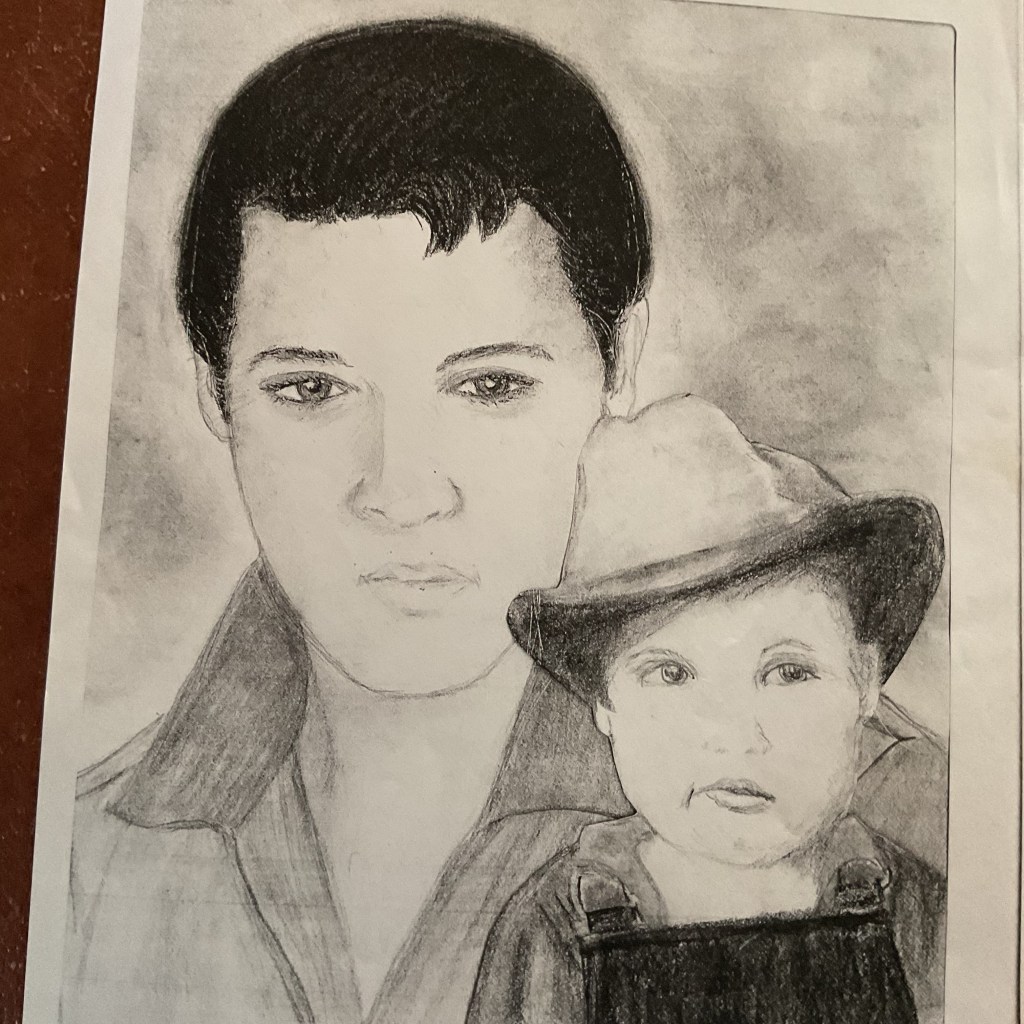
This is a sketch I did of my dad when I was probably in my teens, meaning he was in his forties. For those that remember him, they know the sketch is not perfect but recognizable. It was from a church directory photo with my mom. I sketched her picture also and gave the framed sketches to them as part of their Christmas presents that year.

Dad was a hard-working, dedicated Christian. He wasn’t perfect (none of us is perfect), but he was a good man. He was a faithful husband, a loving father, and a daily Bible reader.

He also had strong opinions. And one of those opinions was he thought people who reported near-death experiences were making it up. Or at least just reporting a dream.

He passed away on February 12, 2012, but the dying process began weeks before that. On Christmas 2011, he fell, slipped into unconsciousness, and ended up in the hospital, where he received a blood transfusion that brought him back to consciousness.

That’s when he told me his dream or vision or whatever you want to call it. I’m going to write this as though he’s telling it, although I know the words are not exact.

“Everything was quiet,” he said. “There was a man in front of me who looked like he didn’t have any clothes on but he did have clothes on.” I questioned him about this until I figured out the man was covered in something like a wet suit, everything fitting tightly but covering all skin. “He motioned to me and turned around and we started flying through a tunnel.” He held out his arms like Superman. “I wasn’t touching anything. We got to a room where there were people sitting in chairs. Nobody was talking. The man turned to me and told me it wasn’t time yet, that I had to go back.”

When Dad was telling this story, he had to pause several times because he was so weak, but you get the idea.

Then began episodes of him seeing people in his room who weren’t there. He talked to my mom’s brother, my uncle, who had passed away earlier. He laughed at things he was seeing that no one else could see. He was disoriented and would try to get out of his bed, saying he needed to go home, even though he was at home and in his own room. He was in a hospital bed since breaking his hip over a year earlier, so maybe that’s why he thought he was in a hospital.

A few weeks later, he lost consciousness again. Back to the hospital. Another blood transfusion.

The doctor talked to us about hospice care, and we agreed. When I read the literature they gave us, I read about the tunnel experiences, which I had never heard of. Dad had many of the episodes described.

I asked Dad one day how he felt during the tunnel experience. “I wasn’t touching anything,” he said. “No,” I said. “I mean, how did you feel emotionally?” His voice was raspy when he answered in a matter-of-fact tone. “I felt peace. Everything was peaceful.”

Since Dad’s death, we’ve been at the bedsides of my mother-in-law and father-in-law as they passed peacefully. My mom was the last one to pass away, and her experience was quite different. She fought death every step of the way, and it wasn’t until she went into an unconscious state that she stopped struggling.

I know this is a morbid topic to most, and I know other experiences with their loved ones are as varied as the people themselves. But I always think of this as the anniversary of Dad’s death approaches, and I remember his words. “I felt peace.”

Peace. I take comfort in that.

Why me? Well, why not me?

You may be wondering what this photo of a very young me has to do with the title of my blog, but read to the end, and you will find out.

I was talking with a fellow church member the other night, and during the course of the conversation, I learned about the many struggles and issues she has had for years because of her health. Diabetes has taken away her ability to drive due to neuropathy in her feet. That condition has caused her to fall, break bones that had permanent consequences, taken away her independence, and made even walking with her walker inside her own home a challenge. Because of the neuropathy in her hands, she has to support her hand holding a fork with the other hand to enable her to eat. Even at that, she drops food and makes a mess. And now the diabetes is attacking her vision. She has to get eye injections, something I know only too well, to keep the atrophy from spreading. So far, the shots are working and she can see well enough to read most things and watch television.

But diabetes didn’t cause the cancer she battled. It didn’t cause her husband’s cancer. Cancer is its own insidious disease. She is through with treatments and only has to go for annual check-ups, but friends and family who have had cancer tell me it’s always in the back of their minds, wondering if it will come back.

She’s just a few years older than I am, and when I did the math on when these problems began, I realized she was much younger than I am now.

So I asked her how she handled everything emotionally. She told me she just took one day at a time. “I never ask ‘why me?’,” she said. “My family won’t let me give myself a pity-party.”

Her attitude was upbeat, and I was impressed by the “one day at a time” philosophy. She was able to say this despite the fact she can’t dress herself very well due to the damage from one of her falls that broke shoulder bones and left her unable to raise her arms. You know what she does? She lays a front zip or front button garment, something we used to call a housecoat, on the bed, lies on it, slips her arms in it, and then fastens the front. If she needs to wear more appropriate clothing for being around others, her husband has to help her dress.

Yet no pity-party. No “why me?”

The truth is, some people have more struggles than others, and it doesn’t seem fair. Why should that cranky old man who growls at people in restaurants and drives his family crazy have such great health while this young mother or young child faces what seems to be insurmountable hurdles?

We all know people who have lived well into their nineties who never knew tragedies we all fear. They never lost a child, they never experiences severe health issues, they even never knew divorce or abuse or broken relationships. Maybe they outlived a spouse and suffered from the loneliness and loss of widowhood, but their losses were the normal ones, the expected ones if we live long enough.

Believe it or not, I’ve never asked “Why me?” with my vision loss. Don’t get me wrong, I hate it. I’ve cried plenty about it, but I’ve come out of the valley. Sure, I’d love to be able to see like most of you see, and there are still triggers that might bring tears to my eyes or cause me frustration.

But I know it could be so much worse. So I’ve learned to count my blessings and really mean it.

If we can find the blessings in our lives, despite the terrible tragedies we experience, we can get through them. If we focus on the simple blessings, we can realize that we can endure.

What does the picture of a very young me have to do with any of this? Well, It’s because that photo is a reminder of the innocence of youth. That little girl had no idea what lay ahead of her in life. I was cared for by her parents, and her biggest concerns were food to eat (well, I was a picky eater and not really into food…), a comfortable bed when tired, and playing with my cat and the few toys I possessed. I was too young to think of the future or worry about anything.

Some of you reading this have experienced more heartaches than I have. It could be your joy will never fully return because of the losses you’ve had or the struggles you continue to face. But maybe, if you’re asking “why me?,” it will help you to know there are others enduring the same or even worse situations.

Life can throw a lot at us. But it never helps us or anyone else to ask “Why me?” That doesn’t mean we can’t be sad or grieve or get frustrated. But accept that this world is full of heartaches and problems. And don’t feel as though you’ve been singled out for punishment.

No one ever said life was fair. But the strong know how to persevere.

I am a praying person and a Christian. My prayer for those of you who might be asking “Why me?” is for you to understand and accept life’s challenges and that you will take your negative and turn it into a positive to help others. Mentor someone going through the same struggles you’ve had. Visit or call the lonely. Participate in organizations who are connected to your cause. Don’t allow yourself to become isolated and bitter.

Sorry for the sermonette. No, I’m really not. I think it needed to be said. You can disagree with me, and that’s fine. But I can’t help but imagine what a wonderful world it would be if people were kinder, more understanding, more helpful, and less focused on self. I’m including myself in that admonition. I need to do more, to think less of me and more of others.

And I don’t ever need to ask “Why me?” There are 8 billion people on this planet. Why not me?