
There are millions of us. People who have so many ideas swimming in their heads they don’t have enough time to get them written. People who feel the need to express themselves in words. People who will never be successful writers.
But we write anyway. And in this day of self-publishing for free on KDP (Kindle Direct Publishing), some really bad books are out there. So are some really good ones. Most, I suspect, fall somewhere in the middle.
My early fiction writing attempts were published by a traditional small press. I never paid anything to have them published, and I made a little money off the sales. Very little. But I wrote anyway, and I look back now and realize a few things about myself. First, my topics are antiquated. I write stories like those written by Janette Oke(Aimee) or the writers of children’s mysteries published in the 1950s and 1960s (The Ghosts of Graceland, Music City Mayhem). The romance themes were sweet and innocent, in a way (Smoky Mountain Brides).
In other words, most people under 80 or older than 10 would not want to read them.
All of those books are out of print now because the publishing company has sold and the time to make them available has expired. So, I rewrote Aimee, changed a few things, and self-published. I believe the newer edition is better. I took the novella in Smoky Mountain Brides and polished it before sell-publishing as Can’t Help Falling in Love.
I know I don’t have what it takes to be like John Grisham or my favorite author Lisa Wingate. I can’t write a Pulitzer Prize winner like Geraldine Brooks did with her book March. And I definitely can’t write books like those by Kristin Hannah, Kristi Harmel, Ann Patchett, and others.
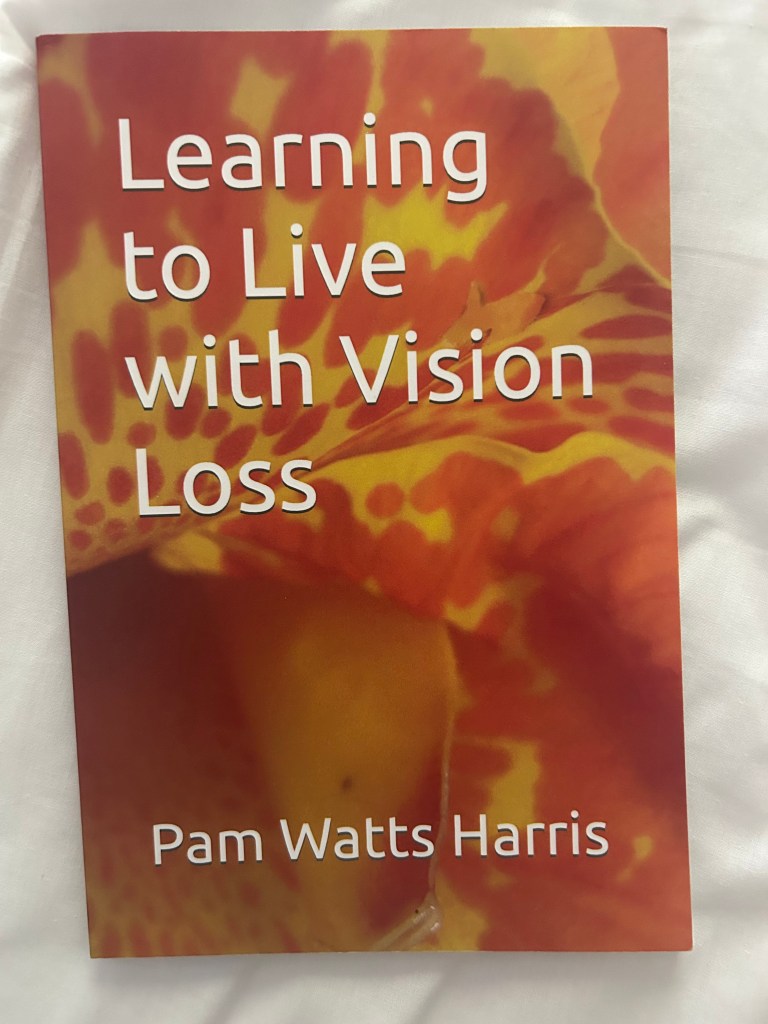
My best selling book so far is the one pictured. Don’t get me wrong, royalties are very small. I think my last royalty check was just under $15. But that’s okay because the purpose of the book is to help people.
I’m more of a journalistic style writer. Like with this blog, I write informally, as though I’m having a conversation (one-sided) with the reader. I kept the book short, knowing most people won’t ffiish a long book. I don’t think my own children have read this book even though it was published two years ago. They’re busy, I know, but neither do they read this blog. People read what interests them, and the number of people with an interest in vision loss or a the information is small.
That’s okay. That knowledge is not stopping me from writing a sequel to it. I’m almost finished with the first draft of what I am currently calling Journey to Sight but will be renaming it before publication.
I’m going to continue to write fiction because I’ve been writing stories since I was seven years old. I still remember the story I wrote and illustrated that my teacher allowed me to read to my class. Suzy the Elephant was about a circus elephant. Wonder where I got that idea? Yes, I loved all things Disney. When I was nine, I wrote the riveting story “The Tale of the Bloody Bluff Brothers” set in Arizona where I lived at the time.
Writing to me was what some of you experienced with Little League and other sports. It was what I loved.
All I ever wanted to do was be a writer, but just like those of you who had dreams of becoming a professional athlete, that never materialized. I focused on reality and discovered interests in other areas.
I’m still going to write fiction. I’ve promised a young girl to finish Secrets of the Smokies, the third in the Mandi mystery series. I’m working on a sequel to Aimee. This one is set in 1911 at the Yuma Territorial Prison in Yuma, Arizona. By the way, the prison had closed at that point (1909), and when the local high school burned, classes met at the prison from 1910 until 1914. Their mascot to this day? The Criminals. And I’m likely going to rewrite my novella Surf Song that was part of now out-of-print Coastal Promises before next summer. It’s a beach read set in the Outer Banks of North Carolina. I’ve even started on a book for women that can be used in a class setting with a working title of The Woman God Sees.
Writers, you understand how I feel. You love books. You love to write. No matter how unpopular the end product is, you have to express yourself.

 Life As I know it