
You may not be a Christian. You may not be a person of any sort of faith. But I strongly believe developing a grateful attitude is an important component of finding contentment and peace in this troubled world in which we live. No doubt there are other factors, but having a grateful attitude, no matter what the circumstances, can help.
I was privileged a couple of weeks ago to lead our ladies’ class at church in a devotional and discussion about this topic. The reason? My own journey and what I’ve learned.
Why have I finally learned to grasp the full meaning of gratitude? Call it having lived long enough to have experienced many of life’s ups and downs.. Call it having a lot of time on my hands to reflect. Call it being a deep thinker.
It’s all of that and more.
The truth is that it’s easy to be grateful for our blessings and good things in life when things are going well. Yet even when they’re goin well, we often are guilty of not appreciating what we have. For example, are we not only grateful for our food but also for the fact we get to choose what we want to eat? In the United States, people relying upon assistance to buy groceries cannot afford the healthier options, but even they have more choices than people in many third-world or developing countries. In Cuba, for instance, residents are given a ration card that allows them to have one pound of chicken per person each month. They are allowed five eggs per month per person, but that has been unstable, and they often don’t get eggs at all.
Cuba is just one example.
We’re spoiled. We have heat in the winter and air conditioning in the summer. We have enough clothes that we are concerned with fashion instead of clothes to wear for modesty and comfort. Most of us sleep on a comfortable mattress at night instead of a thin pallet on a hard floor.
You see where I’m going with this. We take things for granted until or unless we don’t have them.
Like income until we lose our job. Like health until we get the cancer or another life-threatening r diagnosis. Like walking until an accident or health issue robs us of that ability. Like family and friends until death takes them away from us.
Yet even in those times we can have gratitude. Maybe not at first. We are grieving, and there is nothing in the Bible that tells us not to grieve. It is a human emotion, and God doesn’t expect us to be a Miss Pollyanna about everything in life. It’s okay to hurt. It’s expected. It’s okay to grieve. It’s normal and part of the healing process. Even if it takes years.
Experiencing loss of a loved one? Grieve, but be grateful for the friends and family who are there to support you. Diagnosed with cancer and enduring harsh treatments? Be grateful there are medicines available now to treat the condition. Being grateful for those things doesn’t make the struggle you are enduring go away, nor does it make you feel better in the moment. The weight of your struggle far overshadows the good things we are guilty of taking for granted. But maybe, just maybe, counting your blessings and expressing gratitude for them will help.
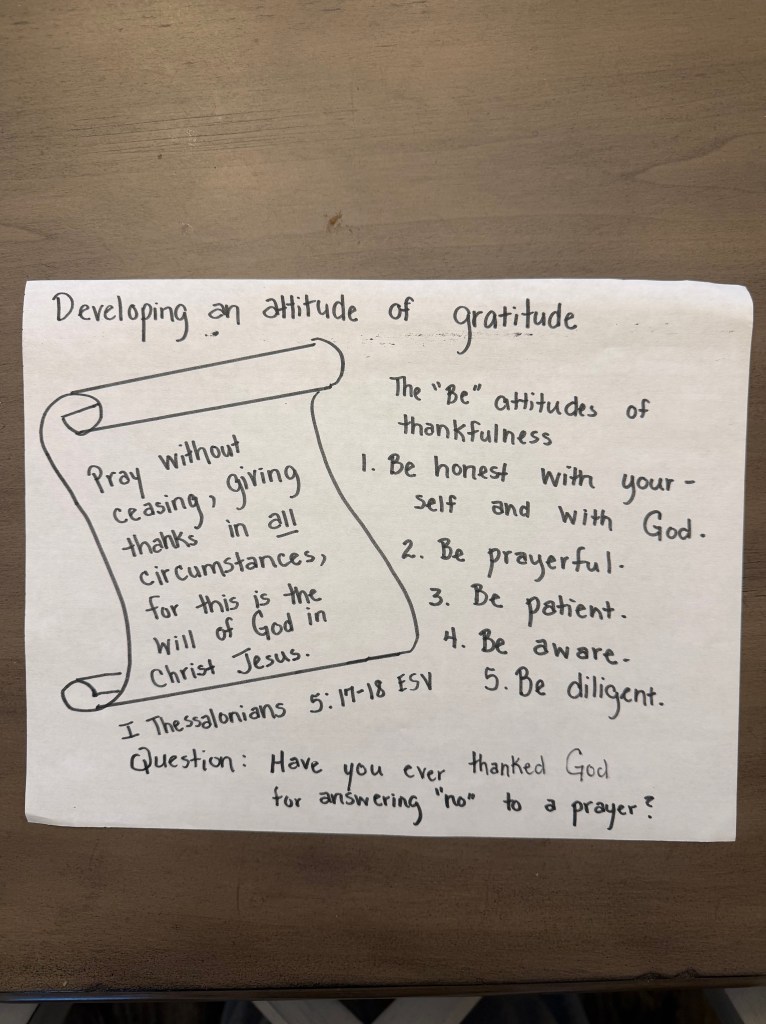
Christians know about the apostle Paul, who penned the verses I have written on the handout pictured, He endured beatings, imprisonment, rejection, public ridicule, and shipwrecks. He eventually was killed because of his Christian faith. Yet he wrote that the people of Thessalonica, and us as readers of his letters, should give thanks in all circumstances. He practiced what he preached.
You know what I’m thankful for with my vision loss? I went through two or three years of true depression. I cried. A lot. I never asked, “Why me?”, but I desperately wanted my independence back and my ability to see the world clearly. I started praying for the ability to accept and adapt, and that is what happened. I didn’t receive a treatment that would fix things. I didn’t get normal vision back. But I found a new purpose in life.
My purpose is to help others going through vision loss. I have made friends with legally blind and completely blind people from California to Arizona to Kentucky to Virginia to all parts of Tennessee. I am so grateful for those friendships. I am grateful for the opportunities to share and to help.
Please don’t tell me you admire me or that I inspire you. I’m just a person being true to who I am. It is nothing special. And my functional vision allows me to live a very normal life in most ways. The people that inspire me are the ones who have endured much worse, such as the loss of a child or spouse or health, who endure what I cannot imagine.
And the truth is, I may join that number someday if I live long enough. The vision loss has made me more empathetic to others, and I’m grateful. It’s made me more appreciative of the sounds of birds in the early morning, m ability to walk for miles at a time, of friends and family who drive me places or serve as my eyes when needed. I’m grateful for technology that allows me to do what I’m doing right now–writing–since that has been one of my greatest joys ever since I picked up a pencil and learned to spell.
I hope you no matter what you are enduring, can feel true gratitude for the other things in your life that are good. I hope you can find the peace I’ve found. I’m not always content, I’m ashamed to say, because I am restless and get bored easily, so when I can’t go and do what I want to do when I want to do it, I can get down and out.
Then I think of some friends and family going through much worse, and I’m ashamed for my feelings. How minor they are in the scheme of things.
Gratitude. True gratitude. Maybe it’s the first step toward true peace and contentment.

