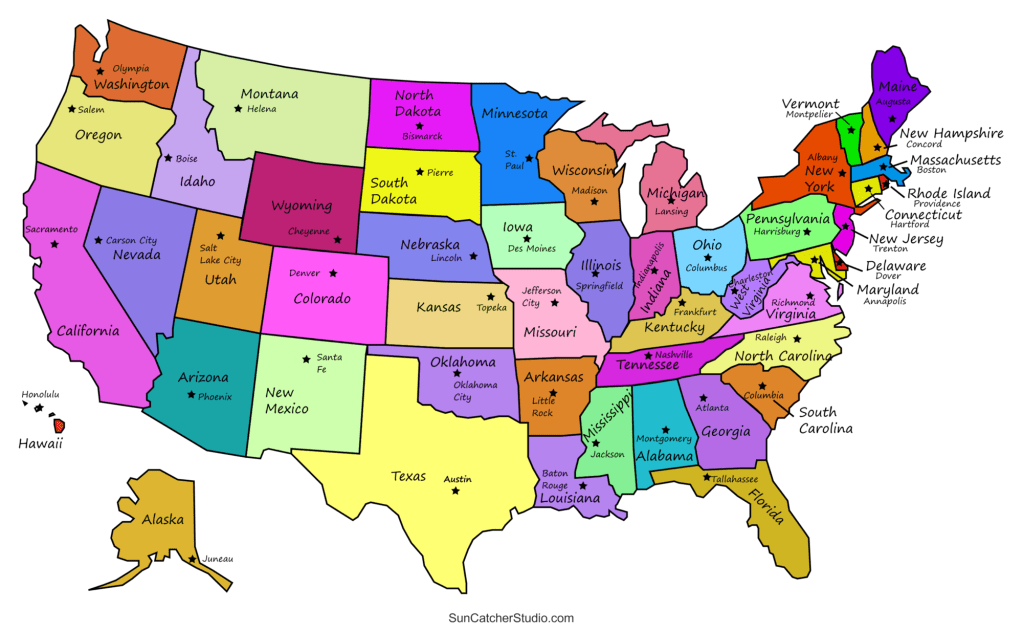
50 states and 12 countries in one year? How is that possible?
Please allow me to explain.
No, I haven’t won the lottery. And no, I haven’t inherited a fortune.
But that’s okay because what I’m doing is free.
It all began with an idea I had when thinking about the upcoming year. 2026 is one of those decade-changing birthday years, and I decided I wanted to make all of 2026 a memorable year. I texted my two best friends since age 12 and challenged them to do one new thing every month of 2026 and report to the others what we did. It doesn’t have to be complicated. It could be something as simple as trying a food I’ve never tried. But the goal is to broaden our worlds by doing just one new thing each month.
They accepted the challenge, and my brain continued to spin. Of our 50 states, I’ve only been to 25. I’ve been to three other countries–Mexico (too many times to count since I lived in the southwest corner of Arizona during my growing up years), Canada (but only Windsor and slightly north of there when I visited Detroit), and the Bahamas.
You may be thinking, “Wow, that’s a lot” or “That’s not very much,” depending upon your own experiences. To me, it’s not enough. After all, there’s a reason I majored in Spanish and minored in French, and that reason was not to teach the languages and culture. The reason was to experience the cultures and use the languages.
Fate or God or just life had other plans (maybe all three), and I ended up following a different path.
That doesn’t mean I lost my curiosity or my desire for parts unknown. Now that I’m retired, I have the time to visit more places, but once again, life has thrown me a curveball. The vision issue.
Losing all my central vision along with some peripheral vision and being able to see not very far away with what I do see being very different from what normal people see means I can’t enjoy beautiful scenery anymore. I have to have assistance with things like boarding passes and navigating airports and things like that. True, I can get that assistance from my husband or friends or employees of the airline or cruise ship or whatever, but it’s not as easy as it would be if I had normal sight.
The dilemma, then, is what to do? How can I see the states and countries that interest me?
You’ve already figured it out. YouTube. I can sit or stand one foot away from our 65-inch smart TV and see scenery that I would never be able to see in real life. I can be a virtual traveler by viewing videos and exploring those areas in other ways.
I texted my friends something along these lines: In addition to trying something new each month, I will find a video about each state and send one video link each week for us to watch. I will begin with Alabama and work through the list alphabetically until we finish with Wyoming. Also, each one of us will pick a country to “visit,” and we will view one country video a month. Because there are three of us, that means I only have to come up with four countries to visit during 2026. I will select countries I’ve never been. My first choice is Austria. Blame it on my favorite movie The Sound of Music.
And the additional challenge to the world tour? Prepare a food that is common to that country. Prepare it in an authentic manner, not the Americanized version.
You may be thinking I have way too much time on my hands to come up with such crazy ideas, and you’d be right. I have lots of time. When you can’t drive and your children and grandchildren don’t live close enough to require your services or to be dropping by all the time, you have plenty of free time.
So, why not make the most of it?
I have already sent the link to the video about Alabama, even though the new year has not arrived, and I’ve already scheduled my “something different” activity for January. I’m meeting with a personal trainer to design a workout plan for me to help me achieve my strength and fitness goals.
It also looks as though we’re going on a Disney cruise (we’ve done other cruises, not Disney) in November with my youngest son and his family and in-laws. My oldest son doesn’t know it yet, but I’m going to approach him and his wife with the idea of the four of us going to New York City or Boston and Martha’s Vineyard. They’re places I’ve never been (obviously) but have always wanted to see.
Oh, a side note (you know how I get off topic at times) concerning places I recommend you visit if you’ve never been: Sedona and the Grand Canyon in Arizona, the Outer Banks of North Carolina including Manteo, Kill Devil Hills, Duck and Currituck, Washington, D.C. (stay inAlexandria and hop on the metro, be sure to go to The Holocaust Museum but take tissue along, see all the normal tourist places, ride the trolley on King Road in Alexandria down to The Potomac River), and the Caribbean (the water is incredible). Can’t go due to limitations? Virtual visits!
Okay, back on topic. I have an idea for December that I’m not sharing with anyone yet, not even my husband, because I have no doubt I will be told I’m insane or at least unrealistic. I’ll keep you posted on that.
None of us is guaranteed tomorrow. As I write this, one of my friends through work and church is battling ALS. A classmate is battling pancreatic cancer. My niece’s long-term cancer treatment is ongoing. My cousin’s husband has been fighting cancer and going through treatments for a year. My niece’s mother, who survived ovarian cancer, has the ongoing battle with Type 1 diabetes and an auto-immune disorder. Another cousin who battled breast cancer has now been diagnosed with another cancer not related to the breast cancer. I know several people with Parkinson’s.
I could go on and on. My point? Make the most of each day. Do what you can with what you have. Can’t afford to travel the world? Travel is the way I’m doing. Have a “bucket list” activity you’ve been putting off? Find a way to do it. Don’t be foolish in throwing away your money unnecessarily or by taking unnecessary risks, but if you want to and have the means to be a “Survivor,” “Amazing Race,” “Jeopardy,” or even “Wheel of Fortune” contestant, go for it.
If you read my blog at all, you know I push the idea of helping others and remembering people who are shut-in by calling or visiting or just sending a card. I’m not promoting selfishness here. I still think the greatest joy in life comes from helping others. But every now and then, it’s fun to give yourself a treat.
If you are perfectly happy doing what you’re doing, that’s great. We’re all different, and while you and I may not be able to relate to each other because of our dreams or lack of dreams, we can respect each other’s perspective.
I plan to share recipes along the way, so here’s the one for Alabama:
Alabama White Barbecue Sauce from Serious Eats
2 cups mayonnaise
1 cup apple cider vinegar
1/2 cup apple juice
2 teaspoons prepared horse radish
2 teaspoons freshly ground black pepper
2 teaspoons freshly squeezed juice from one lemon
1 teaspoon Kosher salt
1/2 teaspoon mustard powder
1/2 teaspoon Cayenne pepper
Step 1: Whisk all ingredients together in medium bowl. Let sit for 30 minutes and serve immediately with pork, chicken, or turkey, or place in jar in refrigerator and keep for up to two weeks.
I do this a lot. I post a photo that has nothing to do with my topic of the day. I just thought this was pretty, a view of Sedona, Arizona, taken by my son when they were there this past summer. Sedona is beautiful. I highly recommend a visit.
Yesterday my small book club, consisting of six people, made our annual trip to Patti’s at Grand Rivers, Kentucky. Locals know the restaurant and area even if they’ve never been there. My lunch? Grilled chicken spinach salad with hot bacon dressing and one-half of Boatsinker’s Pie. It was very good, but really, the food wasn’t the main reason for the trip. It was the camaraderie.
We started out as a group of six, and we’ve kept the number to that. The original group consisted of three fellow teacher friends (all retired), a realtor who has lived in the same neighborhood as I do for over 30 years, and a younger mom of three whose husband was our church’s youth minister at the time. At first we rotated our meeting place each month, but that evolved into a regular spot at Blake’s (a popular local restaurant) the first Thursday of each month. Our youngest member took a full-time teaching job (we miss her, would have seven in our group if she were able to be with us!) and was replaced by the widow of our former principal at Dresden High School. We sit at the same table each month, and the staff knows us very well.
I have known all these women for over 30 years, and four of them for 40 years. If you can do math, you’re figuring out our ages, but that’s okay. I don’t mind sharing my age. Just don’t call me “sweetie” and treat me like my brain is on the level of a child. I can out-walk most of you much younger folks, I guarantee it.
Oops, there I go again, getting off-topic. If you read my blogs regularly, you know I do that a lot.
The way we do our book club is that each person has a turn choosing the book we’re going to read for the month. This is great because it forces us to read genres we might not read otherwise. There have been many times I started a book someone selected and would’ve put it down after a few chapters except for the fact I wanted to be able to participate in the discussion and honor my fellow member’s selection. And you know what? While there are definitely some books I would never read again, I found all of them interesting if not enjoyable.
I’m a strong believer in exploring new experiences and getting out of your comfort zone. I know some people just want to stick with what they know, but for me, that would be a very boring life. I am still curious about the world, and my brain is constantly thinking of ways to expand my horizons.
The books we read help to do that, but the group is so much more. Yes, we discuss the books, but we also talk about trips, grandchildren, health issues, family, and more. Yesterday the six of us rode in the same vehicle for the 72-mile trip to Patti’s, but due to the flow of conversations, the trip seemed much shorter. We had our own room (thank you, Mary Ellen), so we were not bothered by noise from other tables. We shared childhood stories, talked about some serious things, and laughed at other stories. And, oh, how we laughed. We always do, but yesterday I think we were almost giddy from all the food on the way back, and one story after another had us all laughing like school girls.
You see, being older doesn’t mean we don’t have a sense of humor. And no, alcohol was not involved. We were just being ourselves and enjoying the time together. In a way, it was like being in my twenties and thirties again. Kind of like when I’m with my high school best friends Terrie and Nancy, I’m a teen-ager again or a college student working at the local bank during breaks from college. With them, I’m not someone’s mom, someone’s teacher, someone’s wife. I’m just me. With my book club friends, it is similar, although I do have the added labels of “mom,” “teacher,” and “neighbor.”
I feel sorry for people who don’t have good friendships. I know some people are loners by. nature and have no desire to have a large circle of friends, but for me, the more the better. I love people. I may not like all people (well, I think maybe in my lifetime I can count maybe five people I dislike, and I will say that even those people I care about because they are God’s creatures just like all of us–it’s just that I’d rather not spend time with them), and I know I look at people through an innocent lens because I tend to think most people feel the same as I do about the world. I know, that’s a false assumption, but it’s just the way I think. At the age I am now, that’s not likely to change.
My life in retirement could be a fairly lonely one since I can’t drive anymore, and I’m beyond grateful for my friends and family I call my “Uber” drivers who pick me up for civic meetings, the wellness center, and other activities like a wedding or baby shower. I am blessed to have a wonderful husband who is my best friend in life, but even with that blessing, I need friendships. You may be the same way. My advice to anyone who can drive and is lonely is to look for groups to join or activities to do with others. Your church, your local library, a sports group like basketball or pickle ball, a quilting group, a painting class. All of those opportunities and more are available right here in my small town of 11,000, so I know small towns have options.
It may take a while to feel as though you fit in as you meet new people, but chances are you will eventually. Just remember you can always drop out if a year or so of meetings is not to your liking.
And, if all else fails, find a few friends to start a book club.
When we were at Blakes several months ago, “Southern Living” was there to take photos and interview people. A man came to our table and told us about a book club he was once a part of in Birmingham. That club, he said, was high end because they actually traveled to the place where the book was set to discuss the book! Can you imagine? I guess they never read A Gentleman in Moscow since travel there would be undesirable, but wouldn’t it be fun to read Jaws and discuss it at Martha’s Vineyard (or a book by Elon Hildebrand set there)?
Hmm…that gives me an idea. Maybe I need to pick a J.A. Jance book set in Sedona. Rent a house for all of us to stay in for a few days. See, my brain is spinning with ideas.
I don’t know about you, but I’m a member of several communities. My family, of course. My town, obviously. My church family. My civic groups. At one time, I was a part of a work community but now in retired community.
And now there’s a new one.
A few months ago, a friend who lives down the road from me told me she had joined the Wellness Center and asked if I wanted to go. I was only too happy to join since I had been a member in the past and with my friend down the road going anyway, I had transportation. I was thrilled to be able to use the weight machines, treadmill, and walking track again, but the biggest surprise was how much I enjoyed the aerobics class.
Back in the day, I took Jazzercise classes and then worked out to those Jane Fonda videos at home, so participating in the aerobics class (I guess it’s a Silver Sneakers class?) was not a stretch for me. Our leader, known as LT, designs classes for all ages and ability levels, but let’s face it–all of us are “of a certain age” with some more “certain” than others. You know what I mean.
The fun of the class, though, wasn’t the only surprise. The second surprise developed rather than burst on the scene. I reconnected with people I hadn’t been around in years and met new people. I started being around former college friends, former co-workers, parents of former students, parents of children who are my children’s ages, and on and on. Soon I realized I was a part of a group unlike any I’d been a part of since college.
For the first time since college graduation, I spend a few hours each week with a group of people who are in or near my age group. Yes, I know, the eighty-somethings are not near my age, but we are all categorized as “senior citizens” whether we want to be or not. And although we come from a variety of backgrounds, we are able to have fun with each other while we work to keep ourselves as fit as we can.
LT does a great job of leading the classes, and honestly, I don’t know how she keeps from laughing at us. As we do the moves, we are definitely not in sync. Arms flying every which way, and some going left when they should be going right, and not to mention how we sometimes run into each other…I almost crack up laughing just looking at the few around me as we try to keep the pace. With her looking at approximately 40 people facing her, she’s bound to be wanting to laugh out loud.
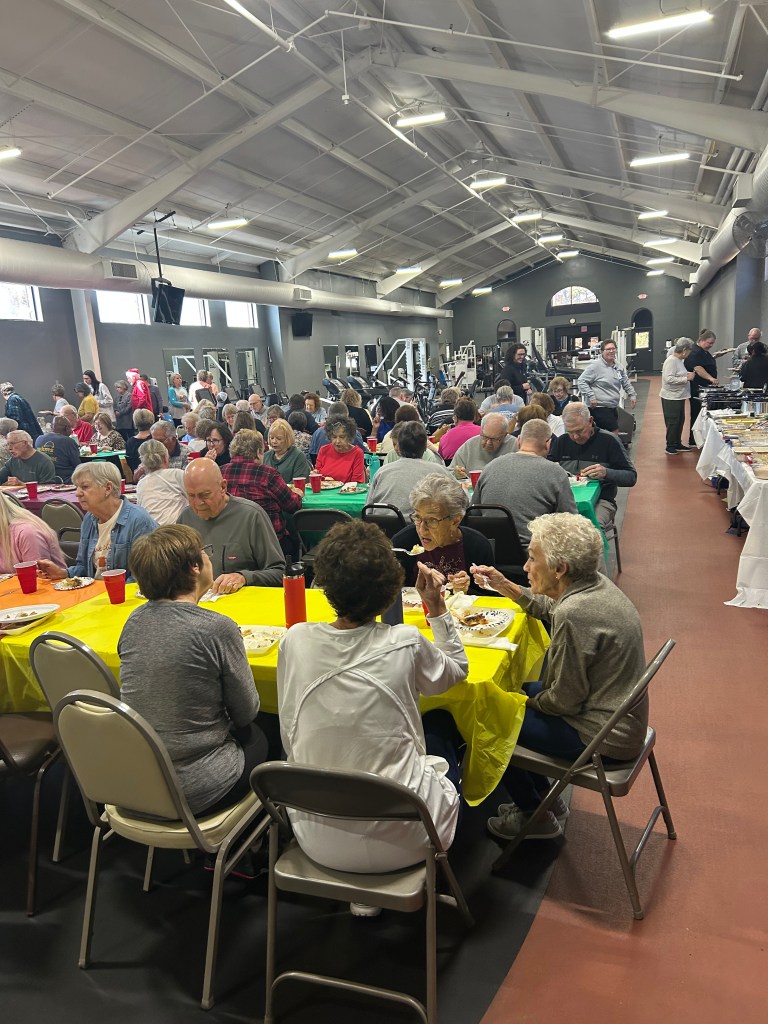
This past Monday, members of the WC gathered for a Friendsgiving. We signed up in advance for what we’d bring (I made homemade bread, in case you’re curious), and the center closed for two hours to allow enough time to set up, eat, visit, and clean up. More than 100 people were there to enjoy the event.
You know, I think small towns get a bad rap. People complain of nothing to do, but in our town of just over 11,000, you can find plenty to do. You just need to look for it and take advantage of what’s offered. I’ll stop right there because that’s a blog for another day.
Back to my topic–ever notice how I get off-track in my blogs??–about community. I think of it as a group of people who share a common interest or circumstance. Think of sports fans, especially college sports fans. My husband has several Vols (Tennessee Volunteers, in case you don’t know what “Vols” means) caps and shirts, and he wears them wherever we go. If we are out of state, I guarantee he’s going to hear at least one person say, “Go, Vols!” Vols fans are a community, even if they don’t know each other by name.
Our common interest at the Wellness Center is to stay (or get) strong and fit. We don’t have to be best friends or share our feelings or any of that. But we can chit-chat, share recipes, talk about great books we’ve read or movies we’ve seen, and even our families. It doesn’t have to go beyond that to be a community, and honestly, I still don’t know everyone in the class. But I’m learning.
One Friday afternoon, I asked my husband to drop me off so I could use the weights and walk on the treadmill since it was too messy to walk outside. I was amazed at the emptiness of the gym. Two other people were there. I did my routine, but I didn’t enjoy it. It was boring not having people go by and greet me or ask me about something. It was boring not hearing the music played during the exercise classes. I didn’t like it.
Yes, I’m a sociable person. I love being a part of multiple communities. And when I can exercise and have fun doing it, I’m in a win-win situation.
If Glenda had not asked me if I were interested in going to the center, I never would’ve known about the classes and likely would not have tried them on my own even if I did. I might have joined the center but would have been limited to going in the afternoons most days since my husband is involved in the mornings with his own community–a bunch of Pickleball players who play three mornings a week–and I would have to rely on him for transportation.
I hope you’re a part of at least one community outside of your family or work. Don’t forget that it takes time to feel a part of a group, but in time, you likely will.
So, in this season of gratitude, I’m adding involvement in communities to my list of reasons to be thankful. My faith that sustains me, my family, my home, food to eat, clothes to wear, friends, electricity, running water…my list of things I’m thankful for is too long to share.
It is my hope yours is too. Happy Thanksgiving, everyone.
That red glow is not from a forest fire. My son took this photo of the Northern Lights last night. He was not in Iceland or Alaska or any of those places we think of when we hear about the beautiful phenomenon. He was at home, right here in Tennessee.
Every once in a long while they’re visible, and I don’t profess to understand any of the science behind why we can see them so far south, but I am awed by them.
Here’s the catch. I can’t see them in real life because of vision loss. So my son took the picture and sent it to me, knowing I could see the beauty of this event on my large-screen iPad or on my 47 inch TV screen connected to my laptop. It doesn’t matter I can’t see them like he can. Just seeing the photo and knowing they were visible in our area is enough to impress. And maybe my friends who ave no sight can enjoy the sight by hearing a description of the photo.
Photo description: A black sky with a red glow behind tall trees. The trees form a line on each side of the photo with an open area in the middle that extends to the ground. The ground, to me, looks completely black. Small lights are visible in the openings between the branch of the trees.
“Here she goes again,” you may be thinking.”Can she never avoid mentioning something about her vision loss?”
Sure I can. And I’ve tried to avoid mentioning it, but since I am fortunate enough that the biggest hurdle I’ve had to jump in life is the vision loss issue, it is my point of reference. I haven’t struggled (yet) with a major health issue. I have been blessed with a wonderful family and friends. So when I think of the biggest challenge in my life, that’s mine. Yours is something else.
I’m bird walking. Teachers know what that term means. Back to the point I am trying to make.
He took photos of the night sky in Sedona this past June, and I have saved them to my gallery. When I was growing up in Arizona, we sometimes went out on the desert at night. There, away from city lights and without the humidity we have in our area, the stars were amazing. Now the lights of the town and the humidity and cloud cover we often have in addition to my vision issues make that experience a thing of the past. On a clear night, I might be able to see one or two stars that are very bright (probably Venus and Mars, right?), but at least I can see the star-filled sky in the photos. Beautiful.
There is something about the sky that is awe-inspiring to me. I look up at it often in the daytime. Sky blue is my favorite color, and the colors of the sunset…well, I just love the sky. Just looking at it brings me a sense of calm and wonder and appreciation. It quiets my soul.
My point? I think we humans often focus on the negatives instead of the positives. It’s human nature, I think, but I do believe it’s worse than it used to be. Blame social media or what’s going on in the world or the higher population (in 1960, the population of the U.S. was 181 million, today it’s 347 million), but it’s worse. We are bombarded with conflicting opinions, hate speech, too many activities to fill our time, and other things that harm our emotional well-being.
My solution? I watch the national nightly news maybe once a week. I watch the local news more often because their stories concern our area. I don’t scroll my phone. True, it’s mainly due to the vision loss because I have to use Voice Over which is not perfect and often annoying), but I check notifications on Facebook each day (usually), post a few times a week as the mood strikes, and live my life in my community as best I can. I stay informed, but I don’t obsess.
And I have quiet time. I sit on my front porch when the weather allows with no noise except for the sounds of nature and the wind chimes when the breeze is strong enough. If the weather is too cold, I find a spot indoors just to be. Just to be by myself with my own thoughts. I pray during those times. I reflect. But for at least fifteen minutes, I have quiet.
Yesterday my husband and I went to a town an hour away to do some shopping since he has no luck with online shopping for clothes and needs to try them on and our town is limited in its offerings. While there in the men’s department, I was touching all the clothes to feel the fabric and discovered some pajama pants that were so soft and warm, I just had to have a pair. Yes, they were in the men’s department, but I purchased a small, and though they’re a little long even for my five foot seven and a half inch self, they are wonderful. Last night, I put them on and commented more than once, “I just love these pajama pants. I wish I had bought more!” Just wearing them soothes me and makes everything feel cozy.
Photos (or descriptions) of the night sky, looking at the daytime sky, feeling the warmth of a comfortable pair of pajama pants, quiet time…the small joys of life.
I still fall victim to the negative mentality at times. I wish I didn’t, but occasionally I slip into that pit of wishing my life were perfect according to the way I see perfect.
Then I go on YouTube and watch the young man paralyzed from the chest down because of a dirt-bike accident and how he navigates life or talk to a VIP friend who has worse vision than I do or no vision at all, and it brings me back to the mindset of being grateful for what I have instead of being bothered by what I don’t.
I guess I sound like someone being preachy or being a counselor, for which I’m not qualified, but that’s not my intent. My intent is to share my own journey and thoughts in the hope it will help just one person who is navigating a difficult path. And I’m writing this because it serves as a reminder to me to practice what I preach. Hey, I guess I am being preachy!
When I was working, I often said working was what kept me sane. The busyness of life kept me from focusing on the worries and disappointments that life throws our way. As a teacher and principal, I was too occupied with school duties to think about my personal situation. Long days that extended into night activities like ballgames made me too exhausted to worry when I got home. Keeping busy really is a good thing in many ways, but I still carved out my quiet time. It was fifteen minutes each morning, before my family woke up, and those fifteen minutes calmed my spirit before beginning yet another hectic day.
There’s a song we sing at our worship services based on a Bible passage whose lyrics include, “Be still and know I am God.” There is a great deal of wisdom in that simple statement.
Be still.
And if your life is not a busy one and you have too much still time, be busy. Oh, my, that’s a blog for another day!
Chances are if you’ve made it this far reading my blog, you are doing so simply because you know me personally or because you can relate. People who don’t relate likely stopped reading after the second paragraph if they even made it that far. And that’s okay.
The holiday season brings joy to some and sorrow to others due to many causes. If you are someone who struggles during this time of year, I hope you can find joy in the little things of life if circumstances have robbed you of the big things. I hope if you’re lonely that you will reach out to someone else who may be lonely so you can help each other. I hope you can know peace.
Best wishes to all, and thank you for reading and/or following my blog. I am grateful for you!
Social media is blamed for many ills in our society, and no doubt it has its problems. But like anything else, it can be used for good as well as bad.
It depends on the people using it.
Ordinary, everyday people with no journalism or writing background now have the ability to post opinions, insult others, stir up controversy with a simple post. They write things they would never say to someone’s face and hide behind the perceived protection of a certain amount of anonymity. I think we all recognize that.
On the other hand, ordinary, everyday people with no journalism or writing background now have the ability to share their life experiences, thoughts, and photos of vacations, grandchildren (as in the above–aren’t they just too cute for words?), and even a meal they’re enjoying in a restaurant or one prepared at home.
I prefer the latter group. If you post something political, I won’t listen to it. Remember, I can’t read very well because of vision loss, so I have to use VoiceOver. If I want to learn about what’s going on in politics, I listen to and watch various sources to get a true picture of what is going on. Maybe those sources aren’t telling the entire truth, but your opinion is not exactly correct either. I tend to view all of it with skepticism, but the beauty of social media posts is I don’t have to read them. I can skip them, and I do!
Just as we can skip those posts about grandchildren, if we have no interest in our friends’ grandchildren. Just as we can skip those posts full of hate speech. We can even delete them or block that person. WE are the ones who have control.
When I first joined Facebook in 2i009, I created my account to include my maiden name. I had moved away from the places I grew up, and lived too far away to be in contact with my classmates and friends. Facebook, I reasoned, was a great way for us to find each other. And I was right. Because of Facebook, Judi and I reconnected. Mimi and I reconnected. Many of my classmates, whom I had not seen or talked to since graduation, and I reconnected. It was and is great!
I have used Facebook and other social media outlets to spread information about what it’s like to lose vision and how to cope with it. I use Facebook to share this blog. I’m guilty of sharing my motivational thoughts (I try to say I’m not being preachy, but my husband says some are preachy) because I’m a writer. Not necessarily a professional one. But I’m a writer. Ever since I was very young, I was writing short stories and keeping a diary or journal. Other writers understand. It’s as though the words just have to come out in print, as though I have to type them to sort through them. For writers, sharing our thoughts this way is a form of therapy. And it is our hope our own self-therapy will help someone else.
But I understand the way social media is impacting some people. I understand how addictive phones are for many of you (remember, I can’t scroll stuff the way you do. I am often annoyed by being surrounded by people who are constantly checking their phones, but I’m sure if I had that ability, I’d be doing the same. After all, information and entertainment and communication all in one small device.
I especially understand how social media is impacting young people. When I was growing up, it was the name-calling at school (my particular names from my junior high classmates–and that age group is the meanest age group of all for various reasons–were Twiggy, Four-Eyes, Zipper, and Coke Bottles). Explanation of the Zipper name–Hey, Pam, turn sideways and stick out your tongue, and you look like a zipper! Yes, I was very skinny. Coke Bottles? For those of you old enough to remember soft drinks in glass bottles, you remember how thick the glass on the bottom was. The reference was to my very thick glasses for a very near-sighted me.
But I digress. Back to social media. I could go home from school, cry about the hurtful words, and I could tell my mom about my day, and I could escape it. The access to texting and social media these days make those insults impossible to escape, and far too many young people are suffering because of it. I don’t know what the solution is other than not allowing them to have accounts, and it is a huge concern which I’m not qualified to address.
For me, though, I’m grateful I have social media outlets. For those who live alone and are lonely, it’s a way to reach out to others. For those of us who want to know what’s going on with our friends and family, it’s a great way to share. A loved one has passed away? If you desire, you can honor that person with a social media post. Someone celebrating a birthday? You can share it with the world. By the way, my mom lived to be almost 94, and as she got older, I shared a picture of her and the fact it was her birthday. Numerous people wished her a happy birthday on those posts, and when I shared them with her, it made her day. She loved the attention, and why shouldn’t she have?
Social media, then, is not the real problem. The real problem is the people using it. It’s not the social media platform creating the controversy, spreading the misinformation, or spouting profanities that would not be tolerated in mainstream media. The real problem is the person behind the post.
I skip those posts and even block them. You may not. You may love them and have a desire to interact with them. That’s fine. It’s your choice.
We have a choice. How we use social media, when we use it, if we use it. We have a choice in what we read.
People have been creating controversy for as long as humans have been on the planet. But there have been and are many people who try to make the world a better place.
I like to be around those people. I want to be one of those people.
And I will continue to post pictures of my family, grandchildren, friends, dog, our trips, and about ways to live with vision loss. I will continue to post things about my books, my “preachy” thoughts (I’m preaching to myself as much as to anyone else), and anything else that inspires me.
If you don’t like them, skip them. That’s fine. We all have that choice.
I was going through some old documents and deleting what I no longer want to keep and found this short story I wrote seven years ago. If you choose to read it, I’d love to know what you think happens to Hope after…well, if you read it, you’ll know. I have my own idea of the kind of person she is. I’d love to know what you think. And maybe, just maybe, you have been a Hope or a Callie.
Love and Hallmark
“That kind of love doesn’t exist, Hope. You’re delusional because of those cheesy Hallmark movies you watch all the time.”
I stare at my best friend over the rim of my coffee cup. Callie doesn’t know what she’s talking about, but I understand why. Her mom’s been married and divorced twice and is currently dating a “prospect.” Her dad’s only been married once – to her mom—but he’s had a series of live-in relationships. These days he’s with a tall, too thin woman only five years older than Callie.
“You’re just jaded, Callie. It’s not like that for me.”
“Jaded?” She arches a perfectly crafted eyebrow. Everything about Callie is perfectly crafted, from her blunt cut red hair that just brushes her shoulders to her airbrush quality make-up to her sleek black and white dress that probably cost more than most people earn in a week. I guess there are some perks to having rich parents who try to buy their way out of their guilt.
I can’t imagine. My parents stopped paying my expenses when I landed my first full-time job out of college. I get it. My two brothers are still in high school, and my folks are teachers. Rich, we’re not.
“Yes, jaded, cynical.” I take another sip of my Starbucks caramelized honey latte, my weekly Friday morning caloric and financial splurge.
“I know what jaded means. And I’m not jaded. I’m a realist.” She shakes her head. “There is no such thing as forever love or love at first sight. Lust, maybe, but not love. And no love lasts forever.” She snaps her fingers. “Something goes wrong, and it’s over, just like that.”
My parents have been married almost thirty years, and sometimes they’re so lovey-dovey it’s disgusting, but I’ll take it over what Callie has. All four of my grandparents, married to the same person for over fifty years. I don’t just think it; I know true love is real.
“You’re wrong, Callie.”
Callie gives me that smile that says, “I love you, girlfriend, but you are so naïve.”
Maybe she’s right. Maybe I am naïve. Maybe I should have been born in the fifties instead of the nineties. Maybe the modern world is just a too modern for me.
“I need to get to work.” I stand and pick up my drink to finish on the short walk to the financial firm where I will spend my day juggling numbers.
“Me too.” Callie follows my lead. The men in the coffee shop stare as we walk by, but they’re staring at Callie, not me. I’m a mere shadow. She’s tall and curvy in all the right places. I’m average height and maybe five or ten pounds over average. She has amazingly green eyes to go with that dyed-red hair. My brown hair and brown eyes fade in comparison. She’s extraordinary. I’m . . . ordinary.
We part ways at the law office where she works as a paralegal, and I continue another couple of blocks to the skyscraper I have worked in for the past two years. The security guard smiles at my usual greeting but doesn’t say anything as I show my ID and head to the elevators.
My heart skips a beat. He is waiting for the elevator too.
The doors open, and we step inside, just the two of us. This has happened before, and we usually make small talk, the kinds of things co-workers say when they think they have a connection just because they work for the same company.
“Morning.” He nods his head at me as the doors close.
“Good morning.” I search for something to say. Talking about the weather is too mundane. What can you say? It’s July, so it’s hot. And humid. And maybe there’s a chance of an afternoon thunderstorm.
“Casual Friday for your department?”
I look down at my dressy jeans, black high-heeled sandals, and turquoise, black, and white top that Callie insists shows off my best feature, my olive skin. “Yes, it is for us every Friday.”
“Wish it was for us. I’m in meetings all day.”
He’s wearing a navy suit, white shirt, and light blue tie that make his gorgeous blue eyes sparkle.
“Too bad.” I smile, then take a sip of my lukewarm latte. Callie has told me I have a beautiful smile. I don’t think so, but ever since she said that, I find myself smiling a lot more than I used to.
“Yeah, too bad.” He grins, and my heart lurches. He’s looking at me, really looking at me, like maybe he likes what he sees. “The place I worked before had casual dress every day. The past month here has been an adjustment.”
No wonder I hadn’t noticed him before June. He’s new. “What department do you work in?”
“Investments. Pretty interesting.”
High pressure too. I wouldn’t want the responsibility. “I work in accounting.”
The elevator stops on my floor, and I step out, wishing I could stay longer. “Have fun in your meetings,” I say, then want to shake myself. How lame.
He laughs. “Thanks. Have fun crunching those numbers.”
I feel better at his equally lame reply. The door closes, and I head to my cubicle. A few co-workers wave as I go by, but everyone is already focusing on their duties. Casual Friday it may be, but the work is constant, with no let-up. It’s because the company is growing so fast, our manager says, which is good for all of us. Bonuses, pay raises, all sorts of good things will happen if we keep it up.
I sit down and log in to my computer.
“Hi, Hope.”
Derrick is smiling at me. He works in the cubicle across from mine, but we can’t see each other untless one of us stands up.
“Hi, Derrick.”
“TGIF, especially with having Monday off for the fourth.”
I repress a sigh. He always tries to make conversation, but he’s not very good at it. I know Derrick is interested in me. He has never said anything, but a girl can just tell. He’s a nice guy. Good-looking enough, too, with sandy blonde hair and hazel eyes, although he’s a little stockier than I like. Not tall and muscular like the hunk in the elevator. I wish I knew Mr. So-Handsome-He-Could-Be-A-Movie-Star’s name, but he never wears a name tag, at least not when I’d seen him.
“Yeah, a three-day weekend will be nice.” I click on the program I’ll be using for the next hour or so. Derrick is still standing there, like he wants to say something else. “Did you need something, Derrick?”
He blinks. “Do you have any plans for the fourth?”
No, I don’t, but I don’t want to tell him that. I’m a little more than unhappy that my parents and brothers chose this week to go on their annual vacation with my grandparents to Gulf Shores. Too far to be worth my while to take the time to drive and too expensive to fly. Besides, my own vacation is in two weeks. Callie and I are flying to New York. I have scrimped and saved for a year to be able to go.
“Nothing special,” I hedge. “Just the usual. What about you?”
“The usual.” He hesitates. “A day at the lake water skiing. Want to go along? About seven or eight of us in three boats. We eat at a restaurant on the lake, watch the fireworks at dusk, then head home. Interested?”
It’s my turn to hesitate. Usually I spend the fourth at home with my family, so I had lied to Derrick, which makes me feel bad. This year, though, the fourth will be nothing more than sleeping in and spending the day alone. Callie is going to her dad’s. She invited me to go, but I turned her down. Her dad creeps me out. Fifty and shacking up with a thirty-year-old. No doubt she’s in it for the money, but the visual images that their relationship brings to my mind. . . yuck.
I am tempted to say “yes.” I love to water ski, and a holiday alone is not appealing. I hear myself saying, “Sounds like fun.”
I regret the words as soon as they slip out, but it’s too late. Derrick’s eyes light up. “Great. Want me to pick you up or meet you somewhere?”
I don’t want him to know where I live. “Can we meet up at the riverfront park?”
“Sure, how about nine? I’ll be in a white Dodge Ram.”
I should have known he drives a truck. He has “country boy” written all over him. I bet he really knows his way around a Bass Pro Shop.
“Looking forward to it,” I lie. I know lying is wrong, but I think lies that keep from hurting other people are okay, so I don’t feel guilty. Unless my agreeing to go to the lake is leading him on. A guilt attack hits.
I shove the guilt aside and go through my workday. When I leave at four-thirty, I don’t see Mr. Good Looks anywhere. It’s just as well. Seeing him would make me regret Monday even more.
Saturday and Sunday pass too fast, although I don’t do anything special. I can’t wait for Monday to be over, and I spend half my time trying to come up with an excuse to back out. Why, oh, why did I accept?
Sunday night I get over my anger with my parents enough to call Mom. She had texted me when they got to Gulf Shores and told me it was raining. I hope it rains there all week.
“Hi, hon, how has your weekend been?” Mom always sounds so cheerful. Despite myself, my spirits lift at the sound of her voice.
“Okay. Did my morning run yesterday, some window-shopping at the boutiques in midtown, and treated myself to pizza last night. Today I’ve been lazy, watching a movie right now.” It’s one of my favorites, when a big-city girl goes to a small town to take care of her grandmother who is recovering from hip replacement, and the girl falls in love with a guy who owns a bed and breakfast. Of course, she decides to leave the big city and run the B&B with him. Callie says they divorce two years later when she is bored out of her mind and ready to go back to the city. I prefer to think they have a kid on the way.
“What about Callie?”
“Remember, Mom, she’s at her dad’s.” Mom never retains what I tell her.
“Oh, that’s right. Are you lonely?” She’s worried, I can tell. Good, she should feel bad for leaving me in the lurch on a holiday weekend.
“A little. But I’m handling it.” I put just the right amount of bravado in my voice.
A pause. “Well, if it makes you feel any better, it has rained every day since we’ve been here.”
I grin. Yep, I do feel better.
“I’m going to the lake with a co-worker and some of his friends tomorrow.” Oh, no, I said the word “his.” Now she knows it’s sort of a date.
“Oh, that’s good!” She’s almost gushing, and I frown. Her guilt hasn’t lasted nearly long enough. “Who’s the guy?”
“Derrick . . .” I don’t even know his last name. “He works in the cubicle across from mine.”
“So, what’s he like?”
“He’s okay. Mom, don’t get your hopes up. I’m not interested in him. It’s just something to do.”
“Well, have you met anyone you are interested in?”
Before I know it, I’m telling her about the elevator guy. “There’s just something about him. I’ve never been attracted to anyone like I am to him. I guess it’s how you must have felt about Dad.”
Mom is quiet for a moment. Then she laughs. “Hope, what makes you think it was love at first sight for your dad and me?”
I frown. “Well, Dad always says he knew right away.”
“Maybe he did, but I didn’t.” Mom is still chuckling. “He pursued me, Hope. I was interested in Ben Chambers, a boy I dated for about six months. When we broke up, I was heartbroken and wasn’t interested in dating anyone else for a very long time. Your dad had a crush on me for at least a year before he got up the nerve to ask me out.”
This is the first time I’ve heard this. My mom dated someone else besides my dad? Not only that, she had really cared for someone else? Makes sense, but I still don’t like it. Dad probably had a girlfriend before Mom, too, now that I think of it. After all, they were in their early twenties when they married.
“You never told me this. So how long did it take before you knew that Dad was the one?”
“Several months. I liked your dad, liked him a lot, but it wasn’t right away.” She pauses. “Be careful, Hope. Don’t shut out the possibilities. I fell in love with your father for many reasons, but maybe the most important reason of all was because he loved me and treated me well. He’s solid. That’s what I want for you. Someone who will love you and treat you like a queen, someone who will stand by you. That’s true love, Hope. Not what you see in those Hallmark movies.”
My head is spinning. “But I want that kind of love.”
“You will have it. Believe me, I wouldn’t have married your father if I hadn’t felt that way. But it takes time. It doesn’t have to be love at first sight.”
It doesn’t have to be love at first sight, I remind myself the next evening when Derrick drives me home. I’m exhausted, but in a good way. Derrick’s friends were a lot of fun, and I spent hours on skis. I probably won’t be able to walk tomorrow, I’ll be sore, but it was worth it.
But now the day is over, and I know Derrick thinks we’ve been on a real date. That means he might be expecting something, at least a good-night kiss. Me, I’m not feeling it.
He pulls into a parking space and turns to face me. “Well, here we are. I had a great time today.”
“Me too.” That’s true. I’d had a great time, but I would have had just as good a time with Callie or my brothers. “Thanks for inviting me.”
He has a strange look on his face. I can tell he doesn’t know what to do, so I decide to help him out. I reach for the door handle. “See you at work tomorrow.”
Before he has time to get out and open the door for me like he’d done earlier, I hop out.
“Yeah, see you tomorrow.” I can see the disappointment on his face, and I feel like a heel. But wouldn’t it be worse to make him think I’m interested?
I get in my car and make the short drive to my apartment. I want to slap myself. Why can’t I be attracted to him? He’s a nice guy, seemingly solid, like Mom said. Not like Mr. Wonderful, but maybe Mr. Wonderful is not so wonderful. Not so solid. He might even be engaged or married.
When I get home, my head talk continues. By the time I go to bed, I have convinced myself that I was stupid to shut Derrick out. I need to give it time, get to know him.
I dress carefully for work, my olive skin just a shade darker after my day in the sun. The coral blouse and tan pants look good on me, I must admit. Maybe Derrick will think so. Then again, maybe I don’t care what he thinks.
When I enter the building, no one is in the lobby. I press the “up” button and tap my foot while I wait. What am I going to say to Derrick?
“Good morning.” My tapping stops, and I look to my left. Mr. Gorgeous has arrived.
“Good morning.” I give him my best smile.
He smiles back. “We’ve got to stop meeting like this.”
I laugh as my heart skips a beat. “Or at least introduce ourselves.”
“Good idea.” He extends his hand, and we shake. His warm skin sends shivers up my arm. How is that even possible? “I’m Kyle Patterson.”
“I’m Hope Stone.”
“Nice to meet you.” I like how his eyes crinkle at the corners when he smiles. “How long have you worked here?”
“Almost two years.” The elevator doors open, but we remain standing there as two other employees brush past us. I don’t miss the questioning looks they give us, but I ignore them. The elevator doors close.
He nods. “I thought you looked like a seasoned veteran. Me, I’m just a small-town guy working his first big-city job. Exciting, but I’m still learning the ropes.”
“It’s a good place to work.” I’m at a loss for words, but at the same time, I don’t want the conversation to end.
“What time do you go to lunch?”
I don’t usually eat lunch in the cafeteria on the main floor. My usual lunch is a peanut butter sandwich in my cubicle while I check Facebook and Pintrest. “At twelve-thirty.”
“Want to meet up in the cafeteria? I can go to lunch whenever I want.”
“Sure, sounds good.” It sounds better than good. It sounds great.
He pushes the “up” button, and the doors open immediately. We step inside and make inane small talk. The ride to the fourteenth floor ends too soon. When I step out, he says, “See you in a few hours.”
“See you then.” The morning is going to drag.
Derrick is not in his cubicle, so I’m spared the awkwardness of greeting him, at least for now. The morning goes by faster than I thought it would, and before I know it, it’s time to head downstairs to the cafeteria.
“Where’s Derrick?” I ask Miranda, the receptionist on our floor.
“He got a promotion. Friday was his last day in our department.”
I’m stunned. He hadn’t said a word about it. Heat creeps up my neck. He’s been here less than a year. Our degrees are the same. A promotion already?
Miranda goes on. “You did know he’s Mr. Jensen’s grandson, didn’t you?”
The founder of the company? I shake my head. “I had no idea.”
Miranda sighs. “I’ve been trying to get him to notice me ever since he got here, but no luck.”
I frown. “He told me he was from a small town.”
“He is. His parents divorced, he was raised by his mother.”
Miranda sure knows a lot about Derrick.
My thoughts are spinning as I make my way to the cafeteria. I’m a fool. I had a nice guy and heir-apparent to a multi-million-dollar business interested in me, and I had shut him out because of a schoolgirl crush on a guy I know nothing about.
Kyle is waiting for me, his coat unbuttoned, standing with one hand in his pocket, looking like a manly version of a catalog model. Much more manly. My knees turn to rubber as warmth spreads all over my body. He gives me a lopsided grin, and all thoughts of Derrick flee.
Callie’s warnings to be careful with my emotions are screaming in my head, but I don’t care. No doubt in my mind, this is love at first sight.
Then I see another guy standing next to Kyle. I keep my smile plastered on my face.
“This is my cousin Lucas. He works in the building next door.”
I’m confused, but I nod and say something appropriate.
“Kyle has been telling me about you,” Lucas says. “I’m an accountant too.”
I stare at him and then at Kyle, who has headed toward the food line. So, that’s what this is. A set-up. Kyle’s not interested in me. He thinks I’m a good match for his not-nearly-as-good-looking-and-much-shorter cousin.
“Oh.” I can’t help it. My smile fades. I’m crushed. Lucas clears his throat and looks away. I pull myself out of my heartache enough to feel a little bad for him. “So where did you go to school?”
He looks encouraged, but I know there’s no future here. Lunch is going to be awkward.
I think I’ll text Derrick later. I really should congratulate him on his promotion. Tell him I miss him being in the cubicle across from me. Thank him again for a great time yesterday.
I can see it all now. Small-town girl dates heir to a fortune. She’s hard to get at first, but he wins her heart. They marry and live a good life.
In the movie Brown vs. The Board of Education, there is a great line. One of the fighters for integration tells Sidney Poitier’s character about one of the others involved, “He’s a great lover of mankind. It’s people he can’t stand.” Now that’s an oxymoron or paradox whichever way you’d describe it.
Me, I love people. This friend in the photo who did the St. Jude Walk with me in September also loves people. I know because I see what she does. She doesn’t have to tell me. I see it in her generous giving of her time, in the way she takes care of those going through struggles (health and emotional), the way she is always ready to give a helping hand. She has always done this but even more so since losing her husband a little over four years ago. Her grief continues, but she doesn’t allow it to make her withdraw from the world. She’s too outgoing to do that, and she’s too concerned about others.
I’m one of those people she has helped and continues to help. But that’s the subject of another blog.
I had one sibling, a brother nine years older than I was, and in a way, it’s as though our parents raised two only children. By the time I was seven, he was sixteen and working part-time jobs and doing things with is friends when he wasn’t in school. I was the pesky little sister who invaded his room at times or did annoying things. When I was about 17, we developed a close friendship, but it wasn’t the same as if I’d had a sibling closer in age.
When we moved to a town in Middle Tennessee (people from Tennessee understand why I capitalized those two words, don’t think it’s grammatically incorrect), I was almost 12, and we moved to a neighborhood with no kids. Everyone on our street and nearby streets were older with no children living at home. That was a first for me. I’d always had neighborhood friends. Those were lonely years for me. Every now and then a friend came over or I went to a friend’s house, but most days were lonely ones. We lived a couple of blocks from the library, and during the summer months, I walked to the library, checked out five or six books, took them home and read them, and then three days later walked back to the library. You get the picture.
When we moved to a newer neighborhood when I was 15, I had a few friends within walking distance, but the game-changer then was…I got a telephone in my bedroom! How exciting! And when I got my license as soon as I turned 16, the world opened up.
I loved school for the most part. Why? Because I was with other people my age. I was in clubs like the Drama Club, Interact, and more. I was on the yearbook staff. I went to every home football and basketball game even though I didn’t care about sports. Sure, I cheered for our team and found it exciting, but I was there for the social interaction.
College meant dorm life, and I loved living in the dorm. I really did. I loved having friends around me most of the time, and if I mention this dorm and someone who was there reads this, they’ll understand–Ellington Hall. The best!
When I graduated from college and went to work at a local bank, my co-workers were near my age but married. I was single. My roommate had a steady boyfriend who took up all her free time, so, just like those early years in Middle Tennessee, I was bored and lonely when not at work. I looked forward to Mondays and hated the weekends.
Don’t get me wrong. There were and are times I needed alone time. When I was in high school and busy with classes and clubs, there were Saturdays I just wanted to stay at home and do my own thing. When I was teaching and surrounded by hundreds of people every day, there were times I longed to be in a log cabin in the woods, with just my family, to get away from the busyness of life. I used to call those times suffering from “people pollution.”
But, for the most part, I need to be around people almost every day. If I go many days staying at home, even if I talk on the phone to friends and even though my husband is around, I go into a semi-depressed state. Well, maybe depressed is the wrong word. But the days seem so long.
Before you think I should just get out and go on those days, remember: I can’t drive. That is the worst part of losing sight. Once again, that’s a topic for another blog.
I have several friends enduring the hardship and grief of widowhood. I have friends who have lost children. I have friends who are dealing with incurable health conditions. Some deal with their struggles by being with other people. Some withdraw. Some are open about their loss and reach out to others going through a similar struggle while others remain private.
We’re all different.
I have wished many times I wasn’t as sociable as I am. I have wished and even prayed about being better at being at home most of the time. My mom loved being at home and never wanted her life scheduled in any way except for going to church. I couldn’t get her to go to the senior citizens’ center. She had no interest. Oh, she did love working part-time at Walmart in the fabrics and crafts section. And she was sociable when it came to call ing people on the phone and chatting. She never understood why I wanted to be on the go so much, and I guess I don’t understand it myself.
Yet I do. I honestly like most people. I can count on one hand the number of people I dislike. And I am a great lover of mankind. I want the world to be a better place. I want people to be the best they can be, to live in the best they can for their situation, and I wish all the political division would go away. Fight for what we believe in, but do it in the right away and always with love in our hearts for others. Christians and members of some other religions know what I’m talking about. That, too, is a topic for another blog.
But that same passion makes me struggle with the life I am now living. I am involved in several civic groups and church groups, all of which meet the first two weeks of the month beginning in the fall and continuing through spring. And I know myself. I know during those two weeks my mental state will be good, and I’ll even appreciate my time at home after being involved with those things. But I also know myself well enough to know the last half of each month and the summer months will bring back the restlessness.
I recognize it’s just who I am. I’ve tried to change me, and maybe I will succeed as time goes on. I’m a work in progress. I am blessed with good health, and I know if I were not in good health, I would be fine with being at home most hours of each week. So I don’t want to lose my health just to change my attitude. I had Covid a few weeks ago, and I texted my best friend from my growing up years: “The bad news is I have Covid. The good news is I’m not bored just being around the house.”
The bottom line is each one of us is unique. I often say I’m weird. After all, I am the one who can live without chocolate just fine and am not a huge fan of pizza or hamburgers.
Please don’t misunderstand me. I am blessed beyond measure. I have my wonderful husband and my children, daughters-in-law, and grandchildren, even though my children and their families do not live in the same town so I can see them regularly, and I have all the physical blessings (health, home, etc.) we all want. I know this sounds like I’m complaining. I’m not. I’m just explaining why I feel as I do at times.
My favorite movie is The Sound of Music. I loved it when it came out, and I still love it today. Maybe it’s because of the music. Maybe because of the beautiful scenery. Maybe it’s because of the story.
But I have a feeling it has a lot to do with that nine-year-old girl watching a family with so many children and wishing she had siblings close to her age and the adult she became wishing for the same thing.
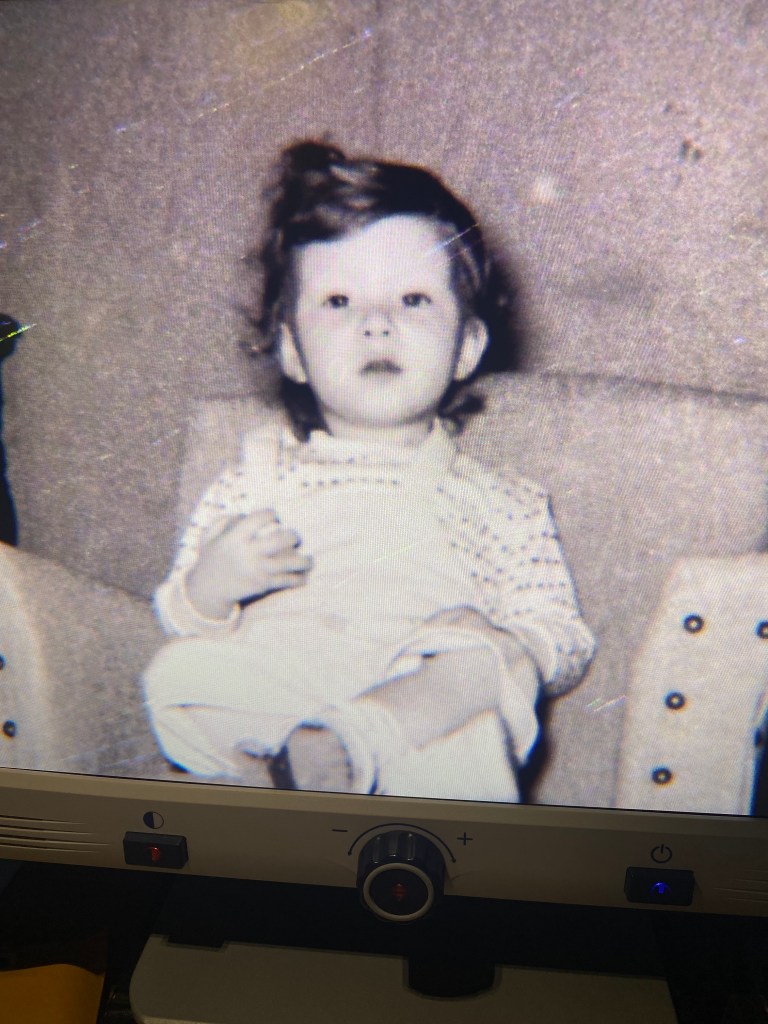
The black and white photo–proof I’m definitely in that age group. Current photos are additional proof!
I accept it while still in wonder about it at times. Because I feel great and am in excellent health (as far as I know, so far), I don’t feel like I’m in that age group. My husband’s aunt, who looks probably 20 years younger than she is, often says age is just a number. That’s true in a way. Your mental attitude, your physical health, and even your hobbies and interests reflect your age more than the calendar.
You know what I mean. Some people’s lifestyles and/or genetic health issues make them age more quickly than the 96-year-old woman in one of my civic groups who still drives and is involved in civic activities. Some people seem to thrive on getting older. My mom seemed to delight in getting older. She lived to be almost 94, but never complained about getting older. She laughed about it at times, and honestly, I think she thrived on being treated like she was elderly. You know what I mean if you’ve reached a certain age. It’s when those younger folks talk to you as though you’re not quite with it. When the nurse calls you “hon.” Or, as our preacher said once, if you fall as a young person, people laugh. If you fall as an older person, people rush to help you.
In Mom’s later years, I went to all her doctor appointments with her, and doctors tended to talk to me about her condition even though she was sitting right there. That would have bothered me, but Mom didn’t mind at all. She wasn’t the independent type and was only too happy for me to handle…everything.
One day a friend and I were at a local sandwich shop (we have several good ones in town), and the young man told me, “Your total after the senior citizen discount is–.” I laughed and told my friend, “I don’t know whether to thank him for the discount or be offended he could tell I qualify just by looking at me.” The young man had been friendly and talkative, and I think he could tell I was just kidding around with him and wasn’t truly offended. He just grinned and said, “I like to give discounts.” I reassured him it was fine, and I appreciated the discount.
Still, it did sting a bit!
I joined the wellness center last month, and I participate in a couple of the Silver Sneakers classes. The classes have anywhere from 35 to 40 people participating. The thing is, we’re all considered senior citizens, but the calendar ages range from the early sixties to up in the eighties. The ability levels are all over the place. Yesterday’s class was focused on balance, something we all need, I think. Today it will be aerobics centered, and it’s one of those classes you can get the heart rate up or not, depending on how much you put into it. LT does a great job of leading us. She recognizes the ability levels are as varied as the women and men (yes, we have some men) in the class, but thank goodness she doesn’t push us the way our P.E. teachers did in school.
My worst grades were in P.E., which is no surprise to my family. And, oh, those horrible one-piece blue jumper shorts with the snaps we had to wear in high school…when I was a junior, I became a member of the yearbook staff just so I could get out of taking P.E. In college, I was thrilled to discover I could take those classes pass/fail. But hey, I did make an “A” in bowling and and “A” in tennis skills. But I was stupid enough to take a class called “Figure Control and Conditioning.” My professor at the time is now in our retired teachers group, and I love to tell her she was trying to kill us in that class!
Don’ get me wrong. I have always liked being active. Just not in the structure P.E. class setting where I felt too tall and awkward.
I guess the whole point of this blog is that aging is real, and how we adapt to it depends on our personalities and our circumstances. In our youth-adoring culture, we don’t want to think about it and resist the thought of it. Older people are not honored in the same way they are honored in some other cultures. We are encouraged to have cosmetic procedures and use serums and lotions to remain as youthful looking as possible for as long as we can. The more tech-savvy generations view us as inept if our skills with technology are not what they think they should be. Sometimes our adult children think we’re not as capable as we actually are.
However, conversations in our age group are funny these days. Discussions about medicine, colonoscopies, arthritis…if you sit back and just listen, it’s hilarious in a way. Yes, we are in that season of life in which Medicare Part D is something to evaluate every year, yet my husband and several of his pickle ball player companions can hold their own playing against much younger men who join their group from time to time. We’re older, but we’re not finished with living.
I have a feeling my husband could hold out longer on the pickle ball court than many younger people, and there’s no doubt I can out-walk most of them due to a lifelong walking habit and the blessing of not having arthritis or back trouble. But I also recognize it might not be a good idea for me to roller skate, something I used to love, or take up jogging since that would hurt my knees.
Yes, I’m in that age group. But as my husband’s aunt says, my calendar age doesn’t define me. I can know my limits without imposing restrictions that aren’t needed. I can treat others with kindness, no matter how they treat me. I can find enjoyment in new activities, and I can listen and learn from younger generations while hoping they can learn from me.
And, yes, I can get that senior citizen discount. Why not?
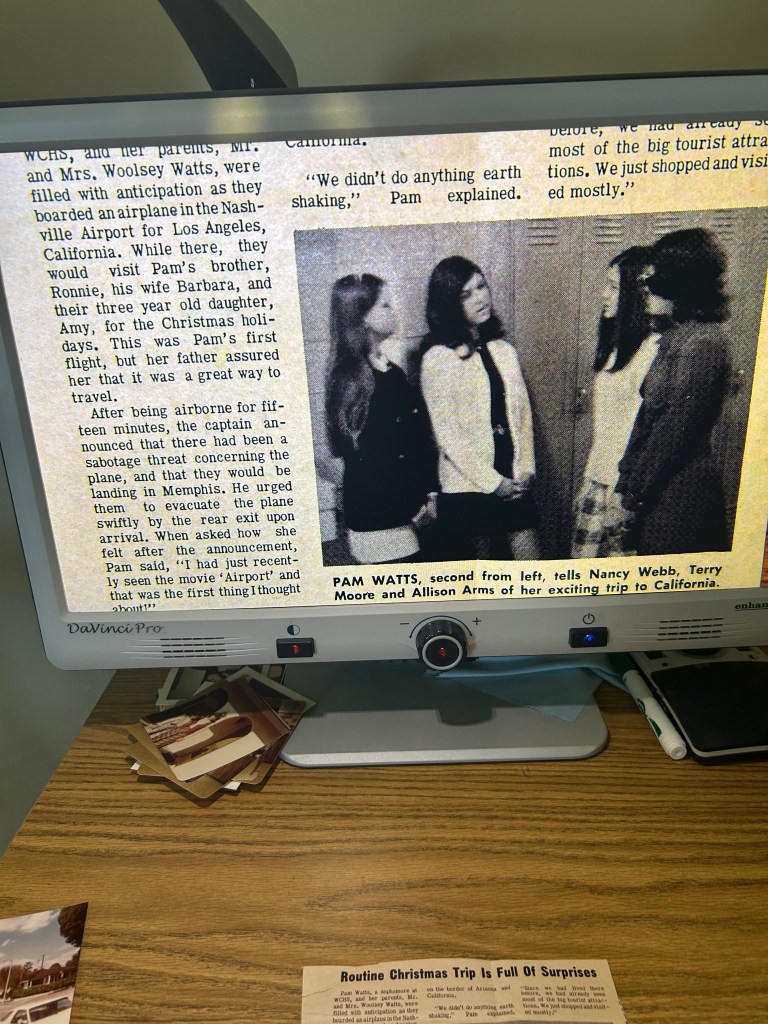
Mom kept any sort of newspaper clipping that mentioned anyone in the family by name or in a photo. Honor roll lists, a fuzzy image in a crowd, you name it. This clipping is from my school newspaper when a fellow student interviewed me following our return from a trip that involved a bomb threat on our plane. Yes, we had to make an emergency landing. No, no one was hurt. Yes, it was a little scary when the pilot announced what was going on, but at 15, I was more interested in the cute soldiers on board.
Don’t judge me.
I have boxes of clippings, and I can’t bear to part with them. They represent events that were important in our lives. Yes, they’re faded, and I can no longer read them. But they’re a tangible moment of the lives we’ve lived.
What will the younger generation have? Will they be able to open a box and find articles and photos of over 50 years ago, or will they have to find it on the Internet ? Maybe they can bookmark it? Will Facebook and Instagram exist 50 years from now? No one knows, and I won’t be alive to find out.
But I wonder.
With the digital and social media age, newspaper and magazine circulation have dropped. I often say my dad, a newspaperman to the core, would be turning over in his grave if he could see what is happening to his beloved industry. And magazines…oh, how I loved magazines. Tiger Beat, 16, and Seventeen eventually gave way to Glamour, Good housekeeping, Prevention, and Southern Living, in that order. You could see the progression of my maturing and age simply by looking at the magazines I was reading.
I loved the articles. I loved the photos. I even found the ads interesting.
Yesterday I had a dental appointment, and the small waiting room had something missing, something that was always in a doctor’s waiting room. Magazines. Not one magazine on the tables. No magazine rack.
And why should there be? People don’t read magazines. They scroll their phones. A lot. (Allow me to vent for a moment. Do you have any idea what it’s like to be unable to scroll your phone because of vision issues and surrounded by people who are scrolling theirs, sharing with each other photos they see, talking about what’s on their screens while I sit and twiddle my thumbs? Or when I’m talking to someone in the room and they pause before answering, and I realize they were reading their phone and didn’t hear me clearly? Okay, I feel better. Vent done.)
The world is changing quickly. Technology is improving our lives in some ways and making it worse in others. Newspapers still exist, and many places have digital archives of older newspapers, which is great. But what will it be like if and when newspapers disappear completely?
Something, I’m sure, will take their place, and the people living in that world will accept it without question. I’m sure I’m just being one of those older people who lament what used to be and talk about the “good old days,” which sometimes weren’t that good. Life with dishwashers and microwaves is definitely easier.
I have never forgotten the details of our “bomb threat” flight because of two newspapers–my school newspaper and the local newspaper. The facts are there, so I don’t have to rely on my memory. What was once news is now my story. My history. It’s a segment of my life.
I know digital is better for the environment. I know it is less costly to produce. I know the quality of print and photos is better.
But just for today, I want to recognize the value of newspapers. They have captured and continue to capture events in their local communities. They give room for opinions to be expressed (I know Facebook has plenty of that), they run ads that let us know what sales are going on or what services are offered, and they keep us informed in a variety of ways. They continue to serve a purpose.
So to those of you still working in the newspaper industry and trying to keep your publication alive, thank you. Thank you for your reporting on things that may be boring to you but interesting to someone else. Thank you for going to that high school or middle school game, taking the photos, and writing about it. Thank you for printing announcements, obituaries, and property transfers (ha, ha–not sure about thanking your for the sheriff’s report or police report. I always feel sorry for the family members.) Thank you for producing a quality publication on a limited budget. And…thanks for the memories.
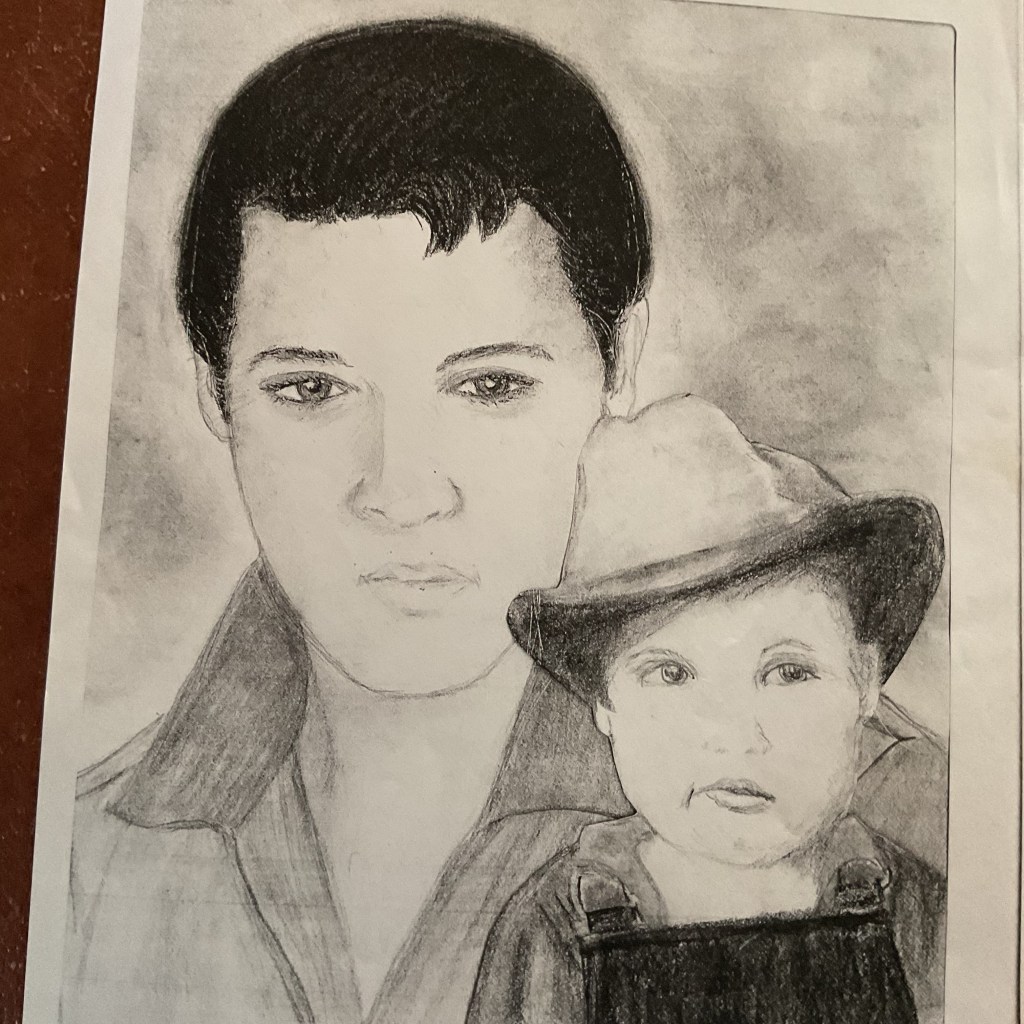
I did this sketch years ago, and it is supposed to be Elvis as a child and Elvis as a. young adult. I called it “the boy within the man.” In my opinion, Elvis stayed a boy in many ways, but that’s another topic. And I’m not sure you can even tell it’s Elvis, but trust me, that’s who it is supposed to look like.
The reason for posting this photo is because, in many ways, Elvis represents the American dream. Rags to riches, obscurity to fame, everything in the world a man could want…but was that really true?
Like many celebrities, Elvis achieved but ended up unhappy. No, he didn’t become a serious actor like he wanted to do. No, he was never a part of a gospel quartet, which was his first dream. But he had money, friends, and fame, and we can’t understand what drove him to escape reality by taking medications that made him sleep and other medications that made him stay awake.
He, like some, couldn’t handle life once his dream was realized. He could not be happy without a goal.
What is the difference between the two? I think it is that a dream is the big picture, and a goal is one of the steps taken to achieve that goal. For instance, you want to lose 20 pounds, meaning the dream is to drop at least one clothing size or improve your blood pressure or whatever. A goal to go along with that dream is to begin a walking program until you are walking three miles most days. You start with one mile and push yourself until you are comfortable with that. You increase gradually until you are able to walk three miles with ease. But you’ve only lost seven pounds at that point. You’ve achieved your goal without realizing your dream–yet.
Our oldest son and part of his family ate supper with us last night, and we (my husband and I) were talking about how different life is at our age. When I said “You have nothing left to work toward because you’ve achieved your goals,” my son thought I was being negative and saying something like, “There’s nothing to look forward to.”
No, there are plenty of things to look forward to. Being with family, seeing friends, taking trips, and even (for me) an in-person shopping experience at Walmart. Don’t laugh. I live in a small town. It really is an occasional treat but only because I seldom go.
When you’re raising your children and working in careers that are maybe not always what you had hoped they would be, it is easy to feel stuck and discouraged. Retirement and being debt-free can seem a long time away, and you may have to push yourself at times to keep on keeping on. You’re tired from too much busyness, or you’re worried about your children, or you’re living in the sandwich generation, meaning you’re dealing with children and aging parents, all of whom need your help.
You are always working toward something, not necessarily looking forward to it.
I’m the kind of person who needs something to work toward. Whether it’s preparing for a walk/run for St. Jude or working on a writing project or watching educational programs on the History Channel and that sort of thing, I am happiest when I’m pushing myself to accomplish or to learn. Yes, I always loved school. Sure, I looked forward to breaks, and no, I didn’t love Algebra 2 or geometry, but I loved to learn and (believe it or not) to be sociable.
When I was teaching, we always encouraged students to have dreams, but maybe we didn’t do as good a job of showing them how to set goals to work toward those dreams. And maybe we didn’t do a good job of encouraging them to have a Plan B, C, and even D in case those dreams didn’t work out. After all, only a very small number of athletes make it to the professional leagues, and while Sally may have a beautiful singing voice, the likelihood of her becoming rich and famous is slim. Go ahead, Sally, give it your best, but discover something else you love to do that is more achievable and can fulfill you in different ways.
Dreams are dreams. Goals are practical. Working towards something is not the same as looking forward to it. The people who understand those concepts and adjust accordingly are more likely to be content. The ones who don’t may end up like Elvis and others who find little joy in life once they’ve found wealth or fame.