
Learning to let go

I’ll explain the photo later in this post.

It took me a while–years, in fact–to learn how to let go of things I can’t control. That’s not to say I don’t have momentary lapses, but for the most part, I’ve done so.

The benefits? Better sleep. A calmer spirit. An improved spiritual life. Translated: better mental health.

You may be wondering how I’ve managed to do this, but before I explain, I’ll list the things I’ve had to learn to let go.

Goals: the goals I had as a 21-year-old didn’t happen

Control: control of my family members, control of all my health concerns, control of whatever is not really in my control

Dreams: We all have had dreams, whether we realize it or not. Your dream might have been as lofty as becoming a professional athlete, singer, or other celebrity or something more normal like finding the perfect mate, but I have to admit my dreams fell somewhere in between the extremes.

Grief: If we live long enough, we all experience grief. If I continue to live, there is no doubt I will endure it again. So when I say I’ve learned to let it go, that doesn’t mean I don’t have my moments. But I don’t allow myself to stay in it.

Maybe none of the above strike a chord within you, and if so, you are either very fortunate or blind to your own issues. I’ll use my mother as an example. Bless her, she was a worrier. She worried about her children and grandchildren constantly as well as her own security issues. She worried about her health. She feared someone was going to break into their house–from her youth she was that way. She feared germs. Truly. Way before Covid. “I don’t worry,” she used to say. “I’m just cautious.” The rest of us could see the truth. She couldn’t.

It’s possible you’re like my mom in some way. It’s also possible you have been blessed with the innate ability to let things go. tMost of us, though, are either a variation of my mother.

Now for the secret to letting go of the disappointments, heartbreaks, longings, and desire to control things beyond my control: prayer.

Before you stop reading at this point because you think I’ve given a cliché religious answer, let me explainIf. I hope you’ll find something helpful.

You remember the Serenity Prayer that was popular many years ago. I pray it. And I mean it. I’ve blogged about it before. To refresh your memory, here’s my variation of it: Dear God, give me the serenity to accept the things I can’t change, the courage or strength to change the things I can, and the wisdom to know the different.”Let’s think about the “wisdom” part. That’s a rough one since most of us wonder if we have the wisdom. And, to be honest, some of you reading this are afraid of change, so you won’t even try.

But we can all agree we can’t change the past. Maybe we regret a career decision but at the age of 55, we feel stuck. Guess what, the truth is we likely are. That doesn’t mean you can’t explore possibilities, but in this youth-oriented, youth-focused culture we live in, chances of finding your dream job are slim. That doesn’t mean you shouldn’t try. Just accept it if it doesn’t happen, you can still make the best of things.

I have stopped expecting people to be a certain way. I pray about my family members, but as far as trying to change them in some way, no. I accept them for who they are, love them, and let it go. I may be disappointed in choices they make or attitudes they have, but that is on them. I can’t control them.

Years ago, I flew quite a bit then had a scary experience that kept me from flying for many years. Actually, 41 years! In 2023, I flew again and felt so stupid for depriving myself of travel experiences for so long. Since that time, we’ve flown a couple of more trips, and I just pray for safety, get on the plane, and don’t worry about it. Fear kept me from living my best life.

Which brings me to my next point. I became legally blind in 2020. That condition continues to decline. So the regret over desired trips not taken is magnified by the fact that now that my fear is gone, my vision is gone to the point I can’t see beautiful scenery or experience new places in the same ways I once did. True, I use my peripheral vision, but no one has 20/20 peripheral vision, and I’m losing peripheral vision as well so…it’s just not the same. I’ve learned not to live in that regret. I have to let it go, and just make the most of now. I have no doubt in five years I’ll be wishing I had the amount of vision I have today (it’s a lot worse now than it was in 2020), so I don’t dwell on the past, don’t worry about the future, and focus on appreciating the present.

How do you let go of grief? First, give it time. It’s not going to happen quickly. It may take years. But keep trying. A friend once told me you never get over grief, you just learn to live with it. Support groups, volunteer work, serving others–find what works for you. And pray for strength to accept it.

I said I would explain the photo and how it relates to this topic. This was taken in Yuma, Arizona, on the back patio of a relative’s house. I grew up seeing those mountains on a regular basis and crossing them multiple times when we headed back to Tennessee for trips to see the relatives here. When we left Tennessee and made the long trip back to Yuma, seeing those mountains made me happy because I knew we were almost home.

When my parents moved us back to Tennessee, it was hard for me to appreciate my new home. I missed the familiarity of my house, my neighborhood, my church family, my friends. I pleaded with my parents constantly to move back to Arizona where my brother and his family were. I spent far too many years of my adulthood longing to go back there to live.

I accept now that it was not meant to be for many reasons, and I accept that sometimes our personal wants must be sacrificed for the good of others. All too often, our personal prayers are selfish ones. We want what we want, not what our loved ones want or need. And my personality is the type that can’t push hard for what I want because I can’t be happy if the people I love aren’t happy. That’s just the way I am.

But back to letting go–it’s a wonderful feeling. It took me years to achieve it, and I haven’t reached perfection. I’m trying, though.

God, grant me the serenity to accept the things I cannot change, the strength to change what I can, and the wisdom to know the difference. Amen.
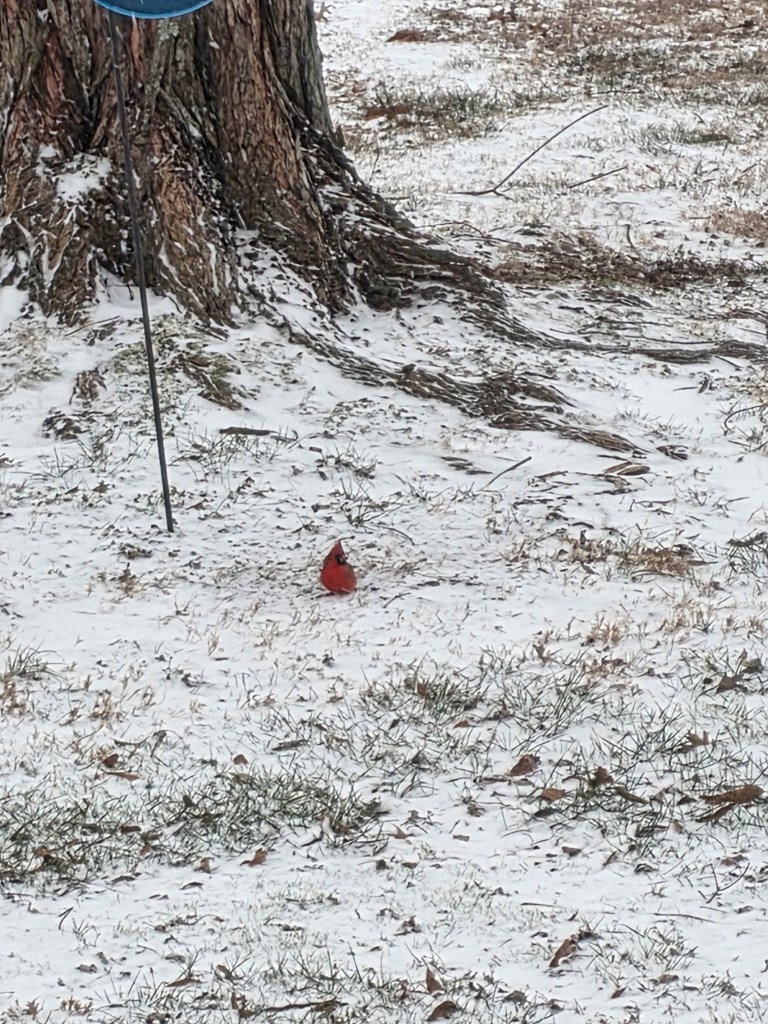
A visit from a cardinal–which loved one is visiting us?

It’s cold here!! The wind chill is currently 0 degrees with an actual temperature of 12. I think the high wind chill is supposed to be 1 today, so guess who’s not planning to go outside?

Whenever it is extremely cold or extremely hot, I am always grateful I live in modern times with modern conveniences and that I am in a financial situation that allows me to have these comforts. My heart goes out to those who are not as fortunate, and I can’t imagine what so many are dealing with right now.

Aside from the dangers that come with extreme temperatures, whether high or low, I will admit I do love the four seasons. I know many would rather live where it is a perfect temperature all year round, I often say that’s why San Diego is so crowded. But, for me, I think that would get old.

Why do I feel this way? Well, if you know anything about me, you know I love change and hate routine. I can handle routine for a while, and then I need a break. Variety truly is the spice of life for me, and I am adaptable for the mosts part in any situation. It’s getting a little more challenging the older I get, but that inner restlessness is always there. I blame it on my growing up years when my family moved frequently. By the end of sixth grade, I had attended six different schools. That is a topic I addressed in a previous blog.

This morning, a cardinal discovered our bird feeder and was brave enough to come on our front porch. We have six-feet tall windows, and the cardinal was just inches from the base of one.

Folklore says a cardinal appearing is a sign someone you love who has passed is visiting you. Of course, I don’t believe that, but I’m thinking about it this morning. Let’s just pretend it is true. Is the cardinal my husband’s mom or dad or my mom or dad? Is it my brother?

The truth is, I don’t need a cardinal to think about my loved ones. They are ever present in my subconscious and conscious thoughts. They are in my dreams occasionally. “Dad would love Draco,” I think when petting our dog. Dad loved dogs and nature in general. He adored our dog Sable who passed away in 2010. “Mom would have loved having a smart phone so she could take all the pictures she wanted,” I remark. Mom always had the camera ready. “Doris was the best cook,” referring to my sweet mother-in-law’s creations. She really was the best cook. “Your dad could keep the straightest face while telling a story,” I might say to my husband when we’re laughing about one of the many times he told something that was not true. Like when he broke a bone from a fall while washing his car and people kept asking him about it, so he started telling them he broke it jumping out of an airplane. Or how he told people his two sons were by his first wife. Totally true because he only had one wife! The truth always came out, but it was still hilarious watching him do his thing.

As for the brother I remember, it’s the 11-year-old boy holding me when I was burning up with fever due to one of my frequent ear infections. It’s the young man I idolized, the young man he was before a tragedy changed him. I like to think that young man was always deep inside of him, and I did see glimpses of it at times. Those glimpses gave me some solace.

I don’t need the appearance of a cardinal to remind me of them, but today it did.

I’m not the type to go to the cemetery a lot and look at their graves. The reason I don’t is because I know they are not there. Their decomposing bodies are no more than an article of clothing left behind. What I do is remember them. Some memories make me laugh. Some make me cry. But the way they continue to live on this earth is in my heart.

The best way to honor our loved ones who have passed? The way that reflects your personal convictions. Frequent changes of flowers on the headstone? That’s fine. Posting memories on Facebook? That’s fine. Talking with others about them? Of course. Looking at old photos and videos? Sure.

The important thing is to remember. Not because of a cardinal who appeared in your yard or on your porch, but because if you truly loved the special people in your life, you can never forget them.

Widowhood

Widowhood is on my mind lately because of so many friends and family members who are dealing with learning to live a new normal. I watch them and hurt for them. I notice how they handle it differently. I listen to them. And I’ve learned some universal truths.

First, widowhood is no respecter of age. It can happen to anyone at any time.

Second, the nights are the worst for most. They can keep busy during the daytime hours, but the evenings can seem long and lonely. Eating alone, whether at home or in a restaurant, is a struggle.

Third, triggers can generate sadness even years after the loss of a spouse. Finding a cup I the back of the cabinet that your loved one used for coffee. Feeling like the odd one out in gatherings consisting of couples. Feeling left out when former couple friends do not include you in their activities. Yet if you go, the fifth-wheel feeling dampens the enjoyment.

Those are the key commonalities I’ve noticed. But here are the differences in coping I’ve observed.

Some isolate. They don’t want to be around others.

Some throw themselves into service for others. They fill their days with helping those who need assistance with transportation, health issues, and doing anything they can to take their minds off their alone state.

Some date again. Quickly. They’re not going to live life alone, no matter how much they loved their spouse, and they are looking for someone else to fill that empty chair at the table and that empty side of the bed.

Some read books about widowhood, attend support group meetings, or reach out to others in the same situation. Many read the Bible or other religious books to find solace and healing.

Younger widows devote themselves to their children. They put their children’s needs first and focus on building a happy home.

I could go on with more observations, but there are far too many because each person handles it differently. It gets better with time for most, but life is never the same. That doesn’t mean it can’t be good.

I don’t know how I would be if I were widowed. No one does until you walk that path yourself. But I think I would want the following from my friends and family if I were ever faced with that grief. The following is what I would want to say, based upon conversations with widows.

I’m grateful for your support at the time of loss, but I’d want you not to forget about me after the initial attention has waned. I would need your support.

If my children live in the same town or at least nearby, please include me in your family meals at times. I don’t have a daughter, but if I did, I’d ask her to have mother-daughter days from time to time. Hey, that’s a great idea even if Mom isn’t widowed. Moms and daughters have a unique bond. Don’t wait until Mom is alone to spend time with her.

It’s okay if I cry and feel lonely. It’s part of the grieving process, and it’s part of learning how to live my new normal. But don’t say things to me like, “Count your blessings” or “It could be worse.” I would know that with my head, but you saying that won’t make me feel it with my heart. It will take time to heal. So let me.

As I write this, I realize the same things could apply to those who have gone through a divorce since they, too, must learn to live a new normal.

I don’t like to think about being alone at some point in my life, but I can’t help but think about it as more and more of my friends lose their spouses. I do know my personality, however. I know I’d be hosting meals in my home for others from time to time. Knowing me, I’d start a widows’ dinner club in which everyone brings a dish and we’d spend time together on at least a monthly basis. I’d cry a lot. Yes, I’m one of those people who cries easily. I’d do what I do now when my limited life caused by vision loss overwhelms me. I’d call friends, I’d call shut-ins, I’d send cards, I’d try to do something for others.

And as long as I’m physically able, I’d exercise. I’d go for long walks or swim or do my intervals (yes, I have a home interval fitness program I’d be happy to share with you if interested), and I’d even go on trips. I’d do whatever I could to escape the aloneness of my life.

But I would never get over the grief completely. I’d handle it better at times than others, but I’d still have my moments. I know that about myself. I’m very self-aware.

Maybe. The truth is, I don’t know what I’d do until I am forced to face it. I may never face it. My husband may be the one dealing with widowhood. He will handle things in his own way.

To all of you who are widowed or divorced, please know that many of us see you. We see your pain. We see your valiant efforts to move on. We may not talk about it, but we’re aware. So we pay for you and do what we can, knowing all along we can’t fix things.

But maybe we can brighten your day in some small way. And maybe your grief will lessen as time goes on and the memories of your life with your loved one will bring laughter instead of tears and joy instead of heartache.

Widowed, divorced, single…lonely?

Is it better to have loved and lost than to have never loved at all?

Ask the recently divorced, the recently widowed, or the recently broken-up from a relationship, and I have a feeling the answers would be very different from those who have had time, maybe even years, to adjust to their loss.

In my family and friends circle, I know widows as young as in their forties and widows in their nineties. I have friends who divorced years ago who remained single. I know of people who never married. My observation? It takes time.

I know someone going through loss often feels as though they will never get over it. I’ve been there. I know someone desperate to find a special someone may feel as though it will never happen, and sometimes it doesn’t.

Yet being alone doesn’t always mean lonely.

I don’t know how I will handle widowhood if it happens to me. I don’t know if I’ll be strong more than I am weak, or if I will fall into a depression. I like to think I’ll be strong, but the truth is we don’t know how we will handle any situation until we are in it. Being strong doesn’t mean not being sad. Being strong means still going through each day, doing what you have to do, and as one of my friends puts it “take one day at a time.”

For those of us outside of this circle, though, we can help. We can invite people to do things with us and not exclude them just because they’re not a part of a couple. Grown children need to include Mom or Dad in meals at their home from time to time. I’ve heard more than one say eating alone makes them feel lonely. I get it–you’re working, keeping busy with your children’s activities, and you’re exhausted. But put yourself In Mom or Dad’s shoes. How would you feel spending most of your hours alone when you were accustomed to having someone to talk to, to dine with, to do nothing more than watch a television show together?

I know I’m being preachy. But I’m amazed by the neglect I witness in the older population. My Facebook friends have seen my post about an elderly shut-in who lives almost 200 miles from me whom I call at least a couple of times a month because she has vision loss and wants to talk to someone who understands. She is unable to drive, unable to walk very far, and a widow for five years. Two of her three children live in the same town, but she often goes two or three weeks at a time without seeing another human being. Her child who lives out of state is the one who keeps in contact with her on a regular basis.

“When I see my son,” she told me, “he always wants to take me out to eat and run errands while we’re out. I’m glad to spend time with him, but I don’t want to do all that. I just want him to come see me and sit and talk for a while.”

And what about the divorced, the ones who feel abandoned by the person they loved, the ones who question why the divorce happened? What about the ones who are single, but all their friends are married with children and leading busy lives of which they don’t feel a part?

I don’t know what the answers are. I do know these people seem to adjust over time and still manage to live fulfilling lives. Whether they accomplish that by clinging to their original core family and/or children or by pursuing a beloved hobby or career, I don’t know. But the strong ones manage. They don’t give in to their sadness or loneliness.

I know this post is random, but what I’ve noticed is the following:

People who go through loss seem to do better when they do things for others to take the focus off themselves. People who keep busy are less lonely. Some people prefer to be alone and can involve themselves in hobbies. The more sociable ones get involved in civic and/or church groups and make a point to reach out to their friends to do things.

I don’t know what it’s like to be a widow or divorcée, but I’ve had my lonely times. When I graduated from college and lived alone, there was no one to do anything with because most of my friends married or moved away. When I first became dependent on others to drive me places after becoming legally blind, I spent the eight or nine hours a day my husband was at work trying to find something to occupy my time. It was the most miserable time of my life, but it gave me a new appreciation for what shut-ins experience.

I believe that time truly does allow hurts to heal, but that doesn’t mean that people recover from grief in a few months or even a few years. Those of us not going through loss should be patient with them. People adjust to new situations at their own rate.

A final thought: it’s great to pray for someone, but doing something for or with someone is even better.

Sorry for the sermon in today’s blog. I just felt the need to talk about an often forgotten group of people. Thank you if you stuck with reading this blog to this point. Let’s all work to make the world a better place by taking care of those in our circle.