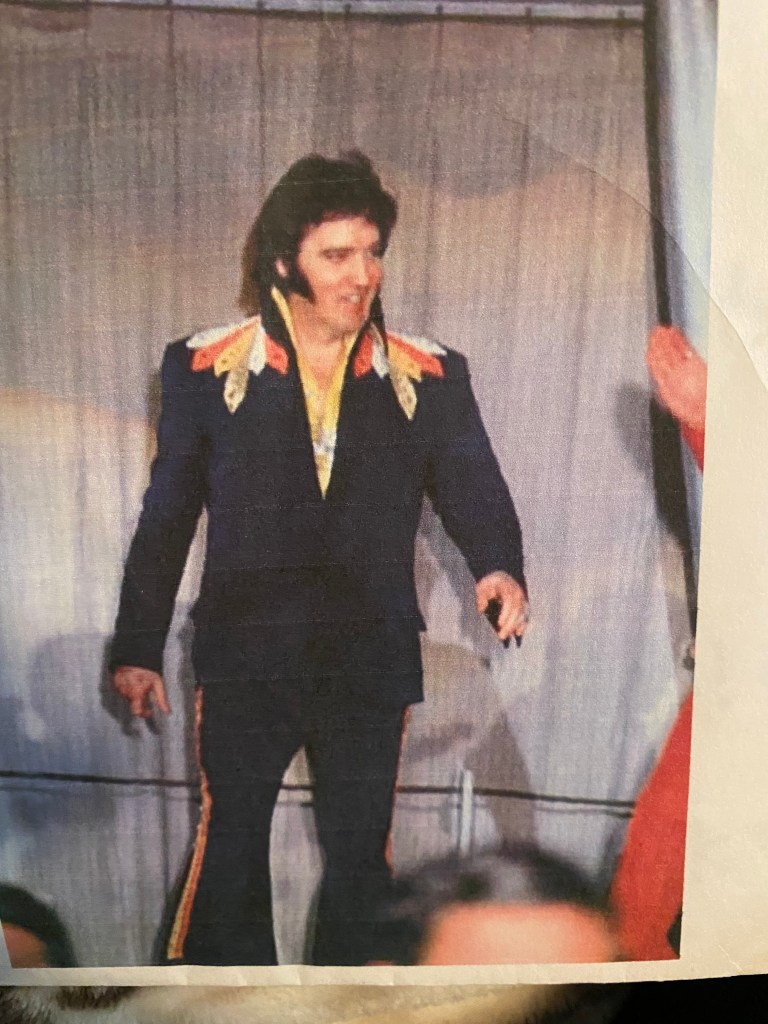
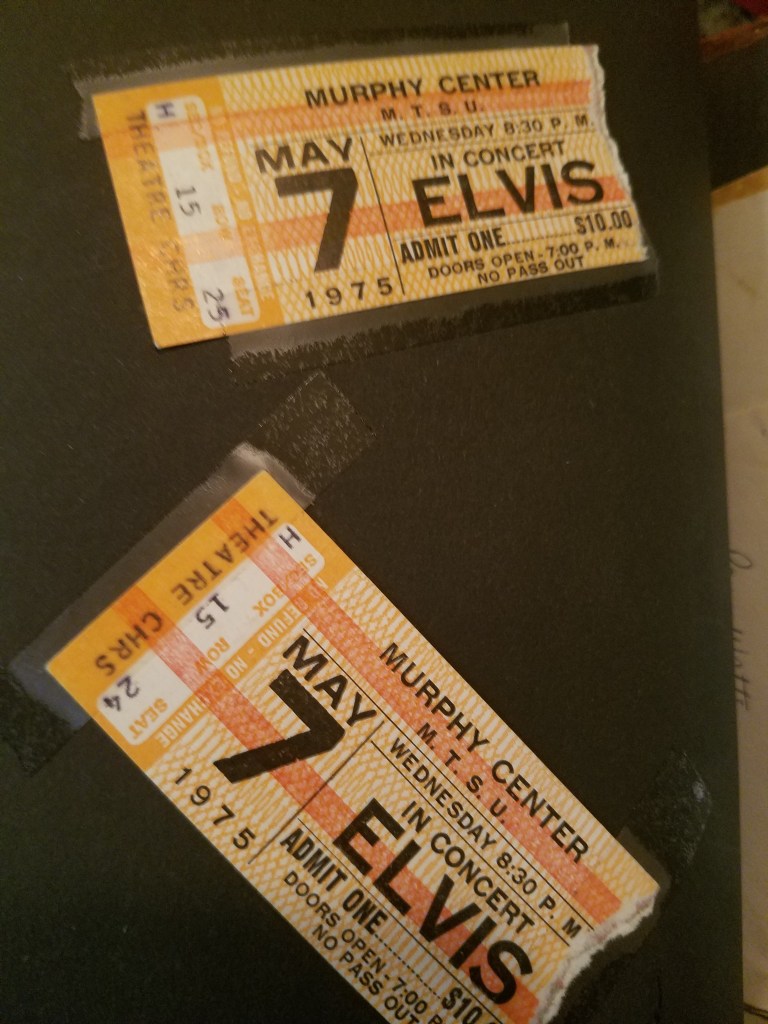
Yes, I was there. No, I wasn’t this close to Elvis. A friend sent me the picture. But those are my ticket stubs.
What was the concert like? Actually pretty decent. They made an album from it–well, from this particular night and the previous night’s show. The entire concert from May 7 is on YouTube. I remember when he told the young mother sitting near the stage that she had her baby too close to the speakers.
I was one of the younger ones in the crowd. Most were women in their late 30s and 40s with the teased high hairdo’s still common at that time.
The tickets were $10 each. That seemed expensive at the time, but I was working and used my own money!
I’ve seen other entertainers/groups who put on better shows. Elton John, The Eagles, Little River Band, and many more. But I was floating when I left the arena that night. At that time, he was the most famous celebrity I’d ever seen. Unless you count James Brolin and Rosie Greer, whom my parents and I saw at a telethon in Nashville. But here’s the catch: no matter what your age, you know who Elvis Presley was. If you’re younger, you may have no idea who James Brolin or Rosie Greer is.
I’ve outgrown the starstruck mentality because I’ve learned that celebrities are just people like the rest of us who just happen to have careers that put them in the limelight. Elvis was a flawed human being whose fame elevated him to some sort of bigger-than-life status that I kind of think he loved and hated at the same time. People may argue about his talent (or lack of talent) and they may choose to believe the negative things publicized about him or the positive, but I think there’s one fact they can’t deny.
Elvis had a fan following like no other entertainer, and that following is still going strong as younger people jump on the fan-wagon. I know of no other entertainer that was as famous and beloved almost 50 years after his death as he was in life.
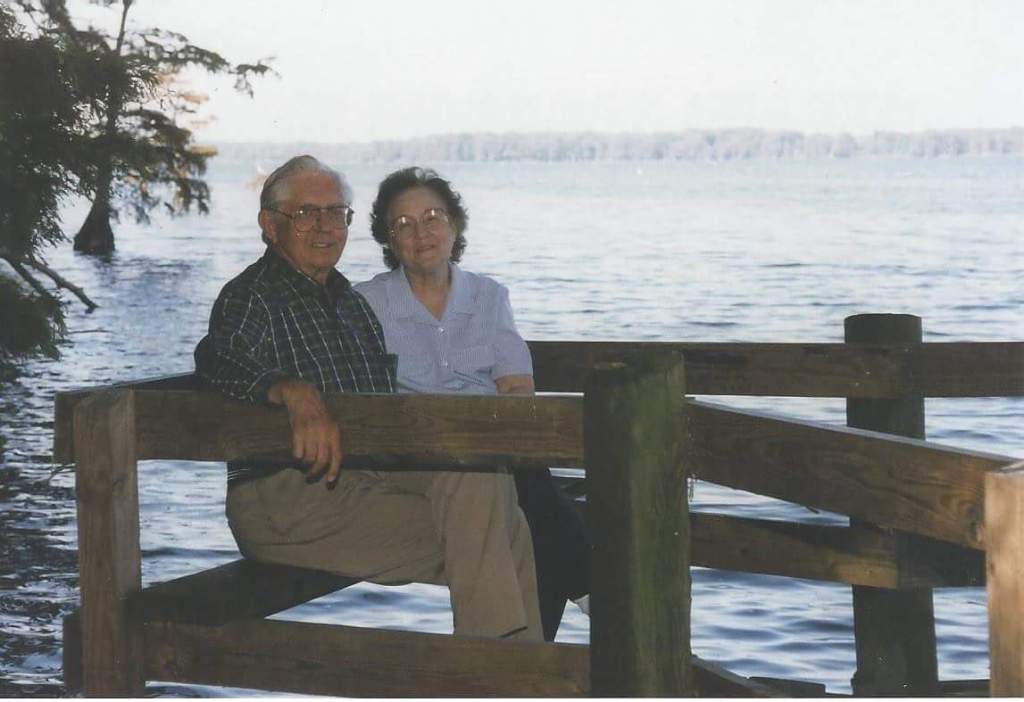
I love this photo of my parents taken at Reelfoot Lake many years ago. Dad passed away in 2012 and Mom in 2021. She lived to be almost 94, and while I respect her memory and always loved (love)her, she had a very human weakness that consumed her. That weakness was worry.
She didn’t see it that way. She was a Christian who prayed regularly, attended church as long as she was able, and read her Bible daily.
But she lived in fear and worry. Fear of someone breaking into the house, constant worry about her children and grandchildren, fear of doing many things, and a worry that caused her to try to control the lives of her loved ones.
For years, I was critical of her tendency to worry without realizing I was doing the same thing at times. I worried about things going on with my job, about my children, about the future.
Thankfully, I had an awakening of sorts. I don’t know what prompted it, but I began to learn to let go. I learned to pray about my concerns then forgot them. The only person I could control was me. I couldn’t control what my co-workers did, what my family members did, or my declining vision.
Mom always worried when my children were flying somewhere and wouldn’t rest until “they have their feet on the ground.” She worried anytime any of us were traveling on the interstate. She worried about our souls and salvation. She worried about choices her children and grandchildren were making.
I understand those concerns. But concern is one thing. All-consuming worry is another.
Yes, I have concerns at times, and my loved ones are always in my heart. But I don’t worry about them. Why? I can’t control their health, their choices, their actions, nor their attitudes. All I can control is me, and even with me there are things I can’t control.
I can control my health and safety to the best of my ability, but even I have limits in how much I can control my own life.
That’s not to say I don’t have my moments. When loved ones have serious illnesses, sure, I worry. If they are experiencing a crisis or serious problem, sure, I worry. But like I said, I pray about it and try to let it go.
We sometimes spend too much time focusing on choices or mistakes of the past and fears of what the future holds, and doing so robs us of joy in the present. What a shame to live a life like that.
I don’t think Mom would mind me using her as an example. If she were alive, she’d be denying it. “I don’t worry,” she used to say. “I’m just cautious.” Or “I can see things you all can’t.”
But if her faith in what follows death was correct, she knows better now. She knows she wasted days and nights living in fear and worry about things she could not control. So I think she’d want to tell us all not to follow her example.
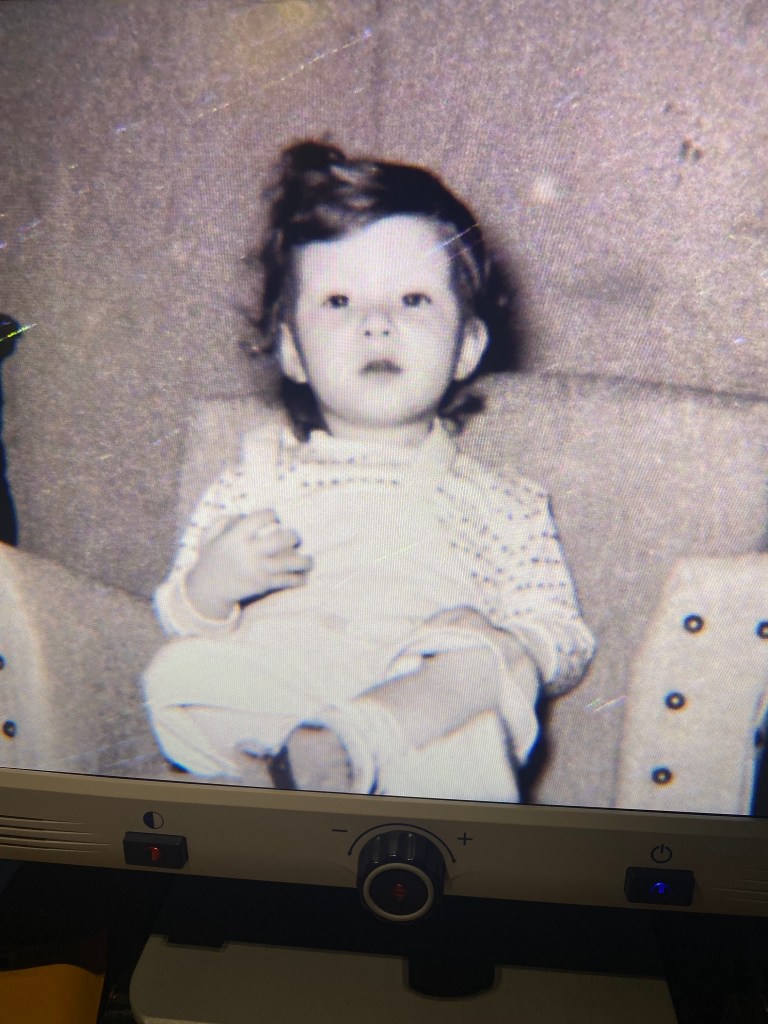
Let’s face it. I have some computer skills. But a gal born at a time when black and white photographs were the only options, most people were just then being able to afford televisions, and telephones had party lines, technology still amazes me.
I’m continuing to learn about assistive technology for the visually impaired, and as a lover of books, I wonder how many other people don’t know, as I didn’t, that Alexa can read any ebook I purchased on Kindle.
That’s right. I don’t have to get a more expensive audio book on Audible. I don’t have to be unable to read books that have no audio format. Thanks to Alexa, if the book is sold on Amazon, I can buy the ebook and have it read to me for free.
I realize you younger or more tech-savvy readers already know much of what I’m sharing, but for the benefit of the “older generation” who may not know these things, I’ll share what Alexa can do to make life easier. As a visually impaired person, I use the Echo dot daily, usually several times a day.
I know some people have concerns that the dot is listening to them, but guess what? So is your phone.
I use Alexa to: ask the time, the weather, the UV index, hear recipes, ask medical questions, ask nutrition information, play games (Jeopardy, Question of the Day, Song Quiz), learn, listen to podcasts, listen to music (including Sirius radio), ask about celebrities, and more. I use Alexa for learning activities. Alexa can call anyone in my contact list. If I were to fall and not have my phone, I can ask Alexa to call someone or 911 for help.
If the information is on the Internet, Alexa knows it. Sometimes I say, “Alexa, I’m bored,” and she suggests some games I might like. If I misplace my phone, I can ask her to call it (although I have an iPhone and can just say, “Siri, where are you?”).
I especially like using Alexa for recipes since I hear the instructions and don’t have to use a magnifier to struggle to read one.
Back to the reading a book to you topic. If you’re listening to a book and tell her to stop, when you decide to go back to it, even days later, she will pick up where she stopped.
So for someone who grew up with no cable, black and white TV until I was 15, no microwave until I was in college, no cell phone until I was middle-aged, and no way to record something on TV until I was in my thirties, Alexa is pretty amazing. I would hate to be without it!
My youngest son, now age 35, became an Elvis fan when we visited Graceland when he was ten years old. For years after that, every birthday and Christmas, we made the two plus hour trip to Memphis so he could tour the mansion and go through the exhibits. As he got older, we always included friends so they could explore on their own while we (or usually I) just chilled somewhere.
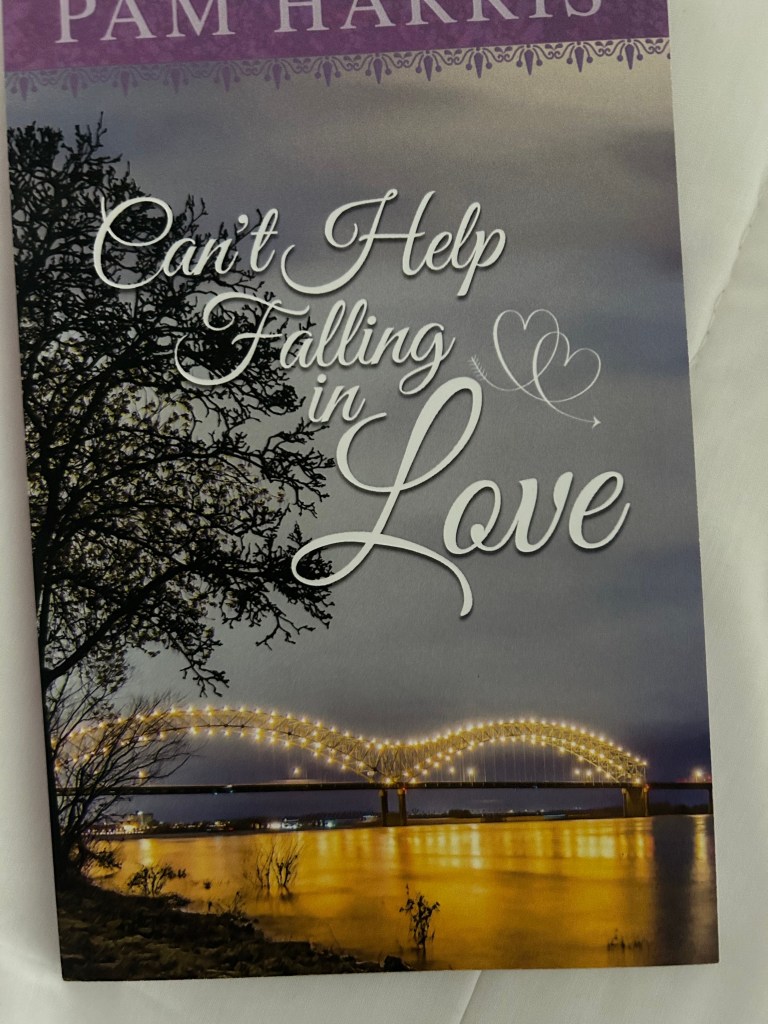
I became so familiar with Graceland and the plaza (now gone), I began to imagine stories connected with it. My first book was for girls ages eight to 12, a mystery involving their stay with a great-aunt who lived behind the Graceland property. When I wrote this novella, my publisher told me to write a romance involving a female veterinarian who took care of the horses at Graceland. That was the only direction she gave me.
I created a novella involving Kyla Porter, a veterinarian with a secret, and Cole Weathers, the handsome man she encounters on her first official visit to the Graceland stable. I learned about the stable from the woman who at that time managed the stables (she answered my questions via email).
My son and his family live on Mud Island (getting ready to move), so I had to include that beautiful section of Memphis in the story as well as Olive Branch, Mississippi, a town just across the state line where my husband’s cousin and his family lived.
I always like to write what I know, and because these places (as well as Knoxville and the Smoky Mountains) are familiar to me, I included them all in this short novella.
It is free with Kindle Unlimited as an ebook, so if you want to read a clean romance involving all these places, maybe you’d like to download it and give it a try.
By the way, the book begins on April 1 (there is significance to that date), so I guess writing about it now is sort of timely!
It’s now available! A short book, only 20,000 words, available as an ebook or paperback. $2.99 for the Kindle ebook and $5.99 for the paperback (large print). Audiobook is in the works.
When I lost all central vision in my one remaining “good” eye four years ago, I didn’t know where to turn or what to do. My life was impacted in a negative way, and I needed to find ways to do normal things. My husband and I researched and sought help, and the knowledge I’ve accumulated in the process needed to be shared.
From an explanation of what blindness is and isn’t to strategies for doing things around the home, using assistive technologies, using smart devices, participating in support groups, online resources and YouTube channels, and more–this short book has information designed to help others find their way in a partially sighted or even totally dark world.
It is also for family members and friends of those dealing with vision loss as I explain the emotional struggles, explain how we function, and list resources to help.
If you know anyone dealing with macular degeneration, glaucoma, cornea problems, diabetic retinopathy, or any other eye condition, this could be the book they need to get them on the path to living as normal a life as possible.
Ah, retirement. It’s what we dream about when we’re burned out with our jobs or feeling stuck or exhausted from the hectic pace of life. We envision how wonderful life will be when we are not controlled by the clock or obligations. The freedom to travel, to sleep late, to do what we want to do when we want to do it. What could be better?
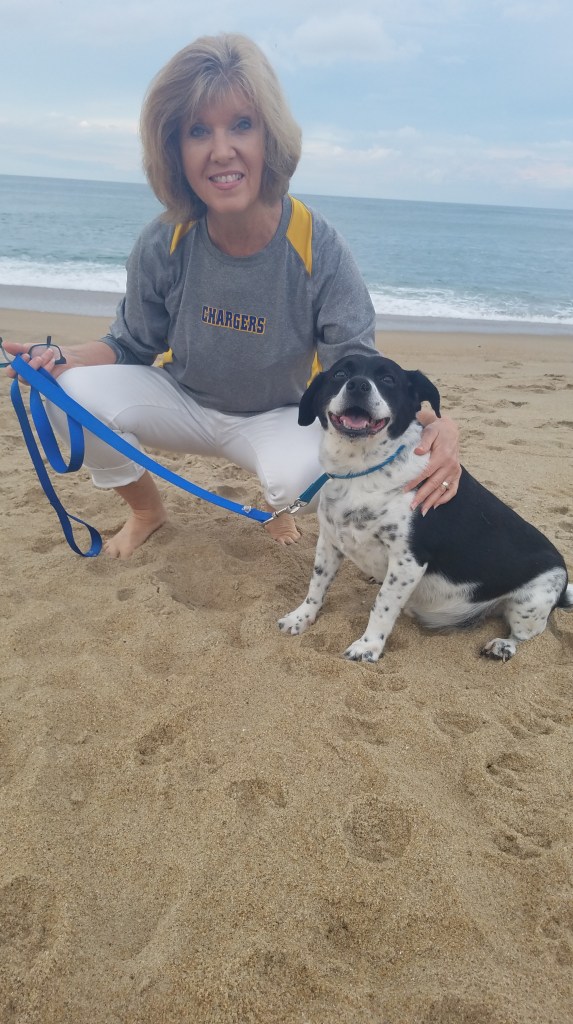
That was how I felt when the above picture was taken at The Outer Banks of North Carolina in 2018. I had retired a week earlier, but the reality of my new situation had not yet sunk in. As a teacher, I was used to summers off, so I knew I wouldn’t realize I was retired until school started back in August.
It was a wonderful feeling to be sitting out by our pool on the first day of school. I thought of my teacher friends and how that first day was affecting them. I remembered my own experiences and was glad those days were over for me. I had signed up to be a substitute at the school where I taught, a perfect set-up for me. I could sub if and when I wanted. I had the freedom to choose.
But the newness of retirement wore off. True, I had freedom, but almost all my friends were still working, so I had no one to do things with. My husband was still working, and he was too tired at night to go anywhere, so life became a routine of…boredom. My vision loss soon declined to the point I could no longer sub, which made it worse, but even if I’d had the vision to keep substituting, I think I would have felt the same.
I know plenty of people who love retirement, and maybe I would also if I could drive and go and do things on my own. Yet I know my personality. I’m high energy, very sociable, and goal-driven.
Six years have passed, and my feelings about retirement haven’t changed. Don’t get me wrong. I don’t miss the 5:30 A.M. alarm, the rushing to get ready, the days so full I’m exhausted at night. I enjoy taking my time to drink coffee, listen to a podcast, listen to a devotional, and get my inner self strengthened before beginning my day. I’m in two book clubs, three civic clubs, and the president of our local retired teachers association. I volunteer for activities at our church.
But there are still many hours to fill each week. TV, especially daytime TV, gets boring. Audiobooks are great–for a while. My hobbies–sketching, acrylic painting, doing crosswords with the use of a assistive technology, playing solitaire with cards for the visually impaired, cooking–sound like a lot, but even those things can get to be more of a chore than a pleasure because I can do them whenever I’d like.
When you retire, you lose something. You no longer have the weekends to look forward to, so every day blends into the next. You miss out on what’s going on in your community because you are not around people on a regular basis. If the weather is bad and you’re stuck at home…well, it gets boring.
My advice to anyone contemplating retirement is to know your personality. If you’re ambitious, goal-driven, and all those qualities I’ve described about myself, you might want to ease into it. See if your employer will allow you to work part-time (ideal for me, if I could) or retire from this job and find a fun part-time job. I used to dream of moving away from our town and living in a city so I could work somewhere fun. Something simple like being a docent in a museum or selling tickets at a place like Graceland or the Country Music Hall of Fame or relocating to the Smoky Mountains and working in one of the many tourist attractions there.
But family relationships and other circumstances prevent those “fun” jobs, so that is why I’m writing again. I’d prefer to have an office to go to where other people are working to do my writing. An ideal work schedule for me would be 9:00 to 3:00 three days a week. Anyone know of a job like that for a legally blind gal? Ha ha!
Like I said, these are just my thoughts. There are plenty of people who love, love, love retirement. Maybe I would if not for my vision issues.
I often say I’m an odd duck. I don’t love chocolate, pizza, or hamburgers. I prefer salads and fruit and yogurt and vegetables. I force myself to eat fish and chicken because of the protein. I enjoy walking several miles most days of the week. Yes, that’s right, I ENJOY walking. I enjoy exercise videos and swimming and would love to roller skate if not for my age and would definitely love to ride horses again.
So if you’re an odd duck like me, you might want to rethink your retirement plants. Just food for thought!
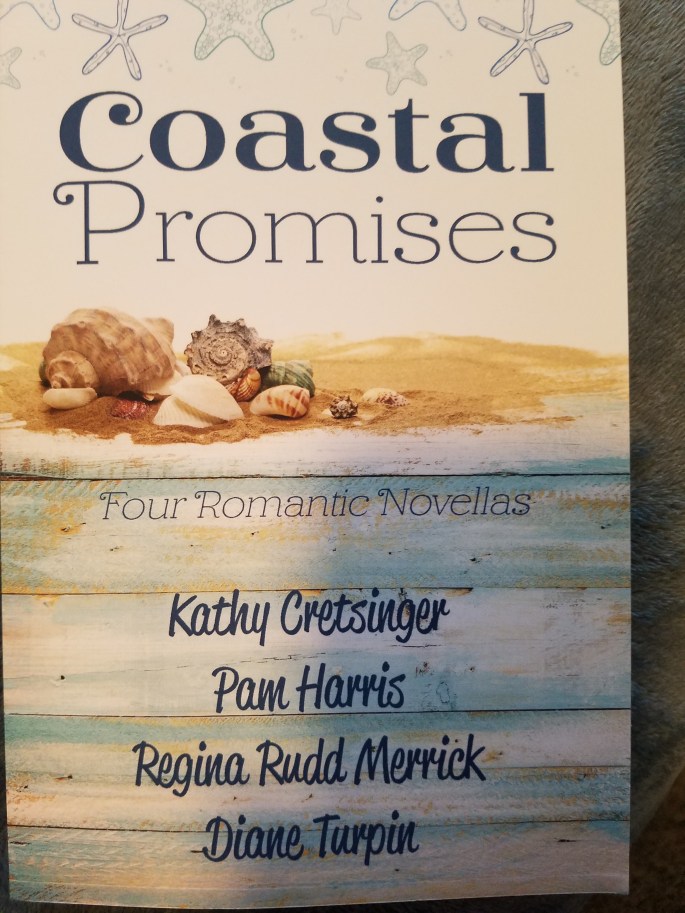
Several years ago, I wrote a novella entitled “Surf Song,” which is part of this collection. When the publisher gave us the guidelines, she simply said a Christian romance set at a beach.
I’ve spent time on lots of beaches. California (San Diego and Malibu), Mexico (Cozumel), the Gulf of Mexico (Alabama and the panhandle of Florida), Charleston, Wilmington (North Carolina), and my favorite, The Outer Banks of North Carolina. The setting for my book was a no-brainer. It had to be The Outer Banks.
Our first and only visit to The Outer Banks was in 2018, and to be honest, our expectations were low. It turned out to be the best beach vacation we’d ever had. Why? Because our idea of fun at the beach is not sitting on the beach all day. We spent time at the beach but also visited a lighthouse, visited the site of the Wright brothers first flight, toured the Lost Colony site and went on a full-size replica of one of the ships, went on a dolphin cruise, and played miniature golf on a rare all-grass with no gimmicks golf course. No crowds on the beach. No condos marring the views. It was perfect. Manteo, Southern Shores, Duck, Corolla…we loved the area.
For the novella, I created a fictitious inn called “Surf Song.” The main character, Holly, was thrown into sudden fame as a teen-ager when she won a singing contest. With her older sister serving as her manager and the two of them dealing with their widowed father’s excessive drinking, the three moved to Nashville because of her singing career. Now in her late twenties, she wants to escape the life she has been living, no longer desiring the fame she once craved. A songwriter at heart, she drives to The Outer Banks to stay in a small inn. Coloring her hair and cutting it short is her only disguise, and for a time she is secure in her anonymity.
She couldn’t foresee her attraction to the inn’s owner or how the time away from Nashville would affect her.
If you’re intrigued, you would also enjoy the other three novellas set in beach communities along the Atlantic. Clean, light reads with happy endings. A great way to start the beach season. Available on Amazon as an ebook and a paperback!
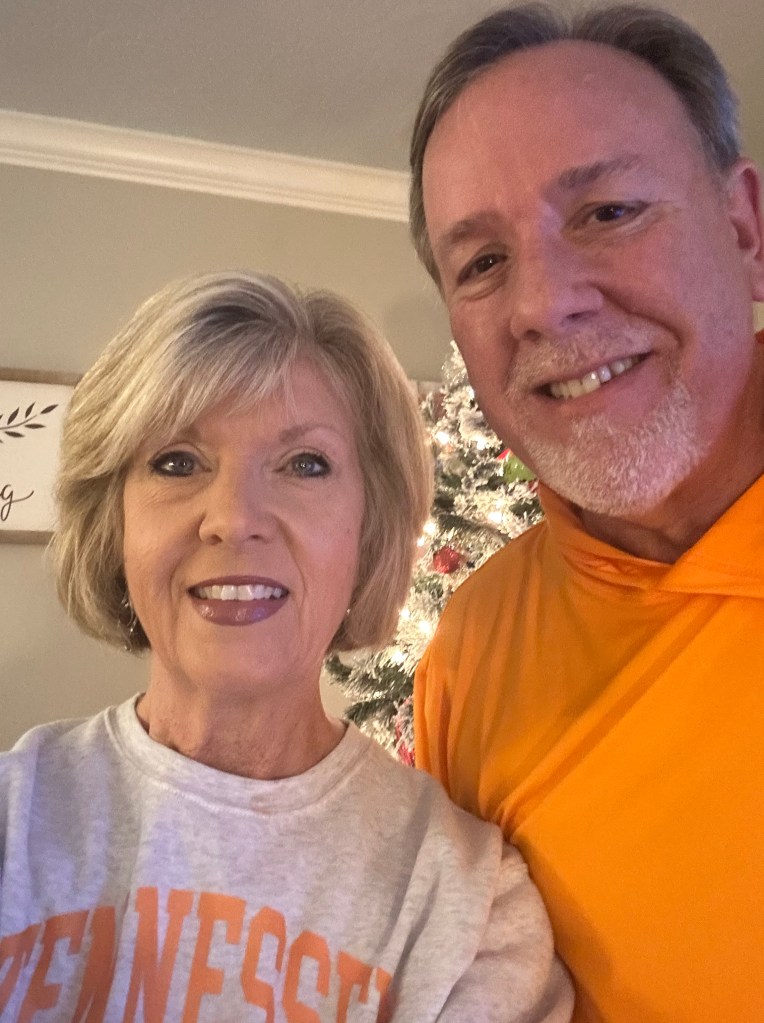
Today is our 43rd wedding anniversary, and unfortunately I have no good quality picture to share of our wedding day. The photographer’s equipment messed up, and the lighting was so poor in all the photos, I have very few pictures. Our wedding was simple, an afternoon wedding in the then common style of a short wedding and a simple reception, not a meal followed by music and dancing as it is now. But close friends and family attended to celebrate, however modestly, our special day, and here we are, 43 years later, still together and closer than we were when we began our journey.
So what is the secret to a good marriage? Before I tell you what it is, let me first share what it is not, although other long-time married couples might disagree with me.
It is not what we see in most movies.
It is not what people read in most romance novels.
It is not about each partner being the perfect mate.
There are elements of all of those things in a good marriage, but the secret, in my opinion, is commitment. By both parties.
Even the best marriages have their rocky moments. Your feelings for each other, especially in the early years, may wane at times or even become overshadowed by the demands of everyday life: jobs, children, obligations, extended family. You may feel you are doing all the giving in the relationship and your mate is doing all the taking. But if you’re both committed to the relationship, you can work through those issues and be stronger as a couple as a result.
I’m not an expert nor a counselor, and I believe each couple has its own dynamic. They have to figure out what works for them. My husband’s parents, for example, were (in my opinion) too dependent on each other, but that was their dynamic and was what made them happy. My parents were married 67 years by the time my father passed away, and to be honest, my mom was the nagging sort of wife. My dad handled it, always loved her (as she did him, in her own way), and while I would never hold them up as an example of how marriage ought to be, I have no doubt they loved each other and were committed to their relationship.
Barry and I have our own dynamic, and it is what works best for us. I avoid being like my mother. He respects my need for independence and doesn’t feel I have violated some sort of marriage code if I go spend a weekend with my friends as I’ve done with co-workers and former classmates. He doesn’t mind if I don’t sit in the living room with him while he watches his many sports programs. He lets me be me, and I let him be him.
It’s what works for us.
I realize there are some situations such as infidelity, abuse, an overbearing or verbally cruel spouse, and substance abuse that can and do destroy a marriage. I’m not trying to say that one person’s commitment can overcome the lack of commitment by the other partner. My heart goes out to those who have tried to keep their marriage healthy and strong but their partner was unwilling to be a part of that effort.
It takes commitment by both.
Sorry if I got preachy. It was not my intent. Our marriage is not perfect (no one’s is), but it has gotten better with each year. I am fortunate to have a husband who has been my cheerleader, my helper, my best friend in life.
Two things I’ve loved to do since I was a child…well, actually three. Read, write stories, and draw. I sketched constantly and continued to do so for years. When I became legally blind (I have no central vision in either eye and see 20/400 with my peripheral), I stopped sketching. I didn’t think I could do it.
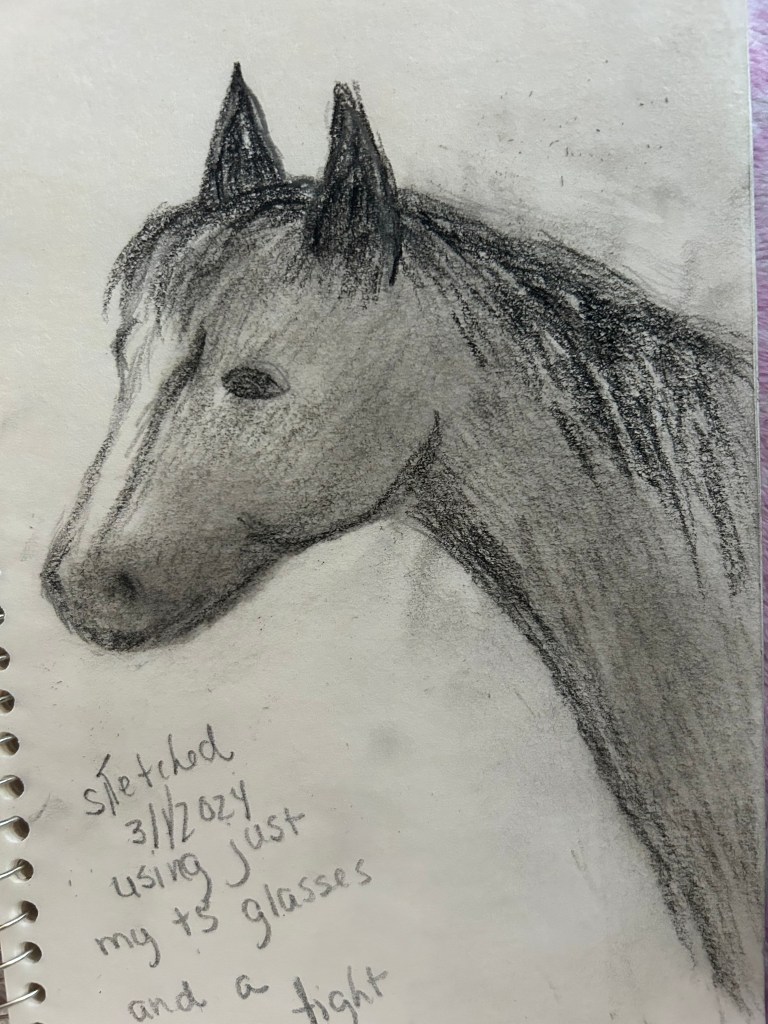
But as I have adapted to my new normal, I’ve learned to use aids to help me do what I love, so I began to sketch using nothing more than my peripheral vision and a very bright light shining directly on the sketch pad. The result was this sketch of a horse.
I’m just a hobby artist. I will never make money from my drawings or paintings, so that is not the purpose of this post. The purpose is to encourage you, my readers, to find ways to do what you love. Sure, there may be some things you can’t do no matter what your mindset, but you may be able to do more than you believe you can.
This morning I listened to a podcast by Max Lucado called “Encouraging Word.” He spoke about looking back at your childhood to discover what your passions are now. What your strengths were then may be your strengths now. We are unique individuals who bring multiple gifts and talents to the world if we choose to use them.
What interest, talent, or gift are you ignoring? Do you feel as though something is missing from your life because you are not using it?
I allowed a defeatist attitude overtake me. That attitude is gone, and I’m now focused on doing what I can while I can. Life is too short to waste time and talent. If you’re doing that, stop.
Life has taught me some difficult lessons, and it’s still teaching me. I’m sharing what I’ve learned in the hopes it will help you in case you are doing what I did, giving up.
As a hobby artist, meaning very amateur, who has always loved to sketch, color, and paint, my vision loss makes doing those things more challenging than in the past, but by using a wearable headset (IrisVision Live) and using extra lighting, I am able to indulge in my passion. I do get frustrated at times because I can’t do things as well as in the past and I don’t always like the finished product, but most of the time it’s enjoyable.
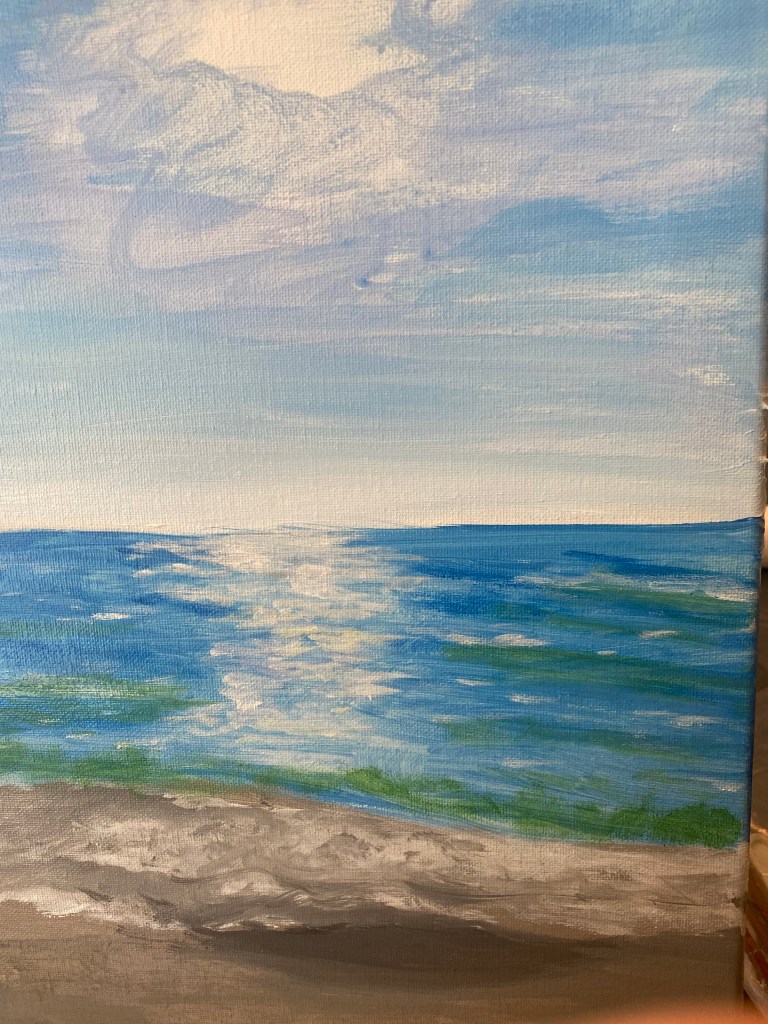
I did this acrylic painting based upon a photo sent to me by a friend while she was in Florida.
Living with vision loss is not the hopeless condition people might have believed it to be before the age of technology. We VIP’s (visually impaired persons) have a wealth of options to help us live full lives in which we can help others, indulge in our passions, and interact with others like we’ve always done. As I type this, I’m wearing IrisVision Live and using a setting that is magnifying the screen seven times larger plus typing in the XL font. I suspect I could speak these words as I do on my phone if I wanted, but I’m an experienced typist, so typing is no problem.
People with hearing loss who create music (think Beethoven), with loss of physical abilities who play basketball in wheelchairs, people completely blind who skateboard, run, swim, even paint…the human spirit is amazing!

 Life As I know it