
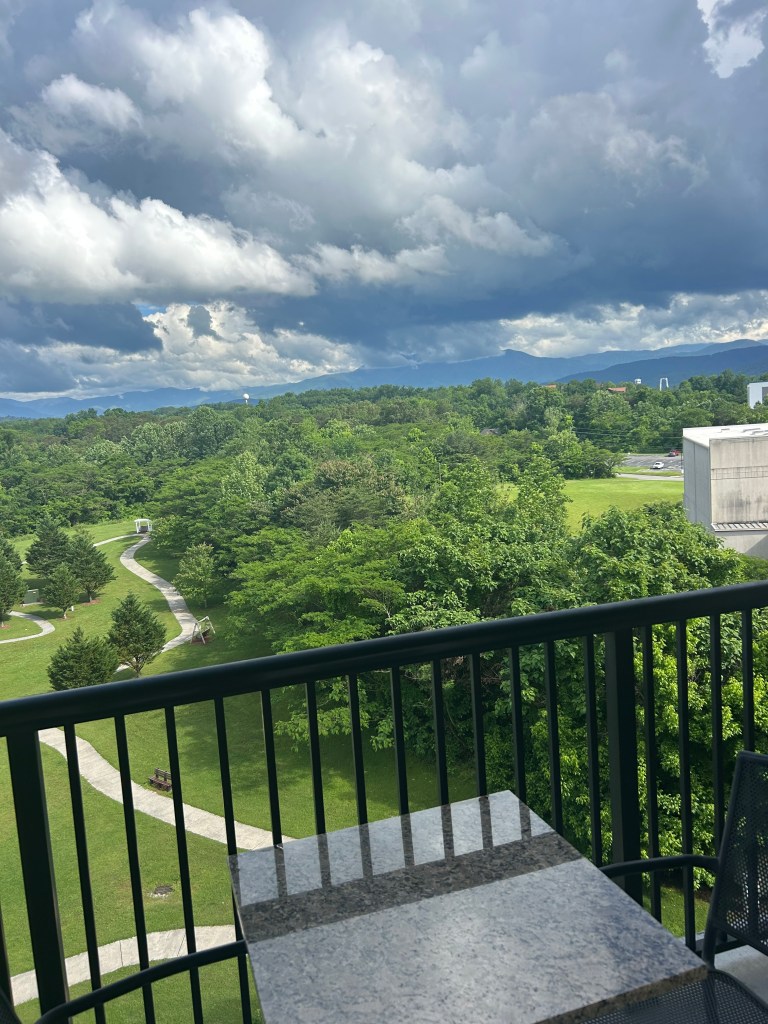
We love the Smoky Mountains, so we go at least once a year. However, I no longer enjoy the beautiful scenery as I once did. I can kind of see it but not really, but guess what? I took this photo from the balcony of our condo and with it uploaded on this site and displayed on the 47-inch television I have my computer connected to, I can appreciate the beauty that area has to offer.
I’m grateful I can at least do that.
My vision loss journey was a long one, but it accelerated in 2019 when I started noticing a fog when looking straight ahead. That fog looked like an actual cloud, and it began maybe 100 feet away from me, maybe farther. I could see everything clearly up to that point, and I could see above and below that foggy cloud, but the cloud obscured what I looked at directly.
I was devastated when that happened, but now I can tell you I’d love to be able to see that well again. Now the fog is everywhere. The only time I don’t feel like I’m looking through a fogged-up window is when I look downward. I’m then able, by using my peripheral vision, to see a slice of the world without fog.
I’m not complaining. I’m just explaining. This description ties in with life lessons I have learned. Some may even apply to you.
- No matter what you’re going through, be grateful for the good things in your life. That’s easier said than done, I know. If you have aches and pains and wish you could run around like you once did, be grateful if you can still walk on your own. Just like my fog story, your condition may worsen until you are unable to move on your own, so be grateful you can do so now.
- Don’t be afraid to learn how to do old things in a new way. We baby-boomers are sometimes resistant to learning technology, but in the world we live in, it is almost essential. No doubt we won’t ever be as comfortable with it as younger people, but I’ve been forced to learn to use Voice Over, speech to text, video descriptions for movies and television (a narrator describes the action), and how to use my laptop by having it connected to the large-screen TV. I use a screen reader to have all sorts of things read to me. If I can do those things, you fellow baby-boomers can learn to do simpler things, right?
- Reach out to others who are going through a similar struggle. You may not need their support, but they likely need yours. I have learned a great deal in two support groups on Facebook. I share tips I’ve learned, and theirs. Every now and then someone needs an emotional boost, so it helps with that also.
- Trust others. With my inability to drive , I have to rely on others. I can’t see well enough to be a “back-seat” driver, so I have no choice but to keep silent.
- Don’t judge someone by his or her appearance. I can’t tell how someone is dressed, how covered with tattoos they are (that is an issue with many in my generation–sorry, it’s just that way, not saying it’s right), or even what kind of car someone drives. I know we all make assessments of others in many ways, but my assessments are based on the person’s tone of voice, language, attitude, and actions. Even with those assessments, it doesn’t take away from the fact that there are many kind, helpful people in this world who don’t fit the social norms.
- If you’re sad, cry about it or be despondent, but don’t take it out on others. Biting someone else’s head off just because you’re feeling down and out or bitter is…unkind, selfish, and childish. Sure, we’re all going to have our times that we snap at someone or say something unkind, but don’t think you make the world a better place by making it revolve around you.
- Shut-ins are lonely and bored unless their health is so bad they don’t care or unless they are loners at heart. When my husband was working, I was stuck at home many days because the weather prevented me from being outside or walking to town to the library. I was still learning what I could and could not do with the vision loss. That gave me a new empathy for shut-ins. If you know someone in that situation, at least call every now and then if you can’t go by and visit. And if they’re able to get out a little bit, offer to take them somewhere, even if it’s just a drive around the countryside. They’ll let you know if they’re interested or not.
- Despite #7, sometimes you just have to get over it and figure things out. It may take a while, but you have to re-adjust your thinking. If you can no longer do things you once loved, find something else. It may take a while to discover it, but if you keep at it, you will find it. I can no longer read books, but I listen to audiobooks and podcasts. I can’t sketch as I once did, so I draw cartoons with a marker. (I’m still working on that one, though, using my CCTV.) I do bad watercolors that are fun to do. I play with Play-Doh. Yes, it’s not just for kids! You get the idea.
- Swallow your pride. The first time I accepted a ride with an 88-year-old woman who offered to drive me to a civic meeting, I was appreciative and embarrassed at the same time. There I was, 25 years younger and almost a foot taller, and she was the one giving me a ride. But I accepted because of her kindness. There are times people have to help me by warning me about curbs and things like that, and while it is humiliating to be the one needing that assistance, it’s often necessary, so I just have to accept it and go on.
- It’s okay to be down and out at times, but it’s not okay to stay that way. Allow yourself some self-pity moments or cry, but don’t wallow in it. Drowning in our sorrows does no one any good. There are countless people who have endured unthinkable losses, live with unbelievable disabilities, or endure constant pain who choose to make things better for others. Don’t believe me? Search YouTube for Joni and Friends. Find the quadriplegic young woman who is an occupational therapist and demonstrates how she navigates life. Search for someone going through the same difficulty you are.
Years ago, the Serenity Prayer was a big deal. I think still is. Here’s the version I use: God, grant me the serenity to accept the things I cannot change, the courage to change the things I can, and the wisdom to know the difference.
And maybe add one thing: God, help me to focus on others more than myself.
These are the lessons I’ve learned. I’m sure there are more I did not verbalize, and you likely have your own lessons you could share. I’d love to hear your recommendations.
 Life As I know it
Truly, someone should be greatful for what they despite counting on, what others have
LikeLiked by 1 person