Our local library–a gem for the community

I love putting jigsaw puzzles together. I used to spend free time with a large plywood board on my lap assembling Thomas Kinkade and similar-themed puzzles. Many were the 1,000 piece sets. When I finished, I brushed them with puzzle glue, framed them with a poster frame, and used them as changeable décor in the bedrooms of our house.

Vision loss, obviously, took that away from me. But I did discover I could put together large piece puzzles using special lighting and devices. There aren’t many, and I’ve only found 100 piece or fewer puzzles. Because they are not as beautiful as the ones I once assembled, I have no desire to glue and frame them. So why buy one? Especially when I can go to our local library and check them out.

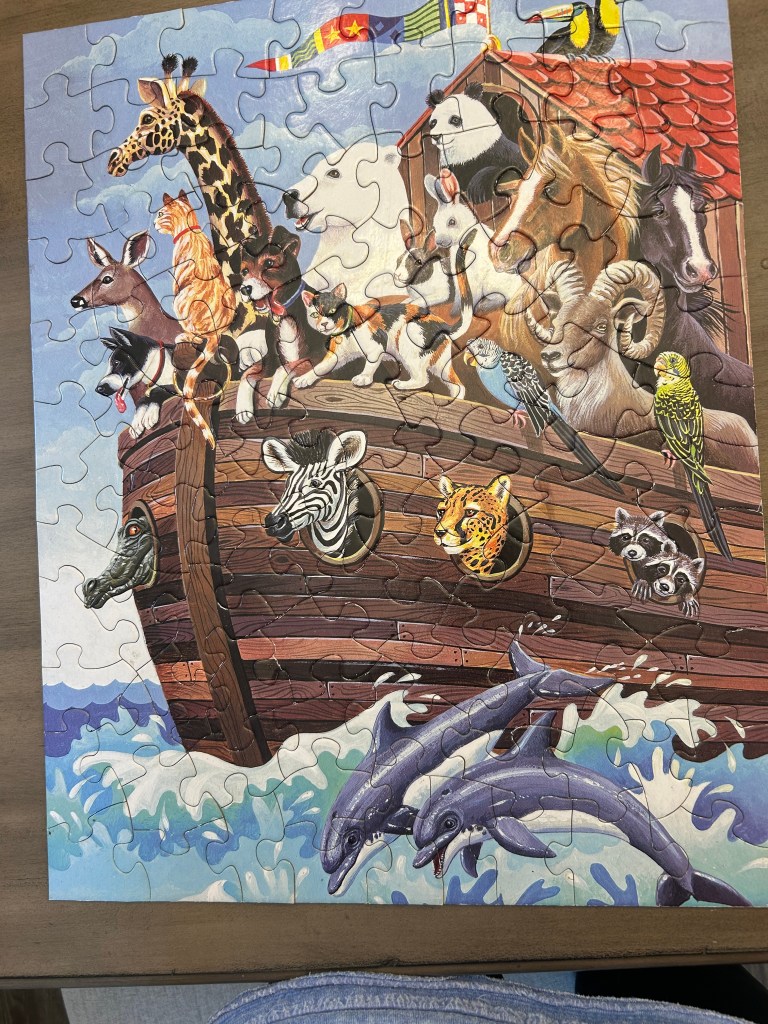
So far, I can only find the ones I need in the children’s department, but that’s okay. I have assembled beach scenes, Disney scenes, and the Noah’s ark pictured, and I’ve avoided the themes that don’t interest me like dinosaurs.

But isn’t it cool I can check them out then return them?

Like to decorate cakes? Our library has an assortment of cake pans so you don’t have to buy your own. Do family research in the genealogy room, use one of the study rooms for group study or tutoring, take your children to story time or any of the other programs offered for children, learn how to do things in the Make-it Space, record your own podcast, music, or video in the recording studio, let your children play with a light board, lLegos, and more. Teens can go to the teen room for video games. Attend free classes offered in the computer room or just use one of the multiple computers in the children’s and adult departments.

The library is a hub of community activity. It is open until 8:00 P.M. on Thursday nights. Last night there were four activities going on. An author of poetry doing a reading and answering questions in the Tennessee room. The Humanities group from the local university having selected students present their work. Another group meeting in the board room. And something going on in one of the rooms of the Event Center downstairs.

Let’s not forget the bookstore that sells used books, CD’s, and DVD’s along with old yearbooks. This is the area you can eat or drink while you read a book or just chat with friends. Vending machines, comfortable chairs, and chairs and tables provide a place to “just be.”

The large outdoor stage hosts everything from music to community-wide church services to plays. The Event Center is the location of countless civic group meetings, special celebrations such as anniversaries, prom, fund-raising dinners, and more.

For years, our town of around 11,000 had to rely on resources on the campus of the local university, but now we don’t have to do that. We have our own resource.

The library of the 21st Century is so much more than a place for books. It’s a place to gather. It’s a place for providing free services to meet the needs of the community. It’s a place for learning.

And for a book nerd like me, it’s a place that brings comfort. I can no longer read an actual book, but I have to admit I like to stroll the aisles and just touch the covers. Audiobooks are my only access to reading, and I’m grateful, but just as the former athlete finds the ballpark, gym, court, or stadium a familiar place that brings an indescribable feeling, that’s what a library or bookstore does for me.

Our local library. Your local library. Check it out. You may be surprised at what you find.

Embarrassing blind moments

Our dog and I have something in common. Read on to find out what it is.

If you read my book Learning to Live with Vision Loss, you understand what blindness is and what it isn’t. But in case you haven’t, I’ll share that 85% to 90% of people considered blind (i.e. legally blind) have some functional vision. Some may only see light and dark, but most of us have enough vision to do daily tasks using technology and other aids.

That means we sometimes think we are seeing more than we are.

In my book, I shared the funny story about the time I thought I’d killed a fly in the kitchen only to have my husband tell me, “You sure did. You definitely got that popcorn kernel.” It was a funny blind moment, not an embarrassing one.

Then there was the time we stopped at a rest area on the interstate. We have traveled I-40 in our state frequently, and when my husband parked at the rest area, he asked if I needed his help finding the facilities. I knew the area well and told him “no.” When I came back to the car, I opened the passenger door then stopped. A bag of chips was in the seat. “Wait a minute,” I thought. “I wasn’t eating any chips.” I glanced up and was shocked to see a man (fuzzy, blurry, not clear but definitely not my husband) sitting behind the steering wheel. He was speechless as he stared at me. I immediately began apologizing. “Oh, I’m so sorry! I’m visually impaired and thought this was our car!” I said it again as I backed away and closed the door. My husband was sitting in the next car watching the whole thing and unable to do anything about it. That vehicle, the same color and similar to ours, had not been in that parking spot when we pulled in.

“Well,” I told my husband when I got into our vehicle, “he’s got a story to tell for the rest of his life.” It was embarrassing but funny at the same time. Most of my VIP (visually impaired persons) friends have had similar experiences.

Recently, however, I had a blind moment that was not so funny.

I was helping serve the after-funeral meal of a dear neighbor and friend, and I was managing to recognize some people by their voices, height, and other clues I use to identify people. A young woman with long, dark hair came up to me as I was helping clear tables. She had already spoken to me in the kitchen, and at that time I wasn’t sure who she was but knew she knew me since she said, “Hi, Mrs. Pam.” After the meal, she was near the family, and I hugged her tightly, thinking I was hugging the daughter who had lost her father.

After a few words, however, she knew my mistake. “Mrs. Pam, I’m (name).” She is a close friend of the daughter, which is why she was there, and she was very understanding because she knows my situation, but still…it was embarrassing.

One of my many flaws is I am an extrovert to the extreme. I love people. I’m a hugger. (Sorry, germ phobes, it’s just an automatic reaction in many situations.) I always tell myself I’m going to change, that I will think before I speak and think before I hug, but somehow those tendencies overtake me. At my age, you’d think I would have figured it out, but obviously, I am still a work in progress.

I have countless other stories, and I guess despite the embarrassment, I have to laugh at myself. I did plenty of stupid things before vision loss, but the incidents have increased in number the past six years.

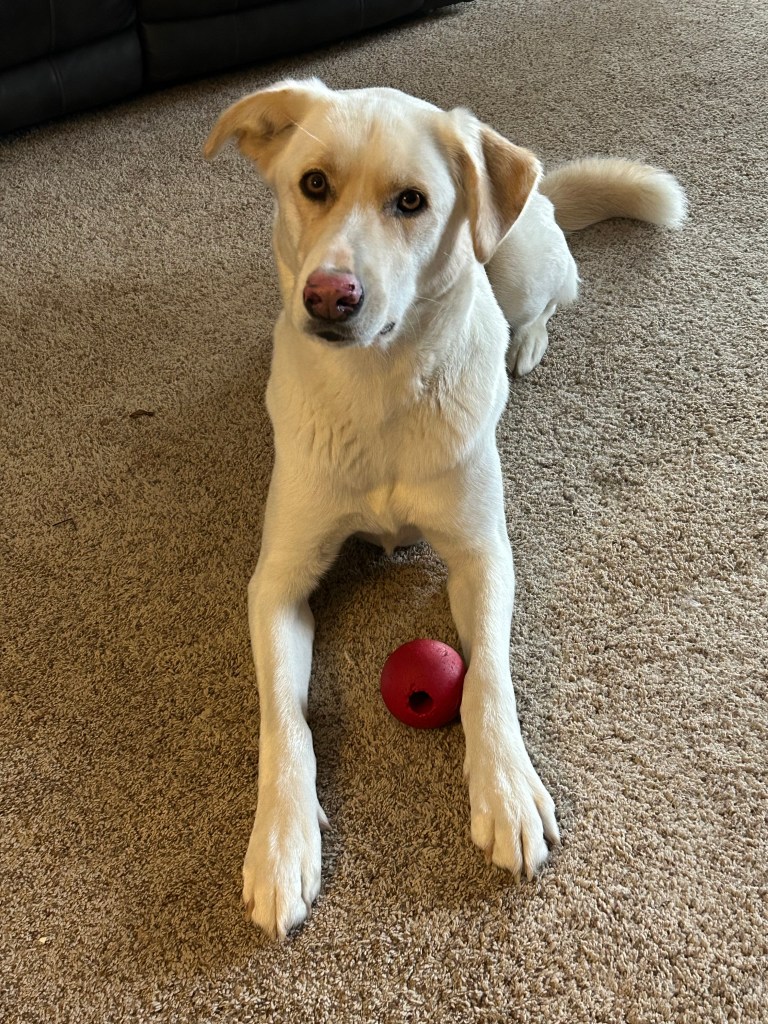
At the beginning of this post, I shared that our dog and I have a lot in common. No, he’s not blind. But he is extremely sociable. He loves people and loves other dogs. He’s excited when we take him to the kennel. When people come over, we have to restrain him at first until he calms down because he wants to be near them. As a matter of fact, he gets so excited about new people in the house, he shakes all over while his tail wags furiously.

He’s four years old, and we continue to try to train him to be calm and not want to jump up on people or bother them with begging to be petted. At least he doesn’t lick. He may never be trained completely.

I may not either. But I’m going to try. It’s the only way I can think of to avoid more embarrassing moments!

Losing Sight? Find hope.

I know what you’re thinking. “Here she goes again.” The thought is in your mind. “Blogging about vision loss. Doesn’t she have anything else going on in her life?”

As a matter of fact, I do. Lots of things–time with family and friends, trips, church activities, civic activities, and hobbies. But if not for assistive technologies, I could not do many of them.

This month is Blindness Awareness Month, and my goal is to share information so those who are going through vision loss can find hope in the knowledge that while their vision is likely to get worse instead of improve, they can still live a fulfilling, independent life. That’s not to say they won’t have their emotional ups and downs Psychiatrists say that losing vision is like losing a loved one as far as the stages of grief are concerned. Denial, anger and/or frustration, bargaining, depression, and acceptance. I understand that grief model is now being questioned and believed to be inaccurate, and I will say that for me, I never experienced denial. I accepted from the beginning. But I did experience all the other emotions.

My point? Someone losing vision can find hope, but it might take a while. They have to learn how to do old things in new ways. They have to adjust to a world that doesn’t look the way it once did, and that could take several years. In some cases, they have to adjust to a world of…nothingness.

What, then, can help these people adjust? Magnifiers from Walmart aren’t strong enough. Large-print books? Forget it.

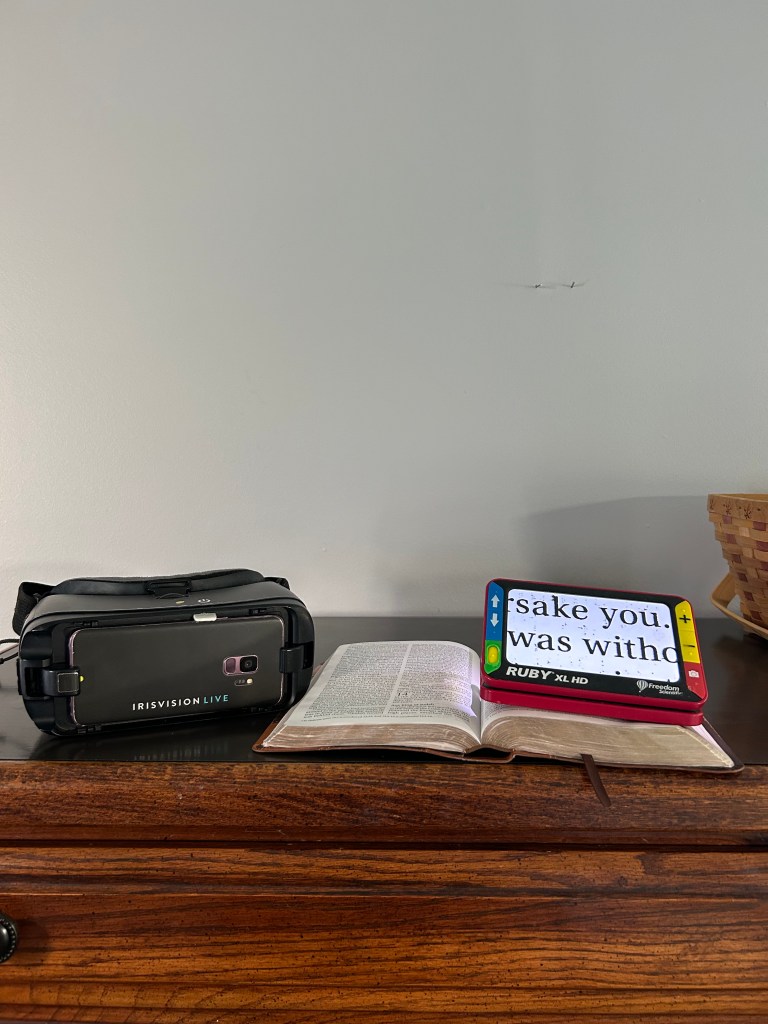
But you can still read books using audio books or even reading ebooks on Kindle by setting the background to black, setting the type to white, and setting the font as large as it will go. If you have Alexa, you can purchase an ebook on Kindle, and she will read it to you. You can go on Amazon to purchase tactile (bump) dots for appliances, remotes, computer keys, and more so you don’t have to use your sight to do those things. You can purchase a magnifier like Ruby that you can hold in your hand to read prescription bottles, recipes, cards from a friend, and check prices while shopping.

Large print cards to play solitaire, low vision cooking aids, talking scales, talking meat thermometers–they’re all available.

Free apps for your phone:

ReBokeh–a better magnifier than your phone’s magnifier and specially designed for the VIP (visually impaired persons) community

Seeing AI–hold the phone above what you want read to you, and it will read it It will describe scenes, objects, colors, and even people.

Be My Eyes–hit a large button, and it will call a volunteer who will access your phone to see what you can’t. The volunteer will help you do everything from finding a prescription bottle to describing a piece of clothing to identifying the can of soup you need from your pantry to reading the frozen food label. By the way, puff paints can work for identifying canned goods and spices.

There is hope. In our area, reach out to the STAR Center in Jackson. Each state has help for the blind, so contact them to get the services you need. I realize I’m writing this as though a person with vision loss can read it, but it is more likely a sighted person is reading it and thinking of someone they know who might benefit. Please help them find these resources. And for those of you who have been dealing with vision loss and adapting for a while–well, I know you’re listening to it as your phone or computer reads it aloud to you!

My book Learning to Live with Vision Loss has more detailed information including resources. Available on Amazon, it’s $2.99 as an ebook and $5.99 as a large-0print paperback. It’s free if you have Kindle Unlimited. It is my hope the book will help someone learn to adapt to a new normal.

“There she goes again,” you may be thinking. “Promoting her book.” In a way, yes. Not to make money. I’ve given away almost as many as I’ve sold.

For me, losing adequate vision to do many things I loved was devastating. It took a while to learn, adjust, and adapt. But I’ve done it, and I can now find joy and purpose in life. I know there are much worse things in life than losing vision, but honestly, when you’re the one going through it, it may be difficult to put things in the right perspective. The suicide rate among the blind/legally blind community is three times the national average.

So I hope this blog will help at least one person begin a journey of hope and accomplishment. For additional motivation, watch Losing Sight?, Finding Hope on YouTube. I think it will inspire you.

Blind, but I’m back!!!

After falling into depths of depression because of my vision loss and giving up writing in any form, I have managed to pull myself out of the canyon of self-pity and despair to connect once again with what I most love to do.

Write.

Write anything. Fiction, non-fiction, blog, essays, you name it. I love to write.

My curiosity about the world and other people prompt me to think others are as interested in those things as I am, and this blog is so random in topics, I’m not likely to attract a huge following. I considered creating a new site with a specific target audience, but I decided I would keep things the way they are. I’m going to write about what interests me, about things in my life, and about the world in which I live.

What does that mean exactly?

It means I’ll write about living life as a legally blind person. I’ll write about interesting people and places. I’ll write about observations. I’ll write about activities.

You know, random stuff. And maybe I’ll entertain, inspire, and inform along the way.

You may be wondering about how I’m writing this as a legally blind person, but I have some functional vision that allows me to use assistive technology to work on the computer. I’ve learned a great deal in the past two years, and I like to think I’m wiser. Older, for sure, but hopefully wiser as well.

If you’re reading my blog for the first time, I invite you to scroll through my previous posts to see if there are any topics of interest to you. I invite you to comment and share your own thoughts and ideas. Most of all, I invite you to be a part of my life as I know it.

I’ll have an announcement soon about a writing project, but until my next blog post, thank you for stopping by!