
What Drivers Need to Know about the White Cane Law

Did you know if you violate this law you could end up with a fine, in jail, or even worse?

October is Blindness Awareness Month, and October 15 is White Cane Safety Awareness Day. All 50 states have some form of White Cane Law, but the information I share is specific to Tennessee. What follows is an article I wrote for the local newspaper in my ongoing commitment to educate the public and the visually impaired about issues related to vision loss.

What Drivers Need to Know about The White Cane Law

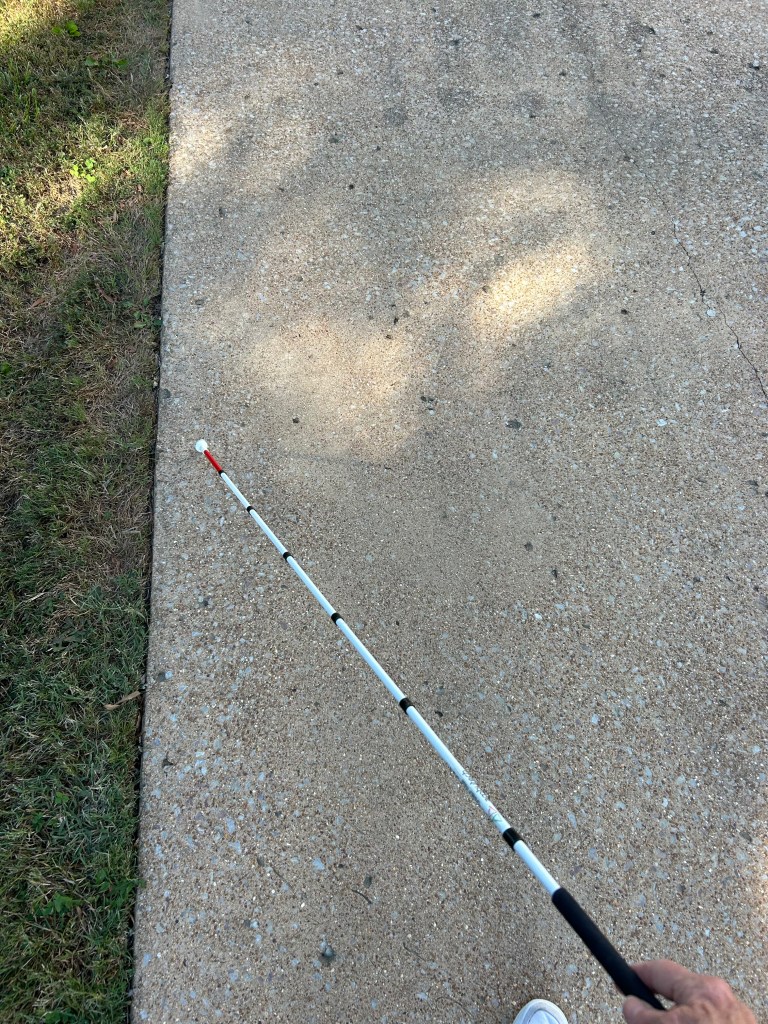
Maybe you’ve seen me walking downtown and wondered why I’m using a white cane with a red section at the bottom. After all, I don’t appear to be blind. I walk quickly and seem to move along without too much assistance from the cane. But there’s a reason I use it.

And maybe you’ve been one of the few drivers to stop for me when I’m waiting to cross the street. If so, you were obeying the law. If not, you were breaking it.

October is Blindness Awareness Month, with October 15 being National White Cane Safety  Day, and while you may think blindness has nothing to do with you, it does if you drive. As a matter of fact, deafness is another factor to consider. The White Cane Law (55-8-180) was passed in Tennessee to protect blind or visually impaired pedestrians. The Driver’s Manual explains it as follows: When a blind or visually impaired pedestrian using a guide dog or carrying a cane, which is white in color or white with red tip, or a hearing impaired person with a dog on a blaze orange leash is crossing any portion of the roadway, even if not at an intersection or a crosswalk, take special precautions as may be necessary to avoid accident or injury to the pedestrian. Stop at least 10 feet away until the person is off the roadway. Do not use your horn, as it could startle the blind pedestrian.

Notice the terminology used is “blind or visually impaired.” Only ten to 15 percent of people considered to be blind have no light perception at all. The other 85 to 90 percent have some light perception and often some functional vision. I fall in that category.

When I became legally blind over five years ago due to a rare condition similar to age-related macular degeneration, I began searching for ways to live a life as independent and normal as possible. The inability to drive meant I was confined to my home or neighborhood while my husband was at work, and for an otherwise healthy, active, and sociable person like me, that was not acceptable. While friends often offered rides to events and offered to take me to stores, I hated asking them to do so and limited myself to accepting rides if they were going anyway. I did not want anyone making a special trip for me, and there was no way I was going to text someone and ask them to take me somewhere. The Northwest Tennessee Transportation service was an option I used occasionally, but you had to schedule your trips at least a week in advance, and because of the driver shortage, I was limited on what days of the week I could use the service for personal reasons.

I received technology training and cane training from The STAR Center in Jackson, and that meant when the weather was all right to do so, I could walk downtown and go to the library, restaurants, the bank, and shops.

But the white cane with the red tip that I use as an identification cane is not always the magic wand that stops traffic. More often than not, cars do not stop for me at crosswalks, and I am limited in where I can walk as I fear crossing University Street because I have no idea if the sign across the way says it’s safe to cross. It’s possible there is a way to have it announced to me, but even so, I’m not comfortable crossing heavily traveled roadways.

I can see cars when they’re about ten yards away from me, but because they are traveling faster than someone walking, they reach where I am standing in seconds. I listen for cars and can tell if they’re leaving or approaching. I can tell when they’ve stopped. At that point, I’m brave enough to step into the crosswalk and cross the street.

An acquaintance of mine in the VIP (visually impaired persons) community lives in near Nashville, Tennessee. She attended a week-long residential program to learn how to walk using a cane with confidence in a city setting. When she returned, she was excited about her new skill and was anxious to show her husband what she had learned. But when they began to cross a busy four-lane, a vehicle turning left almost hit her.

The ironic part of this? It was a police officer.

Her confidence shattered, she called the police chief and told him what happened. He addressed the issue immediately by implementing training with his staff regarding the law.

Failing to stop for a pedestrian as described above is a Class C Misdemeanor, and drivers may be fined or even put in jail, depending on the seriousness of the violation.

It’s possible I’m the only person in our town using the white cane, and it may be no one in our town uses a guide dog. It may be that others who are hearing impaired or visually impaired have no desire to venture out on their own. But I have a feeling there are other independent, active types like me who want to live as normal a life as possible without fear of being hit by a vehicle.

So, the next time you see someone with a white cane, a guide dog, or a dog with a blaze orange leash waiting to cross the street, stop. Not only is it the law, it’s the respectful thing to do.

Why I use a white cane–sometimes

I hesitate to write about this because I’m afraid you’re thinking, “There she goes again, writing about vision loss. Let it go.”

But I feel the need to explain for my benefit as well as the 85% or so of the blind community who are like me, who are not completely blind and likely have more vision than you think we do. We have functional vision.

The truth is, I don’t need a cane to walk in most places. I can see the road, the sidewalk, the floor, etc. But when I’m walking outside, by myself, I CAN’T tell if there is a rise in the sidewalk, a dip, maybe a small obstacle. I can see garbage cans just fine, although I don’t know they’re garbage cans until I’m about ten feet away. Maybe that dark shape is a person. Maybe it’s a tree. Maybe it’s…what?

I used to walk my dog in my neighborhood without a cane. Until I fell because there was an obstacle in the road I didn’t see. I knew that blob of concrete was there, but I had forgotten, and the next thing I knew, I was on my hands and knees and had blood pouring down my leg. Luckily no broken bones.

I use my cane when I walk to town on my own. My husband hates for me to do that, but he hates even more for me to be unhappy because I feel trapped in my house and neighborhood or feel dependent like a much older woman, not the healthy, active woman that I am. You want to feel embarrassed? Accept a ride with someone in their nineties. They’re still driving. You’re not. You appreciate the offer, but it is humiliating.

It is also humiliating to use a cane when you’re not completely blind. You feel as though people see you walk around that garbage can with no problem or cross the street (after stopping and listening carefully for cars). “She’s not blind,” they might think. “She’s just wanting attention.”

Nothing could be further from the truth. It is embarrassing to use that cane. But it signals to drivers that I can’t see them until they are maybe 10 or 20 feet away from me. They are more cautious and observant so I can cross the street feeling safe.

I use it in stores when I’m on my own because if I ask a clerk where something is, the clerk is likely to point and say “over there.” If they see the cane, they are more explicit or take me to the area I requested. I don’t use it at Walmart. I use my wearable headset to look at shelves or items when needed, and people soon figure out I can’t see so well. Or I use my ReBokeh magnifier on my phone or my Seeing AI app that will read aloud to me.

You may be wondering why I do things on my own. Why not just wait and go with someone? Well, first, I’m independent. I hate being dependent on anybody for anything. Second, I get really, really, really bored being at home most of the time. Some of you are homebodies. That’s great. I’m not. I like to be out and about and have my comfortable home as a place to come home to, not a place that sometimes feels like a prison instead of a refuge.

So I use the cane. I have to weigh my embarrassment against my restlessness and boredom, and the embarrassment pales in comparison.

In my vision loss journey, I am determined to learn strategies and adapt to be able to keep my independence and do things for myself. I cannot be that person who wants others to do for me.

I hope this blog will help you to understand people like me. I hope you will spread the word that not everyone that uses a cane is completely blind.

The cane is a tool. It doesn’t help me balance, but I don’t need help with that. I don’t need it in buildings that have smooth floors, although it’s very useful at the airport since it keeps people from running into me as they rush along to wherever they’re going. And, oh, I wear sunglasses outside for the same reason you do. To protect my eyes and avoid the glare. The glare for someone like me can be painful.

As always, thank you for taking the time to read this blog. To my VIP friends, I wrote this for you as well as me. We say we need to educate, so that’s what I’m doing.

What does it really mean to be blind?

When people think of “blind,” they normally think of someone like Stevie Wonder, who is completely blind due to being born prematurely and lacking oxygen, which destroyed his eyesight.

But completely blind people, meaning people with no light perception at all, only make up 10 to 15 percent of the more than one million people in the United States considered to be blind. The other 85 to 90 percent have some light perception and even some functional vision. Another estimated four to six million people in the U.S. live with vision loss that cannot be corrected with glasses, contact lenses, or medical treatment.

October is Blindness Awareness Month, and since joining that one million in February 2020, I have made it my mission to learn how to live as normally and independently as possible utilizing techniques and assistive devices and apps to enable me to do most everyday activities. I will write about those things next week.

People in the VIP (visually impaired persons) community want those of you who are sighted to understand a few things. First, blindness is a spectrum. It is different for each individual. For me, I have no central vision in either eye and some peripheral loss, and the amount of vision I do have is 20/400 or sometimes 20/300 in the right kind of lighting. My friend Trent, however, has no vision at all in one eye and extremely cloudy vision in the other due to cornea issues. Diane has lost all vision in one eye due to glaucoma, and the other eye is declining rapidly.

I have more functional vision than either. I can see to walk just fine, although I have tripped over objects or dips in the sidewalk/road. I can cook using specialized tools, although I usually have some spills or make a mess. I clean my house, do laundry, do all the normal things a sighted person does.

But I can’t drive, I can’t read. I can’t see people’s faces. I can’t see the house next door if I look directly at it, but I can see it if I look up to the sky or down to the ground (peripheral vision). Like Trent, I have a constant fog, although it’s not as bad as his. I can see a car if it’s as close as 10 yards from me, but my blurry distance vision can only make out shapes if anything at all. Yet I have functional vision. And with the devices I use, I can function very well.

Confused? Of course you are. I would be, too, if I wasn’t on this journey. Sam Seavye of “The Blind Life” on YouTube has a great shirt available that says it all: I can see, but I can’t. It’s complicated.” Yes, it is.

I think I speak on behalf of the VIP community when I say that, as difficult as it is to understand, we have some days of better vision than others. We can do more than you might think possible, but at the same time don’t assume just because my peripheral vision picked up that dirty sock on the floor that I can see what you can. Understand that distance matters. Understand that lighting matters. Understand that contrast matters.

The term for people like me is “legally blind.” You might say you’re legally blind without your glasses, but you’re not. Legal blindness means you can’t see the big E on the chart even with glasses. Legal blindness might mean you only have a 20 degree field of vision when the sighted world has 90. Legal blindness might mean you see nothing more than light and dark.

For most of us, our vision continues to decline. We go along for several days and maybe even weeks and begin to think, “Well, I think it’s stable,” but then there’s a sudden drop. Most of us have had days of depression (or months or years), and we still experience frustration. But we accept. We have no choice.

My purpose in writing this? My mission is to educate the general public, inform the VIP community about ways to live an independent life, and offer support to those new to vision loss so they can have an empathetic ear. It always helps to talk to someone who understands what it is you’re experiencing.

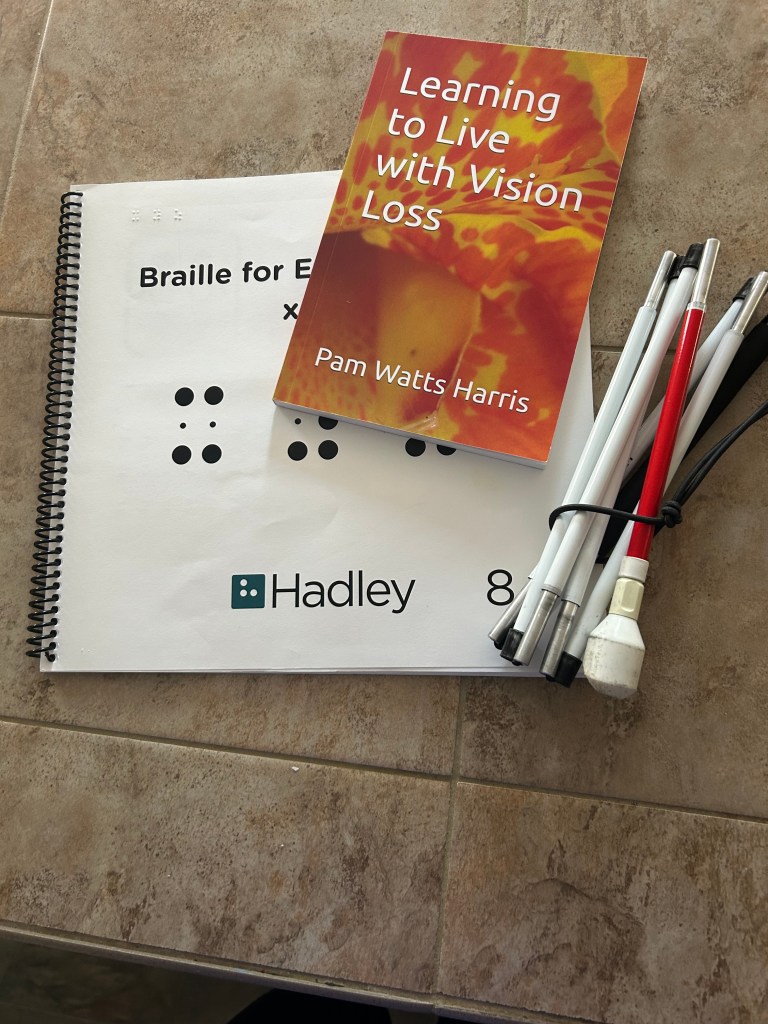
I hope you’ll read my blog next week when I write about the devices I use and some of the apps. And if you’d like more detail, my book Learning to Live with Vision Loss is available for $2.99 as an ebook and $5.99 as a large-print paperback. Sorry, no audiobook, but if you have Alexa, you can purchase the ebook, and Alexa will read it to you.

Thanks for taking the time to read this lengthy blog. Please help spread the word: there IS hope after vision loss.