
Eleven. That’s the number of family and friends of mine who have lost a child. People in my own extended family. My friends. Not acquaintances, not co-workers. My friends. They, along with the fathers of their children, belong to a fraternity no parent wants to join.
That number doesn’t include those who have known the heartache of miscarriage.
That number does not include my friends who have lost a grandchild.
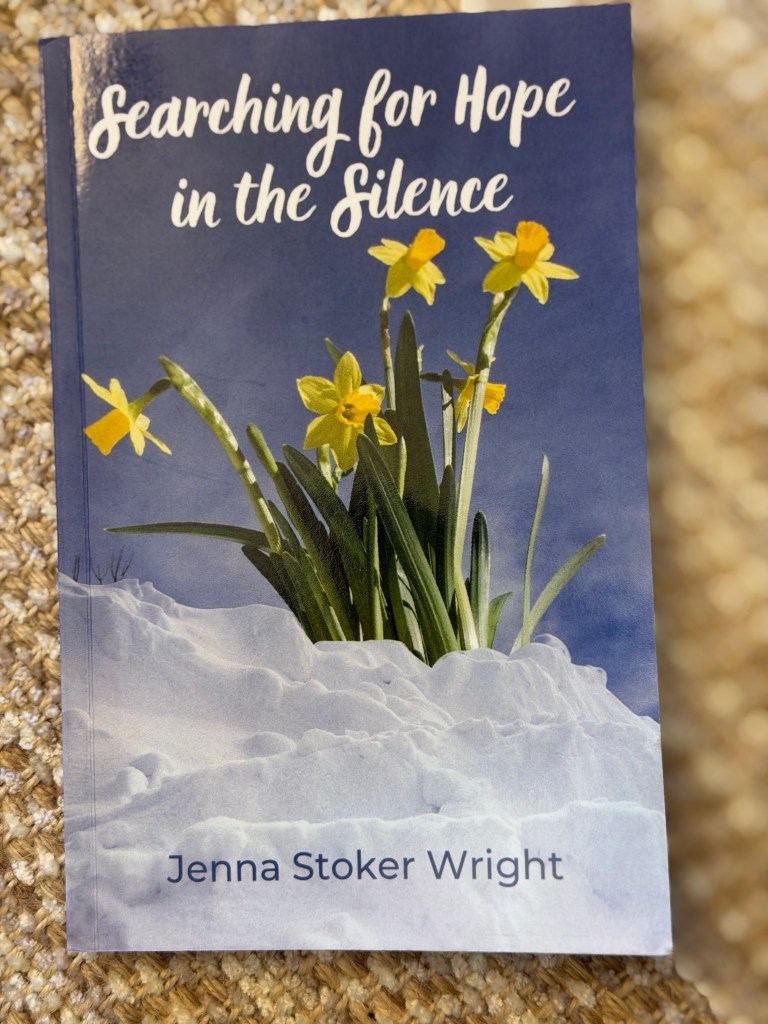
It does include the author of the book Searching for Hope in the Silence, Jenna Stoker Wright. In 1977, she and her husband lost their first child and only daughter to cancer. This book chronicles their short journey of learning about their daughter’s illness, their experiences at St. Jude Children’s Research Hospital in Memphis, and her emotional roller coaster of hope then grief and anger. She is honest about their experiences and honest about her emotions. I would think anyone who has lost a child can relate.
Part two of the book shares her relationship with her mother. A self-proclaimed “Daddy’s girl” (to which I can relate as I was very much a Daddy’s girl), her honesty shines once more in her account of the relationship she and her mother shared and the experiences of her mother’s life that impacted her. Like me, she loved her mother, but also like me, it was her father’s approval she craved and whose influence guided her. But also like me, she can look back now with fresh eyes and understand the positive examples and influence of her mom who gave up a beloved career in nursing to live in a small town and raise their only child.
The third part of the book describes the joy brought to them by their son, born about two years after their daughter. Having another child was not an easy decision since they feared the same fate would befall future children, but doctors reassured them it was highly unlikely. The result was a healthy baby boy who grew to be an intelligent, successful man. A line from this section of the book I am paraphrasing was that eventually the moments of happiness and joy outnumbered the moments of sorrow. The ache of loss, however, never went away and remains with her today.
One of my friends, whose granddaughter was killed in a tragic accident at a young age, once told me that you never get over grief. You just learn to live with it.
This book did make me cry, but it also made me smile. A person of a strong Christian faith, Jenna doesn’t sugarcoat her feelings during the most difficult days. She does, however, share how her faith is what sustained her then and what continues to sustain her now.
Would I recommend this book to someone else who has lost a child? Well, that depends on the person. If you are the kind of person who finds some amount of solace in talking with or reading about others who have experienced something similar to your own journey, I most definitely do. If you are the kind of person who chooses to block all memories of your ordeal, I don’t.
But I do recommend it to everyone else. Too many times we are upset about things that, in the long run, really don’t matter. Reading a book like this can help us be more grounded and put life into a better perspective. Reading a book like this gives a connection to the author and others like her so we are able to sympathize and help in more productive ways.
When her daughter was diagnosed with leukemia, the survival rate was only 10%. Today, the survival rate of childhood leukemia with five-year survival rates of over 90% and for infants with acute leukemia, more than 60%.
When Danny Thomas established St. Jude Children’s Research Hospital, his mission was to eradicate childhood cancer. Thanks to their research and the research of other organizations, that mission is ongoing and showing promise of success. Someone once asked me if the Catholic Church operates St. Jude’s. The answer is “no.” Danny Thomas was a Catholic, and St. Jude is the patron saint of desperate situations and lost causes, symbolizing hope and perseverance in challenging times.
This book does the same.
It is available on Amazon as a paperback and an ebook. If you read it, I hope you appreciate it as much as I do.

 Life As I know it