When life robs you of what you love to do and an unusual but delicious chicken enchilada recipe

Oh, my, here I go with another Elvis theme, but I didn’t want to share my sketches or bad paintings, so here it is. I started this project in 2006 when my sister-in-law and I visited the quilt museum in Paducah, Kentucky. The quilts there were true works of art, and one of the winners was a Beatles quilt. She gave me the idea of making an Elvis quilt, so that’s how it began. As time went on, I got lazy and just bought some fabric withElvis to fill in the squares. I did not do the actual quilting–I just drew the patterns and pieced the quilt together and paid someone else to do the quilting.

It is not a work of art, but it was fun, and if you know anything about Elvis, you will recognize the symbolism in the squares. The gold records, the teddy bear, the Bible (the black book), and so on.

People who enjoy arts and crafts have a need to create. They see the world differently, and probably they are people who feel deeply and who contemplate life a little differently. They (we) get craft ideas from the most random places. Anything–even a blade of grass–can generate an idea.

Just as sports fans are the competitive types who thrive on watching game after game after game and never seem to tire of it, we artsy folks either stick with a particular creative outlet or jump on the trend bandwagons to try. new things.

Me, it all started with coloring and sketching at a very young age. I used to draw, color, and cut out my own paper dolls. I created my own comic books and magazines. Then, at the age of ten, I began to learn to sew, using Mom’s old treadle sewing machine. One of my favorite classes in high school was home ec, and the sewing continued as well as learning how to cook, another skill Mom taught me at a young age.

The college years brought cross-stitch and macramé into my life. I made things for myself and others, and Mom loved the purses and towel rods I gave her. A cake decorating class (thank you, Nancy, for telling me about that and doing that with me) taught me skills I still know today. The sketching continued and expanded to oil painting, acrylics, and even watercolors.

Vision loss has robbed me of the ability to sew, do cross-stitch, even sketch like I’d like to do. But I’ve discovered the round looms on which to make toboggans (caps), so I do that. I do abstract water colors, fit only for me to see because they’re not good, although my precious granddaughters seem to think my Nemo water colors are pretty cool. The innocence of childhood, right?

When I was teaching Spanish, I taught the students to made god’s eyes, using dowel rods and yarn, and it hit me yesterday that I could do that despite my vision issues, so I went on the Walmart website and ordered the 8-inch dowel rod pack. I don’t know what I’ll do with them when I finish them, but the process will be fun.

My point in all this? Sometimes life robs you of things you enjoy, and you have to search for ways to continue. We’ve all heard about Beethoven’s hearing loss and how he composed masterful pieces, but most of us are not a genius in what we do. But that doesn’t mean we can’t explore other ways to enjoy what we love.

Sure, I’d love to be able to sew again. I’d love to be able to sketch as I used to do. That was and is my first love. Sure, it makes me wistful and even teary at times. But I keep doing what I can while I can. If there’s anything vision loss has taught me, it is that you can never count on the future. All you can do is count on today.

But, hey, even totally blind people can read this blog? How? There are accessibility features on phones and computers that read things aloud to them. Even totally blind people can cook. Really! Just watch some videos sometime. And the recipe I’m about to share–well, even if you think you can’t cook, you can do this!

Chicken Enchiladas (from my husband’s aunt Martha)

5 to 6 chicken breasts

One 8 oz. block cream cheese, softened

One small onion, chopped

One can green chiles

6 or 7 soft flour tortillas, taco or fajita size

1/4 stick butter

16 oz. whipping cream

8 to 10 oz. shredded sharp cheddar cheese

Instructions:

Boil chicken until tender, probably 15 minutes. Drain and allow to cool.

Sauté onion in butter (I’m sure this could be optional, you could leave out the onion if you wanted) and add onion and green chiles to softened cream cheese. Mix well. I use a hand mixer for this step, but if the cream cheese is soft enough, you could use just a spoon. Shred chicken and add to mixture. Fill each tortilla with the mixture, fold, and place fold size down in a sprayed 9 x 13 glass dish. Pour whipping cream to cover well. Top with shredded cheese and bake in pre-heated oven at 350 for 30 minutes.

The Pickle Ball craze and a buttermilk pie recipe

Mention “kitchen” to people these days, and their thoughts may not go to that room in your house where food is prepared. Instead, they might envision the area in front of the net of a pickle ball court.

That’s right. The kitchen is part of a pickle ball court. I have no idea why.

Nor do I have any idea why it has taken so many years for this game to catch on. After all, three men in Washington (state) invented it way back in 1965. I never heard of it until recent years, and chances are, you hadn’t either.

But to say it is all the rage now is an understatement. My husband loves it. He wasn’t that interested when, a few months into his retirement, a friend invited him to play with a local group. The first outing was enjoyable, but he had to learn the aspects of the game. As time went on, he became passionate about it.

Apparently, he’s not alone. According to the Internet (and who doubts the Internet?), approximately 20 million people in the U.S. currently play pickle ball. My husband and his ever-expanding group of Monday-Wednesday-Friday morning players number around 20 total players although game-day participants are usually less. Most play one or two days a week. He plays three. Go by those courts at night, and they’re crowded with younger players.

You can buy a cheap paddle at Walmart (not recommended if you want to get really good) or go online or to Dick’s to purchase the paddle that will give you the ability to hit the ball most effectively. And while you’re at it, you might want to consider some safety eyewear. Those balls come in pretty hard and fast.

It’s great exercise, no doubt. It’s also a great way to get injured if you’re not careful. Wear the right shoes. Be smart. If you’re 65, you probably don’t need to make a flying dive to hit a ball just to score a point.

You competitive types know what I’m talking about. You tend to lose common sense in the heat of battle. Me, I’m not competitive at all with others. I’m just competitive with myself.

We were in the Philadelphia airport on July 5, and a family sitting near us struck up a conversation. When the wife found out my husband played pickle ball, she told her husband, and he immediately went to my husband’s side and started talking about the game, including showing him videos of equipment and more. They were from California and at least 15 years younger, but that pickle ball connection was like a fraternity or sorority kinship.

I played tennis in high school and college, and I loved racquetball when it was experiencing its own craze. Both seem much less popular, and I have no doubt pickle ball will eventually lose some of its momentum. But for now, it’s all the rage. Go on YouTube and look at all the instructional videos, the competitions (I think even former tennis players like Andre Agassi?), the tournaments, explanations of scoring, and more. It’s all there. But, of course, everything is on YouTube. What did we ever do without it?

To all you pickle ball players, I’m glad you are doing something active instead of playing video games or being couch potatoes watching one streaming show after another. I’m glad you retirees have discovered a cheaper, less frustrating alternative to golf, and likely better cardio exercise unless you walk the course, which I doubt anyone does.

As I said, I believe something will replace it someday. Until then, enjoy. And burn lots of calories to offset the calories in this easy-to-make buttermilk pie!

Buttermilk Pie (this came from my husband’s grandmother’s recipe collection, but I think it is now on All Recipes)

1 1/2 cups sugar

1 cup buttermilk

3 eggs

1/2 cup Bisquick

1/3 cup melted butter

1 teaspoon vanilla flavoring

Grease or spray pie pan. Mix all ingredients and pour into prepared pan. Bake in preheated oven at 350 for 30 to 35 minutes or until knife inserted comes out clean.

Newspapers and magazines…are they going away?

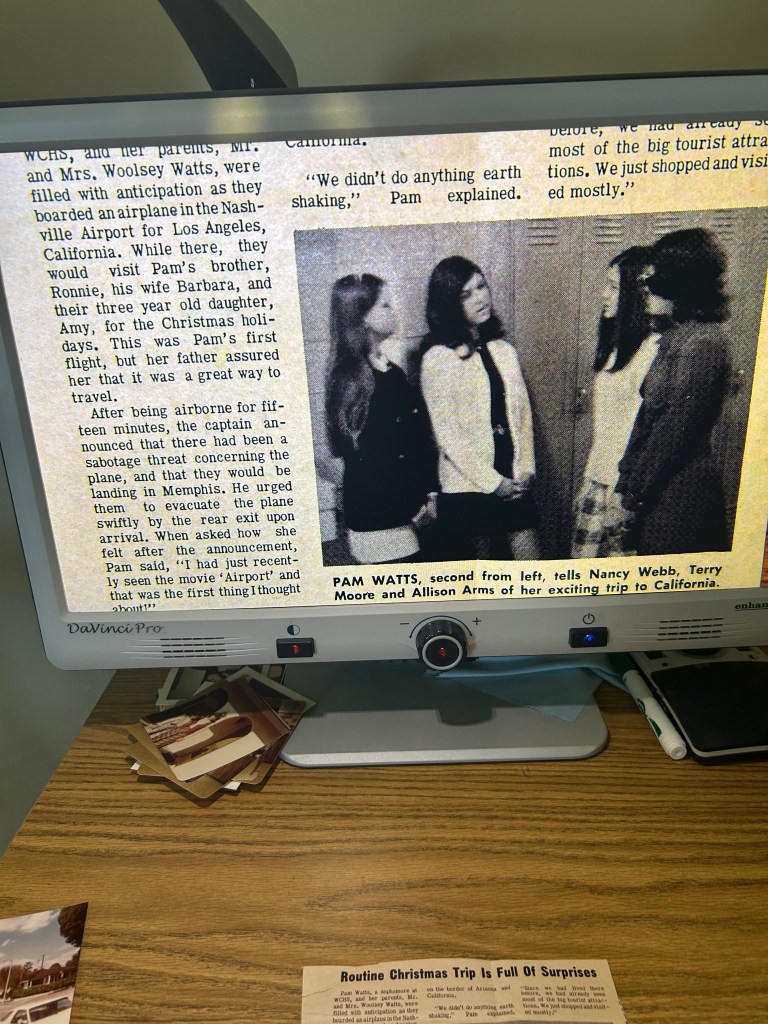
Mom kept any sort of newspaper clipping that mentioned anyone in the family by name or in a photo. Honor roll lists, a fuzzy image in a crowd, you name it. This clipping is from my school newspaper when a fellow student interviewed me following our return from a trip that involved a bomb threat on our plane. Yes, we had to make an emergency landing. No, no one was hurt. Yes, it was a little scary when the pilot announced what was going on, but at 15, I was more interested in the cute soldiers on board.

Don’t judge me.

I have boxes of clippings, and I can’t bear to part with them. They represent events that were important in our lives. Yes, they’re faded, and I can no longer read them. But they’re a tangible moment of the lives we’ve lived.

What will the younger generation have? Will they be able to open a box and find articles and photos of over 50 years ago, or will they have to find it on the Internet ? Maybe they can bookmark it? Will Facebook and Instagram exist 50 years from now? No one knows, and I won’t be alive to find out.

But I wonder.

With the digital and social media age, newspaper and magazine circulation have dropped. I often say my dad, a newspaperman to the core, would be turning over in his grave if he could see what is happening to his beloved industry. And magazines…oh, how I loved magazines. Tiger Beat, 16, and Seventeen eventually gave way to Glamour, Good housekeeping, Prevention, and Southern Living, in that order. You could see the progression of my maturing and age simply by looking at the magazines I was reading.

I loved the articles. I loved the photos. I even found the ads interesting.

Yesterday I had a dental appointment, and the small waiting room had something missing, something that was always in a doctor’s waiting room. Magazines. Not one magazine on the tables. No magazine rack.

And why should there be? People don’t read magazines. They scroll their phones. A lot. (Allow me to vent for a moment. Do you have any idea what it’s like to be unable to scroll your phone because of vision issues and surrounded by people who are scrolling theirs, sharing with each other photos they see, talking about what’s on their screens while I sit and twiddle my thumbs? Or when I’m talking to someone in the room and they pause before answering, and I realize they were reading their phone and didn’t hear me clearly? Okay, I feel better. Vent done.)

The world is changing quickly. Technology is improving our lives in some ways and making it worse in others. Newspapers still exist, and many places have digital archives of older newspapers, which is great. But what will it be like if and when newspapers disappear completely?

Something, I’m sure, will take their place, and the people living in that world will accept it without question. I’m sure I’m just being one of those older people who lament what used to be and talk about the “good old days,” which sometimes weren’t that good. Life with dishwashers and microwaves is definitely easier.

I have never forgotten the details of our “bomb threat” flight because of two newspapers–my school newspaper and the local newspaper. The facts are there, so I don’t have to rely on my memory. What was once news is now my story. My history. It’s a segment of my life.

I know digital is better for the environment. I know it is less costly to produce. I know the quality of print and photos is better.

But just for today, I want to recognize the value of newspapers. They have captured and continue to capture events in their local communities. They give room for opinions to be expressed (I know Facebook has plenty of that), they run ads that let us know what sales are going on or what services are offered, and they keep us informed in a variety of ways. They continue to serve a purpose.

So to those of you still working in the newspaper industry and trying to keep your publication alive, thank you. Thank you for your reporting on things that may be boring to you but interesting to someone else. Thank you for going to that high school or middle school game, taking the photos, and writing about it. Thank you for printing announcements, obituaries, and property transfers (ha, ha–not sure about thanking your for the sheriff’s report or police report. I always feel sorry for the family members.) Thank you for producing a quality publication on a limited budget. And…thanks for the memories.

Cursive writing–important or not? Plus a fresh apple cake recipe perfect for fall

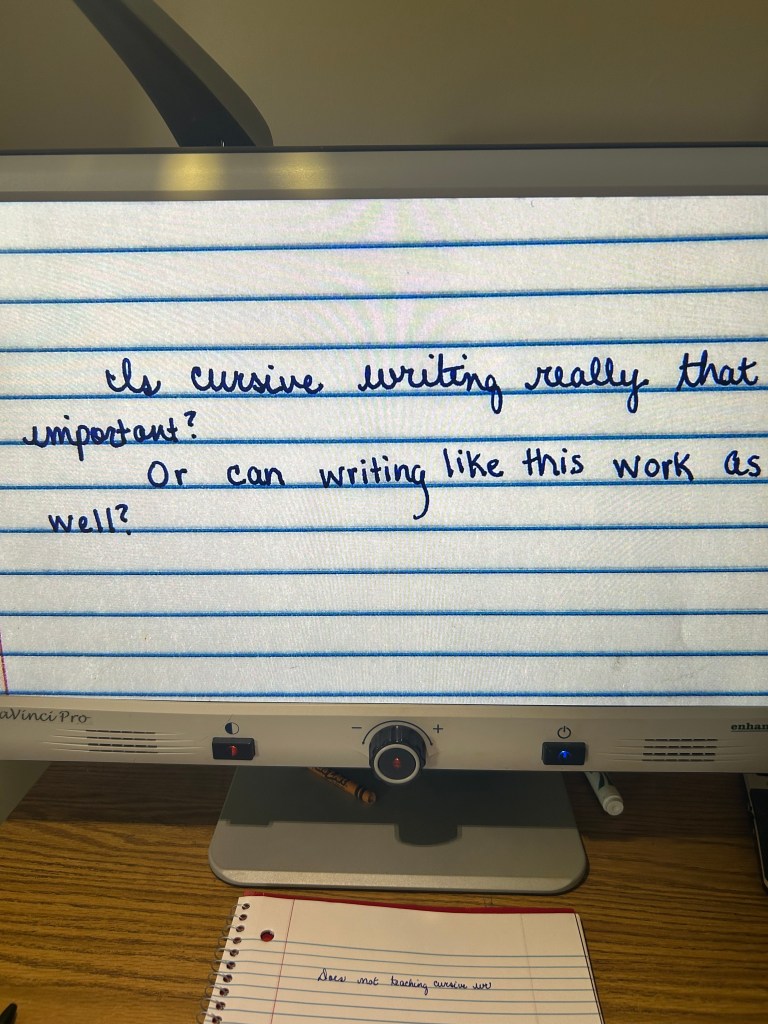
I once heard a man about my age say that the United States was dumbing down education because cursive writing is no longer taught.

You may agree. I don’t.

(Photo explanation to those of you new to my blog. I am visually impaired and cannot see to do things like people with sight, so I use devices. The device I use to write things like I the above picture is a CCTV.)

Cursive writing evolved over many years and became popular to use because the letters were connected, meaning the writer didn’t have to lift the pen from the page except between words. It became common in the 17th century, but in modern times, it is no longer taught in many schools.

Why? Well, other than being able to read someone else’s cursive writing, there’s no need anymore. Sure, we think we need it for our signatures, but not really. Our printed signature can work just as well. And yes, someone will have to learn it to ensure a future of scholars who can read and interpret documents written in cursive. Kind of like us relying on people who know Hebrew and Greek to translate the Bible or people who know Latin to translate ancient documents written in the language. They study it and interpret it for us. I took Latin for two years in high school and remember very little, but at the time our school’s Latin Club was more fun than the Modern Foreign Language Club, so naturally I took Latin. And at the time I was considering entering the medical field, specifically nursing.

My point? People in medicine and the legal fields benefit from knowing Latin as it is the foundation for many terms in those areas. But the average person manages life just fine without it.

That’s the same with cursive writing. It had its use at one time, but it’s no longer needed. When living in a world where you can speak the words and a computer types them for you and in a world in which forms are often e-mailed for e-signatures, it’s just not necessary.

Maybe you’re reading this and disagreeing with me. That’s your right, and I respect that. But you know…I never learned to use an abacus. I never learned to spin yarn on a spinning wheel or make homemade soap or use a loom to weave fabric. There are people who know how to do those things, but machinery has replaced the human worker, whether we like it or not. Machinery is faster and more efficient. The human touch is more special and valued because of its rarity.

If there is anything in modern education that concerns me, it’s the fact students are not required to memorize math facts. Ask any eighth grader to subtract 25 from 105 mentally, and it’s likely they can’t do it. They’ve depended on calculators too long. That bothers me, but then I ask myself, why? If machines do it for them or charts are available to look things up, why does it bother me? I try to think logically about this, but I’ll admit I’m still bothered by it. I guess I’m showing my age and preconceived notions in this case.

And just as there are fewer people learning or knowing cursive writing, there are fewer people cooking and baking. But for those of you who still enjoy cooking your own food, here’s one of Mom’s recipes that is a family favorite. The best part is the cake doesn’t dry out.

Fresh Apple Cake

1 1/2 cups oil (I didn’t say this was a light dish)

2 cups sugar (I didn’t say it was low calorie)

2 eggs

1 tablespoon vanilla flavoring

2 1/2 cups self-rising flour

3 cups peeled and chopped apples (I use Granny Smith)

1 cup chopped pecans (optional)

Preheat oven to 350. Mix all ingredients with a large spoon. Press into 9 x 13 casserole dish, top with pecans (optional), and bake one hour.

Icing:

Mix 1 cup milk (whole or 2%) and 2 cups powdered sugar. Pour over cake while cake is still warm. I usually heat the milk and sugar to dissolve lumps and pour over cake so it is more of a glaze than an icing.

Why do we enjoy the things we do? Plus a homemade bread recipe

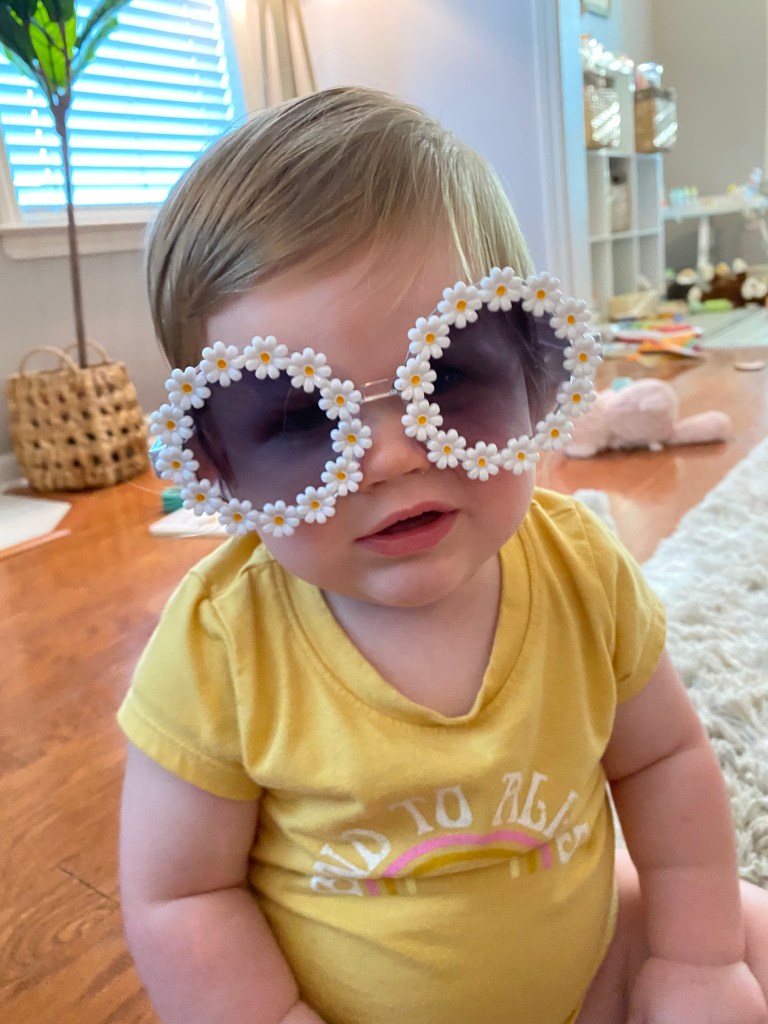
This is an old picture of our oldest granddaughter, but I just thought it was too cute not to share. It always makes me smile.

It has been fun watching her grow and change, and it’s even more interesting to see the ways she and her younger sister are alike…and different.

I get it, we’re all different. That’s not what I mean by my question. The question is: what makes us become interested in things? Is it the influence of someone in our lives? Is it because of a book we read, a movie we saw, or some other outside influence?

You’re probably confused by my questions, so maybe some examples would work better.

My husband is a sports FAN. Notice the capital letters. He has always loved to play and/or watch football, basketball, and baseball, and he even watches some soccer games when the World Cup is going on. A little hockey occasionally. His interest in sports is not unusual since many share his passion. But no one else in his family was that way. His parents didn’t watch sports. His older brother didn’t enjoy sports. Yet he, as a very young boy, became enamored with baseball first and then other interests followed.

Why is/was he so different from his family?

I had an artistic interest from a very young age. I spent hours drawing and coloring. As I got older, I loved play-acting. I spearheaded neighborhood plays which I wrote and my friends and I performed for our parents in our living room. From the moment I learned to read, I loved it. My brother was an avid reader, so maybe his influence affected me, but no one else in the family had my artistic bent.

And no one else loved horses like I did. I used to think I loved horses because of the books I read, but I realized I loved horses before I could read. We didn’t own horses. But I was drawn to horses (and still am) the way my husband was drawn to sports.

I love the Kentucky Derby, but I’m learning some things about horse racing that don’t sit well with me. Some aspects are not humane. I won’t go into that now. More research is required.

I could go on and on. The musician born into a family of non-musicians. The doctor whose family members had no interest in science or medicine. You get the idea.

Maybe you don’t think about these things, but I’m a thinker. I’m a questioner. I often want to know “why,” although often there is no firm answer to that.

Our oldest granddaughter has that imaginative, artistic bent, more pronounced than many her age. She loves make-believe and dress-up. I know what you’re thinking. That’s not unusual for a little girl. No, it’s not, but her fascination with songs from a very young age, from being soothed by “Somewhere over the Rainbow” while a very young infant…yes, I believe she has an artsy bent. Her younger sister? Well, if she doesn’t grow up to be a skydiver and a mountain climber and anything else requiring physical skill and a daredevil attitude, I will be amazed.

I sometimes think our interests, like our personalities, are somewhat genetic. Maybe my husband’s great-grandfather had a competitive spirit and was involved with whatever activity was competitive back then. Maybe my great-great-grandmother drew pictures or wrote stories or had a flair for the dramatic. And maybe my love of horses stems from being a descendent in a long line of farmers who loved their service animals as well as relied upon them.

I guess this blog is pointless. I’m writing about something that has no answer, something most people wouldn’t even think about. But for a curious mind like mine, it’s a natural path to follow. It’s okay if I don’t have the answer. It’s just something that intrigues me.

Well, if you’ve made it this far and are bored out of your mind by. now, maybe your interest is piqued by a homemade bread recipe that does not require having to feed a starter! I’ve been making this for so many years, I have it memorized and have long forgotten where I got it. The bread is soft and perfect as an accompaniment to meals or just to eat by itself.

Homemade yeast bread

Ingredients:

2 packages active dry yeast (I use Rapid Rise)

1 cup shortening

1 stick unsalted butter, melted

1/2 cup sugar

1 1/2 teaspoons of salt

2 cups water

2 eggs, beaten with a fork

5 to 6 cups all-purpose or bread flour (I use bread flour usually)

Instructions:

In a large, deep mixing bowl, pour in two packages of yeast. Add sugar and one cup of warm water. Mix with wooden or silicon spoon.

On medium high heat, in a small saucepan bring one cup of water and the salt to a boil. Set off heat and add one cup of shortening, stirring constantly to melt the shortening. Add this mixture to the water, yeast, and sugar mixture in the bowl. Stir and allow to cool for a couple of minutes. Slowly stir in beaten eggs with spoon or whisk until well mixed.

Slowly stir in flour, one cup at a time, being sure to mix well. Once the mixture has reached the consistency that creates a dough ball, stop adding flour. I don’t measure the flour–I usually just “eyeball” it. I like it when the dough ball is moist and no extra flour is visible.

Cover mixture and allow to rise for at least 1 1/2 hours.

Punch down dough and divide into two equal parts. You cn refrigerate one part for several days if desired or make two loaves.

Melt butter in a bowl. Break off pieces of the dough (about the size of a ping-pong ball) and dip in the melted butter. Drop into a bundt pan and repeat until all dough is used, being sure to distribute evenly in the pan. You will have more than one layer.

Cover and allow to rise for at least 1 1/2 hours. Pre-heat oven to 350 and bake for approximately 30 minutes or until toothpick inserted comes out clean.

A variation:

After dipping into melted butter, roll each piece in a cinnamon sugar mixture before dropping into bundt pan.

It’s Elvis Week 2025. Try this Elvis Gooey Butter Cake to celebrate~

It’s hard to believe that 48 years after his death, there are still enough Elvis fans in the world to converge upon Memphis and participate in activities celebrating the life and legacy of Elvis Presley. Elvis Presley Enterprises is, no doubt, a marketing machine that has kept the legend alive for multiple generations.

I’ve never been to Elvis Week, although my youngest son and I did go to Memphis one year to go to the expo where we met June Juanico, Elvis’s Mississippi girlfriend in 1955 or so (not sure of the year), Bill Black’s children (Bill Black was the bass player who played with Elvis on Sun Records), and others connected to the Elvis world.

Elvis fans can do the week in -person or virtually. I’ve never done those either.

To be honest, I’m not the Elvis fan (attic) people think I am. It’s just that because I once was a super Elvis fan, I know a lot about him, so it’s natural for me to talk about him and his life. I have no illusions about the man, and I never wanted to have him as a boyfriend. My family doubts that, but when I was a little girl, I just wanted to be in his circle, maybe have him for a brother.

Not so with celebrity crushes Kurt Russell and Lee Majors. I wanted to grow up and marry them. Well, not Lee Majors. Heath Barkley. If you’re a baby boomer, you know what I mean.

Back to Elvis Week. The reason it’s held annually at this time is because Elvis died on August 16. When the week began, they had multiple events including “talks on Elvis” in which people in Elvis’s circle shared their memories and experiences, an Elvis Tribute Artist contest, and special tours of Graceland. Those things still take place today. In addition, they have constant music by performers singing Elvis songs, special tours (for a mere $500 this year, you could pay to go on a private tour of Graceland headed by former girlfriend Linda Thompson or Elvis’s longtime friend Jerry Schilling), or you could pay to go by bus to Tupelo, Mississippi, to visit Elvis’s childhood home until the age of 13. Since its inception, the week has concluded with a candlelight vigil on August 15 during which hundreds if not thousands of fan hold a candle and walked to the gravesites beside the mansion. In the early days, that vigil took all night. I’m not sure of the attendance these days.

If you’ve never been to Memphis in August, let me warn you: it’s HOT and HUMID. All caps to stress. Keep hydrated if you go there!

You get the idea. Go on YouTube after the week is over and see what fan-made videos you can find. They’re pretty interesting.

Speaking of Lee Majors…he and Elvis were friends (they met while Elvis was making a movie he hated Clambake and Lee was on The Big Valley) and last year he was a guest speaker for the conversations on Elvis. It was pretty interesting, and you can find it on YouTube. Lee, bless his heart, is now 86 years old and not the “Big Valley” hunk he once was, but it’s still interesting, even if you’re not an Elvis fan.

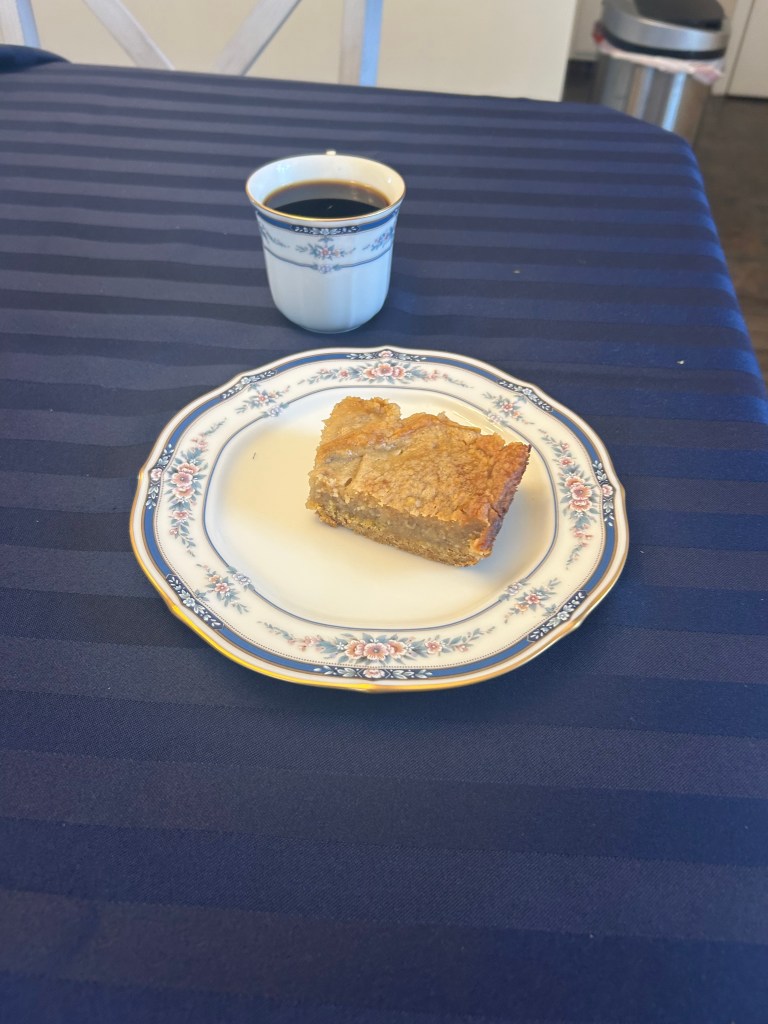
But whether you loved, hated, or felt neutral about Elvis the entertainer/person, you might like this recipe. I found it when going through Mom’s stash of recipes. I’d never made it before yesterday, so it was a true experiment. My husband loves it. If I loved sweets, I’d love it, but I’m not a fan of sweets. A couple of bites is all I can manage. I get nauseated if I eat more than that. I know, I’m weird. I admit it.

Here’s the recipe:

Elvis Gooey Butter Cake

Preheat oven to 350. Spray 9 x 13 glass dish with cooking spray.

Ingredients and instructions for crust:

1 box yellow cake mix

1 stick of butter, softened

1 egg

Mix well with mixer and press into bottom of 9 x 13 glass casserole dish.

Filling (topping) ingredients and instructions.

1 8 oz. block of cream cheese, softened

1 stick of butter, softened

1 teaspoon vanilla flavoring

3 eggs

1/2 cup peanut butter

1 banana

1 box powdered sugar (16 oz.–I used 3 1/2 cups)

Mix cream cheese, butter, vanilla flavoring, and eggs until mixed well to a creamy texture. Add banana (I broke it into pieces before adding) and peanut butter. Mix well. Add powdered sugar, one cup at a time, and mix well between additions.

Using a rubber spatula, spoon over crust and spread evenly. You may need to run water over the spatula or dip it in water to keep mixture from sticking.

Bake at 350 for 45 to 50 minutes or until toothpick inserted in the middle comes out clean.

Musician Jackie Phelps’s interesting life and a sunny vegetable salad recipe

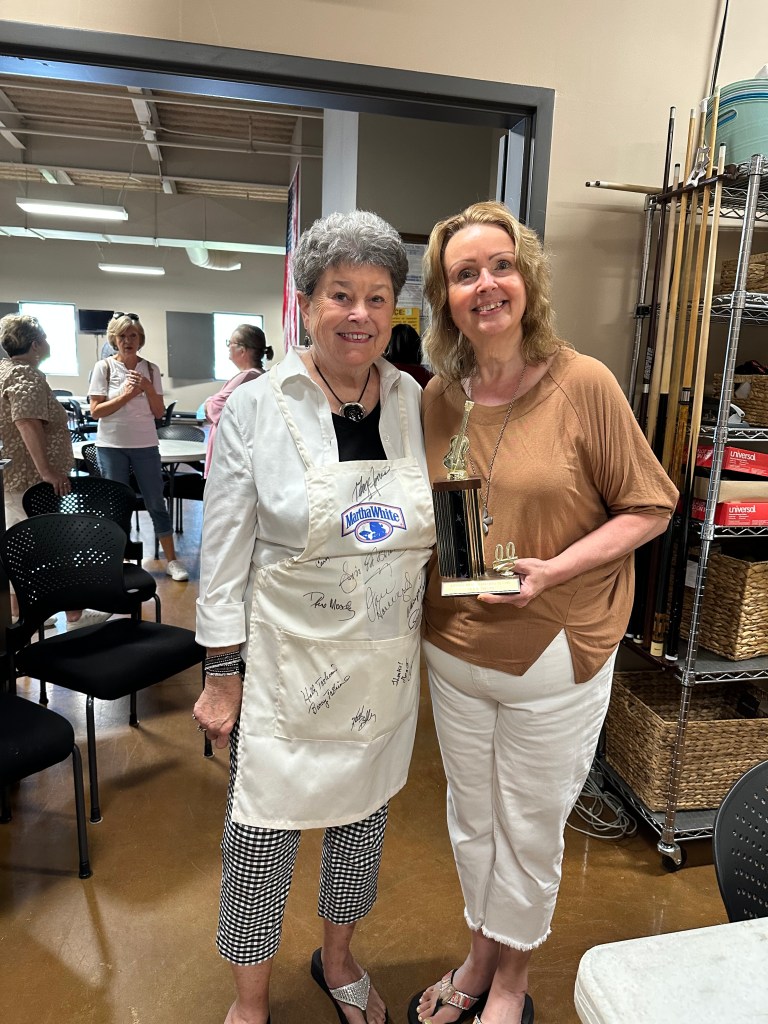
Betty Nan Carroll (left) and Donna Baker at the local senior citizens’ center.

The following is an article I wrote for the local newspaper that will be published next week.

UTM Grad Shares Stories of Her Father’s Life in Music

Imagine growing up in a world in which you viewed people like country music’s Roy Acuff, Stringbean, and Grandpa Jones as friends instead of the musical icons they were. Imagine spending Friday and Saturday nights in a dressing room entertaining yourself or playing with Johnny Cash’s daughter while your father is performing on stage as part of the Grand Ole Opry. Imagine seeing your father every Saturday on WTVF’s Hee Haw and accepting it as a normal life.

Imagine that your godfather was Roy Acuff.

If you can imagine this, you can grasp what Donna Phelps Baker’s growing up years were like. The 1982 UTM graduate and Nashville resident returned recently to Martin to be a part of a speaking series offered at the Gateway Senior Citizens Center.

The Tennessee History series began in July, under the supervision of Becky Hames, activities director. Topics have included historical events like the Battle of Shiloh and historical places like The Ryman in Nashville.

When local retired teacher Betty nan Carroll was asked to do a presentation on The Ryman Auditorium, she agreed and reached out to Baker, fellow retired teacher and member of Alpha Delta Kappa, to be a part of the program on July 25. Carroll’s presentation included the history of the famous building and its builder as well as how the building was used over the years for revivals, public speakers, and performers. Baker’s part of the program involved her father and how he came to be an important part of the Nashville music scene.

It’s possible you may not recognize his name. Although he released six albums on Nashville’s Starday record label, he is more recognized than known to a generation of Hee Haw viewers from 1972 until 1988. Jackie Phelps was an accomplished musician and singer whose journey into the music business began at a young age while growing up in Virginia.

“He was born in October of 1925,” Baker said. “The same month and year that the Grand Ole Opry started.”

Like many of that time, the native of Holland, Virginia grew up poor but learned to play  a pedal steel guitar and an acoustic “flat-top” guitar which allowed him to perform locally at venues like grocery stores. Encouraged by others to audition for Bill Monroe, who is considered to be the father of bluegrass music, he traveled to Norfolk to do so and was rejected. Later, however, when a band member quit, Monroe contacted him and asked him to join the group.

The year was 1947, and it wasn’t long until Phelps was drafted to serve in the military. He was sent to Korea but never saw combat. Instead, his role was to drive officers, including generals, to their destinations. When they learned he could sing and play music, they asked him to perform, thereby enabling him to continue to develop his craft.

Upon his return to civilian life, he continued to play with Bill Monroe’s band occasionally but secured a spot with Red Foley’s band. While touring with Foley in Springfield, Missouri, he was smitten by the cute girl selling tickets to the event and in 1949, he married the girl named Lois. He and his bride moved to Nashville where he did studio work, but his travels did not stop.

By this time, Phelps could play the banjo in addition to the guitar, and he began his tenure of working with Roy Acuff, a tenure that included performing in Bob Hope’s USO tours. The entertainers spent ten to 12 weeks at a time going to places like Laos, Vietnam, and Thailand. “Wherever there was an American military base in southeast Asia, they performed there,” Baker said.

No doubt he experienced some close calls while in southeast Asia, but it was on U.S. soil that the most famous one occurred. Having performed in Kansas City, Phelps and Jean Shepherd were offered a ride on a small plane to return to Nashville, but Shepherd was eight months pregnant and not allowed to fly, so Phelps drove her back to Nashville.

That plane crashed near Camden, Tennessee, killing Patsy Cline and “Hawkshaw” Hawkins.

Another tragedy hit close to home when Phelps’s close friend, the musician, songwriter, and comedian known as “Stringbean” was murdered in his home along with his wife. “She was shot in the back,” Baker said. “It was brutal.” Phelps was devastated by the loss and served as honorary pallbearer at Stringbean’s funeral.

Phelps’s repertoire of fellow performers, in addition to those mentioned, include Porter Waggoner, Jean Shepherd, and even studio work with Elvis Presley. But his most lucrative and steady work began when Archie Campbell and a Hee Haw producer discovered Phelps and Jimmy Riddle one night doing rhythm skills known as “eefing” and “hambone.” Two weeks after auditioning, the two men signed a contract that lasted for Phelps from 1972 until his retirement in 1988.

In 1989, he was diagnosed with cancer and passed away in 1990. His close friend Grandpa Jones served as an honorary pallbearer at his funeral. He was inducted posthumously into Hazard, Kentucky’s Thumbpickers Hall of Fame in 1990.

The Tennessee History series will continue through October, and a schedule of dates and times is available on the Gateway Senior Citizens Facebook page and the City of Martin Facebook page, or you can go by the center and pick up a calendar. The next scheduled topic is August 15 at 10:00 A.M. when Pam Harris will share stories and information about Graceland.

That is the end of the article, but I hope it intrigued you to look him up on YouTube and other sites. Baby boomers likely watched Her Haw and may recognize Phelps.

This week’s recipe was one I got from my mother-in-law who read magazines and searched the Internet regularly for new recipes to try. She was an amazing cook and wonderful person who was loved by all who knew her. I couldn’t have asked for a better mother-in-law.

Sunny Vegetable Salad

5 cups fresh broccoli, chopped

5 cups fresh cauliflower, chopped

2 cups shredded cheddar cheese

2/3 cup chopped onion (I like red onion for this)

1/2 cup raisins

1/4 cup sunflower kernels

1 cup mayonnaise

1/2 cup sugar

2 tablespoons apple or red wine vinegar (I use the red wine vinegar)

6 bacon stripps

Instructions:

Cook bacon strips until crisp. Remove to paper towel to cool and allow extra grease to be absorbed.

In a small mixing bowl, combine mayonnaise, sugar, and vinegar. In a large bowl, combine chopped vegetables, raisins, and sunflower kernels. Stir well, then add dressing from smaller bowl. Add shredded cheese and stir well to mix all ingredients. Crumble bacon and top salad with bacon crumbles. Serve immediately or refrigerate until time to serve. Note: If I am not going to serve immediately, I wait to add the crumbled bacon until ready to serve.

St. Jude Fun(d)raisers and a favorite Mexican dish recipe

Memphis, first Saturday of December 2018. Also my first St. Jude Children’s Research Hospital fundraiser. I, along with 26,000 other people, walked/ran that unusually warm December morning to raise money to help fight childhood cancer.

It had been on my bucket list for years, but my hectic schedule kept me from training. I’d been a fitness walker since my twenties, but walking 13.1 miles requires preparation to avoid injury.

It is still one of the highlights of my life.

You may think that is weird, so allow me to explain. Growing up, I was never the athletic type. Oh, I was good at normal childhood things. I rode my bicycle, was an excellent roller skater, and even tetherball champion at my elementary school in Arizona. Softball…very average. Basketball…below average. Tried out for cheerleading…a fiasco.

I didn’t do team sports. Partly because I wasn’t that competitive with others and partly because I was embarrassed. But individual challenges, things that made me compete with myself and set higher goals for myself, were more in my wheelhouse. In college, I swam in the university’s huge indoor pool, jogged on the running track or indoor gym balcony, and played racquetball and tennis. I eventually participated in Jazzercise classes at the health club and purchased a Jane Fonda workout video to do at home.

You get the picture. Although not exactly athletic, I was and am active.

My college service sorority, Gamma Sigma Sigma, participated in an annual fundraising event for St. Jude. Living just a little over two hours north of Memphis, the location of the research hospital, makes St. Jude very well known in our area. So as time went on, and I learned about the annual fundraisers involving running and/or walking in various cities across the country, participating in one of them seemed like the natural thing to do.

I registered as a “hero,” meaning I donated some money and pledged to raise $600 more. Thanks to the generosity of family and friends, I exceeded that goal. I registered as a walker, not a runner, which was important because that determined which group you would be in to start the race. The race consisted of a 5K and a 10K, a half-marathon, and a full marathon. I’m pretty sure it was a qualifier for the Boston Marathon, but you might need to double-check that fact.

We lined up at 8:00 A.M. in front of the FedEX Forum in downtown Memphis. I was supposed to be in corral Q, but my declining vision made me think it was corral O. The full marathon runners were at the from of the crowd.

Every five minutes (I think), a loud horn released each group. Well, when my group was released, EVERYONE was running. The walkers were two corrals back. So guess what I did? Yep, I ran too. The adrenalin was pumping, the excitement was high, the spectators lined up along the entire course were cheering me on. My name was in large letters on the number attached to my shirt, and cries of “Go, Pam” or “You’ve got this, Pam” followed me the entire course.

No, I didn’t run the entire course. I ran a mile then walked a mile or so. The course took us down by the river, through downtown streets, across the St. Jude campus where patients, workers, and parents were cheering us on, and to the finish line at the Memphis Redbirds ballpark. At every mile, local organizations were set up to hand us a small cup of water or Gatorade. Trash cans were set up to toss the empty cups into when finished. And, yes, there were those blue portable potty buildings along the entire course. Oh, also musical entertainment on stages situated at strategic locales. A group f musicians and singers welcomed us to the St. Jude campus.

Running across the campus (no way could I walk with that group cheering me on and thanking me for being a hero–I wasn’t the hero, it was that group that were the heroes) was a moving experience. It reminded me of why I was doing what I was doing. Yes, it was a selfish thing, a bucket list thing to prove I could do it. But it was so much more.

I finished the 13.1 miles in 3 hours 17 minutes. Nothing exceptional, but I was okay with that. I did it. And it was an experience and memory I will cherish for the rest of my life.

I did it virtually in my neighborhood in 2020, but that wasn’t the same as being with all those people in that setting.

Since that time, I’ve done numerous walk/run fundraisers, and I’m doing one again on Sept. 27. If you’d like to donate, go to my Facebook timeline (Pam Watts Harris) and click on the link. And if you’d like to fundraise on your own, search for St. Jude Children’s Research Hospital Walk/Run Fundraiser Sept. 27, 2025. You can join a team in your area or do it individually as a virtual walker. It’s only 3.1 miles. Piece of cake, right?

We ate Mexican food at an East Memphis restaurant that night, so maybe it’s appropriate I share a homemade chicken quesadilla recipe that’s easy to make.

Baked chicken fajita quesadillas (this recipe makes three quesadillas)

Ingredients:

1 package of chicken tenderloins, usually 1.5 to 2 pounds

1 small red pepper

1 small green pepper

1 small sweet onion

1 tablespoon olive oil

garlic powder

chili powder

1 white queso dip available in supermarkets

Flour tortillas, large taco or fajita size

Instructions:

Bake chicken tenders in a 350 degree oven for 15 minutes. Allow to cool for at least five minutes when done. Remove tendons from each piece and discard. Cut up chicken tenders into chunks or shred by pulling meat apart.

While chicken is baking, Cut peppers and onion into slices. Heat olive oil in skillet on medium high heat and add sliced peppers and onions. Sauté until tender. Sprinkle garlic and chili powders on vegetables (I just guess on this, depends on your personal preference). Add chicken to pepper/onion mixture and more garlic powder and chili powder if desired. Stir well.

Pour queso dip into a microwave-safe bowl and heat until melted.

In a separate skillet on medium high heat, spray with cooking spray and place a tortilla on the pan. Spoon in chicken/pepper/onion mixture one side of the tortilla, and top with two tablespoons melted queso. Immediately bring other side of the tortilla over the mixture and remove with a spatula once both sides are heated. Top with more melted queso if desired.

I usually have salsa, guacamole, and chips to accompany this meal, and you may be able to make more than three quesadillas, depending upon how much chicken you have.

Total time? Maybe 30 minutes. A quick meal for busy lives!

4:15 A.M. thoughts and a great summer dessert recipe

My mom started teaching me to cook when I was very young. Really young. As a matter of fact, when I was four or five, I made homemade biscuits because she was sick in bed. Yes, my dad helped me, but she told us how to do it, and I felt very grown-up when I took her the finished product. The problem? I had used a bowl to mix the dough that she used to put my goldfish in when she changed the water in the goldfish bowl. Looks like my dad would have known, but to say he knew nothing about cooking is putting it mildly. I wonder if she figured that out when she took the first bite—dirty fish water taste maybe:

I took home ec, as we called it, my freshman year, and during the cooking semester we prepared and ate a meal during our 60-minute class time. We cooked easy things, but still we cooked. We had homework to make cookies, muffins, biscuits, and cornbread, and we’d bring one sample to our teacher to evaluate. Maybe other girls had their moms do the cooking for them, but I never even asked Mom. I just went by the recipe, and she helped by supervising.

She also started teaching me to sew when I was 12, using an old treadle sewing machine on which I made Barbie clothes. Yes, I was still playing with Barbies at the age of 12. I can confess it now, although it was a deep, dark secret I told no one back then.

So I haven’t let vision loss stop me from cooking. I discovered low-vision cooking aids on Amazon, and I have measuring cups designed for people with low vision, measuring spoons (which were great at first but with the vision decline, I can no longer see without a magnifier), and tactile (bump) dots. The dots are on my oven controls and on frequently used buttons on my microwave. Sure, I make a mess at times, but truth be told, I did that at times even before vision loss!

I still have problems. Yesterday I made guacamole. I used garlic salt accidentally instead of garlic powder, and it was WAY too salty. I ate some of it but had to throw out the rest. I have a Braille labeler that I used to make labels for my spices, but I have gotten lazy about labeling the new ones that replaced the old ones. Now that’s a project I need to do today.

But why was I thinking about all of this at 4:15 this morning and couldn’t fall back asleep? Partly because I was thinking about what topic I’d like to address in my blog. I was thinking about how, as challenging as vision loss is, it would be so much worse to be deaf with no hearing at all. At least vision loss doesn’t keep me from interacting with other people. It doesn’t keep me from enjoying music. To me, being totally deaf would be much worse than totally blind. That’s because I’m a social person, but maybe someone who prefers to be alone or with a very small circle of people would prefer the loss of hearing over the loss of sight.

We’re all different. Yet it would be my hope that anyone facing adversity would be active in searching for solutions to living as normally as possible and finding fulfillment in new areas.

One thing both blind and deaf people can do, though, is cook. So whether you are reading this blog or using Voice Over or Talk Back to read it, I hope you’ll try this recipe. It’s easy, just the kind of stuff we made back in home ec. And, oh, a special thanks in my mom who passed away in 2021–thanks, Mom, for teaching me so much!

Four-Layer Delight

Ingredients and instructions for each layer:

First layer: 1 stick softened (not melted) butter, 1 cup flour (all-purpose or self-rising), 1/2 cup chopped pecans. Mix well and press into the bottom of a 9 x 13 casserole dish. Bake in a preheated 350 degree oven for 10 minutes. Remove and allow to cool for one hour.

Second layer: 1 8 oz. block of cream cheese, softened; 1 cup powdered sugar; 1 cup of Cool Whip. Mix well with mixer and spread on top of cooled crush. I use a rubber spatula for this, dipping it occasionally in water to keep the mixture from sticking. You could do the same with a table knife.

Third layer: 2 small packages of Jello instant pudding mix (lemon, chocolate, pistachio, or butterscotch–I use lemon) and 3 cups of milk. Beat well and spread on top of cream cheese layer.

Fourth layer: Cool whip and if desired sprinkle pecans on top. Cover and keep in refrigerator.

Dreams vs. goals, and looking forward vs. working toward.

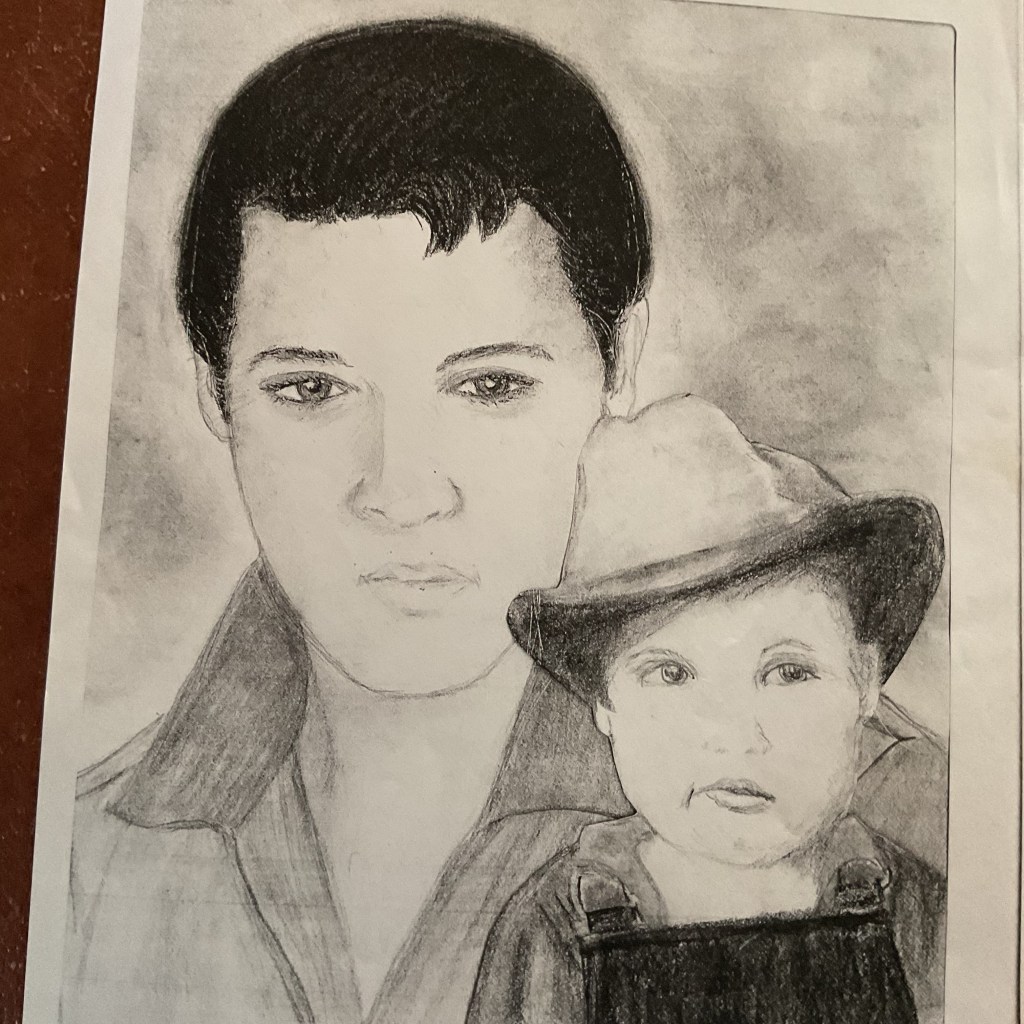
I did this sketch years ago, and it is supposed to be Elvis as a child and Elvis as a. young adult. I called it “the boy within the man.” In my opinion, Elvis stayed a boy in many ways, but that’s another topic. And I’m not sure you can even tell it’s Elvis, but trust me, that’s who it is supposed to look like.

The reason for posting this photo is because, in many ways, Elvis represents the American dream. Rags to riches, obscurity to fame, everything in the world a man could want…but was that really true?

Like many celebrities, Elvis achieved but ended up unhappy. No, he didn’t become a serious actor like he wanted to do. No, he was never a part of a gospel quartet, which was his first dream. But he had money, friends, and fame, and we can’t understand what drove him to escape reality by taking medications that made him sleep and other medications that made him stay awake.

He, like some, couldn’t handle life once his dream was realized. He could not be happy without a goal.

What is the difference between the two? I think it is that a dream is the big picture, and a goal is one of the steps taken to achieve that goal. For instance, you want to lose 20 pounds, meaning the dream is to drop at least one clothing size or improve your blood pressure or whatever. A goal to go along with that dream is to begin a walking program until you are walking three miles most days. You start with one mile and push yourself until you are comfortable with that. You increase gradually until you are able to walk three miles with ease. But you’ve only lost seven pounds at that point. You’ve achieved your goal without realizing your dream–yet.

Our oldest son and part of his family ate supper with us last night, and we (my husband and I) were talking about how different life is at our age. When I said “You have nothing left to work toward because you’ve achieved your goals,” my son thought I was being negative and saying something like, “There’s nothing to look forward to.”

No, there are plenty of things to look forward to. Being with family, seeing friends, taking trips, and even (for me) an in-person shopping experience at Walmart. Don’t laugh. I live in a small town. It really is an occasional treat but only because I seldom go.

When you’re raising your children and working in careers that are maybe not always what you had hoped they would be, it is easy to feel stuck and discouraged. Retirement and being debt-free can seem a long time away, and you may have to push yourself at times to keep on keeping on. You’re tired from too much busyness, or you’re worried about your children, or you’re living in the sandwich generation, meaning you’re dealing with children and aging parents, all of whom need your help.

You are always working toward something, not necessarily looking forward to it.

I’m the kind of person who needs something to work toward. Whether it’s preparing for a walk/run for St. Jude or working on a writing project or watching educational programs on the History Channel and that sort of thing, I am happiest when I’m pushing myself to accomplish or to learn. Yes, I always loved school. Sure, I looked forward to breaks, and no, I didn’t love Algebra 2 or geometry, but I loved to learn and (believe it or not) to be sociable.

When I was teaching, we always encouraged students to have dreams, but maybe we didn’t do as good a job of showing them how to set goals to work toward those dreams. And maybe we didn’t do a good job of encouraging them to have a Plan B, C, and even D in case those dreams didn’t work out. After all, only a very small number of athletes make it to the professional leagues, and while Sally may have a beautiful singing voice, the likelihood of her becoming rich and famous is slim. Go ahead, Sally, give it your best, but discover something else you love to do that is more achievable and can fulfill you in different ways.

Dreams are dreams. Goals are practical. Working towards something is not the same as looking forward to it. The people who understand those concepts and adjust accordingly are more likely to be content. The ones who don’t may end up like Elvis and others who find little joy in life once they’ve found wealth or fame.