

First, let’s get this straight. I have been an Elvis fan since I was six or seven, but I liked the movie version of Elvis who paid attention to children. I liked his music, especially the ballads. I liked his rags-to-riches story. I related to the poverty in which he grew up since my parents did the same.
But I never wanted him to be my boyfriend or grow up to marry him. After all, he was 21 years older than I was. I did want to be in his circle of friends because of his fame and good looks (although he wasn’t always so handsome, especially in his later years), and as I got older and learned more about the man instead of the image, I wanted to set him straight.
Elvis was a talented entertainer but also troubled. The same man who started a rock and roll revolution and lived a promiscuous life loved gospel music and reading the Bible. Graceland has one of his Bibles on display, the dog-eared copy with pages full of his notes in the margins.
Elvis’s life was basically divided in halves. The first half was poverty, family, and pursuing his dream of becoming a singer. The second half was fame and fortune, family and friends, and a roller coaster ride of highs (hit records, a huge fan base, recognition, the birth of his daughter) and lows (the death of his mother, the cheesy movies, the career controlled by Col. Parker, the betrayal by two of his inner circle, his divorce).
With as much as I’ve read about Elvis and the number of documentaries and interviews I’ve seen have given me, I believe, a balanced view of him as a person. Unlike some fans, I recognize his shortcomings just as I recognize (hopefully) my own most of the time. I also recognize his good qualities.
I often say Elvis was a paradox. I also believe he is the epitome of arrested development. He never really grew up in the way most people do. And maybe that’s common for many who are thrust from poverty into riches, but for this blog, Elvis is the subject.
Elvis craved adulation and attention, but he was insecure. The first time his Sun Studio record was played on the radio, he didn’t sit in his living room with his parents to hear it aired. Instead, he went to a local movie theater. The song was requested to be played over and over until Dewey Phillips called and told his parents he wanted to interview him on WHBQ. Vernon and Gladys found him in the theater. When Dewey was talking to Elvis, Elvis thought he was going to be interviewed after they talked. He had no idea their conversation WAS the on-air interview.
He never wore denim when he made the money to buy his own clothes. Having grown up in Tupelo, Mississippi, and having been forced to wear overalls and go barefoot to school, he viewed denim as the clothing for the poor and never wore it again.
His father was one of those men who never held a job. Neither parent was well-educated, and the young Elvis witnessed their struggles. He loved his mother deeply and wanted to provide a better life for her. I think even the young Elvis sensed his father’s lack of a work ethic.
He kept an inner circle, who came to be known as the Memphis Mafia, because he was uncomfortable with friendships outside of his experience. No doubt he felt out of place among many Hollywood types, and his classmates from Humes High School (especially Red West and George Klein), some Army buddies, and his cousins were his constant companions, so much so that his wife Priscilla soon tired of so many of them hanging around Graceland.
He was generous, overly so. His father and Priscilla despaired because of his tendency to give away jewelry, cars, and other gifts to family, friends, and even strangers. He had a soft spot for the poor.
He appreciated his fans and never turned one away who wanted an autograph. He knew his fans were responsible for his success.
He was a daredevil. He loved roller coasters other thrill rides as well as fast cars and motorcycles, and in the 1960s he developed a passion for horses. His personal favorite was a golden palomino quarter horse named Rising Sun. And because Elvis wanted to ride, he insisted everybody in his circle learn to ride. He bought horses for all of them, whether they wanted one or not. And no one in his circle ever told him “no.”
He was like that pushy kid in elementary school who always wanted to do what he wanted to do and pushed everybody else to do the same.
I often wonder why so many stayed with him. He had a temper and in ways was selfish, but he also had a charm and a way of listening to someone that made them feel seen and heard. He had an aura that drew them in, and I’m sure they didn’t mind having small roles in his movies and getting to interact with Hollywood stars just because they were the satellites revolving around their sun, Elvis.
Jerry Schilling’s book Me and a Guy Named Elvis is a great read, and Jerry was one of the few who broke away from Elvis’s orbit to pursue his own interests. George Klein’s book Elivs, My Best Man is another good read because George, too, had his own life.
Whatever your opinion is of Elvis, you have to admit the Elvis Presley Enterprises machine has done an amazing job of keeping the legend in the public eye since opening Graceland to the public in 1982. Elvis died 49 years ago this Sunday, and about 600,000 visitors go to Graceland each year. His music is still being played, and with movies like Elvis starring Austin Butler (2023) have created a new generation of fans.
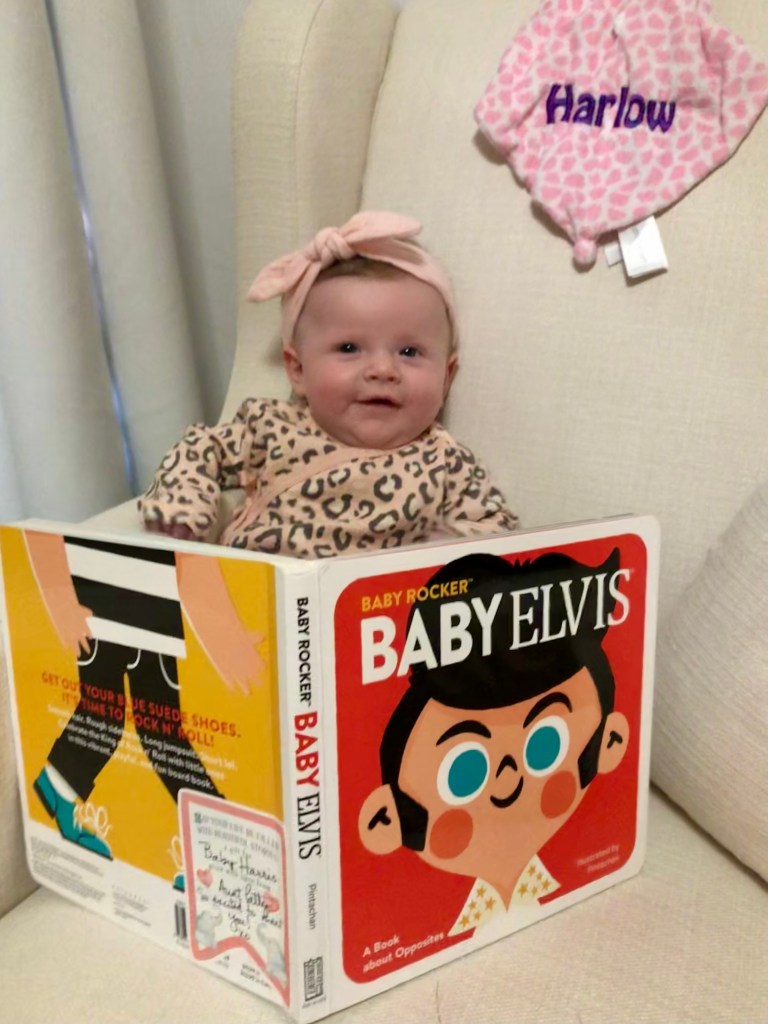
The photo of my granddaughter holding a book entitled Baby Elvis (purchased by my daughter-in-law or her mom as a joke since my son is or was an Elvis fan) was taken over four years ago. She is five now and in kindergarten.
The legend lives on. For how much longer, I don’t know. It may be there are teens and twenty-somethings who have never heard of him, which I don’t doubt since I’ve known teens who thought New Mexico was another country instead of a state, but that doesn’t change the fact that he is likely the most well-known entertainer in the world. I know Taylor Swift and more current artists have captured their own numbers of fans, but I wonder…will they be as well known almost fifty years after their death?

