
I know what you’re thinking. “Here she goes again.” The thought is in your mind. “Blogging about vision loss. Doesn’t she have anything else going on in her life?”
As a matter of fact, I do. Lots of things–time with family and friends, trips, church activities, civic activities, and hobbies. But if not for assistive technologies, I could not do many of them.
This month is Blindness Awareness Month, and my goal is to share information so those who are going through vision loss can find hope in the knowledge that while their vision is likely to get worse instead of improve, they can still live a fulfilling, independent life. That’s not to say they won’t have their emotional ups and downs Psychiatrists say that losing vision is like losing a loved one as far as the stages of grief are concerned. Denial, anger and/or frustration, bargaining, depression, and acceptance. I understand that grief model is now being questioned and believed to be inaccurate, and I will say that for me, I never experienced denial. I accepted from the beginning. But I did experience all the other emotions.
My point? Someone losing vision can find hope, but it might take a while. They have to learn how to do old things in new ways. They have to adjust to a world that doesn’t look the way it once did, and that could take several years. In some cases, they have to adjust to a world of…nothingness.
What, then, can help these people adjust? Magnifiers from Walmart aren’t strong enough. Large-print books? Forget it.
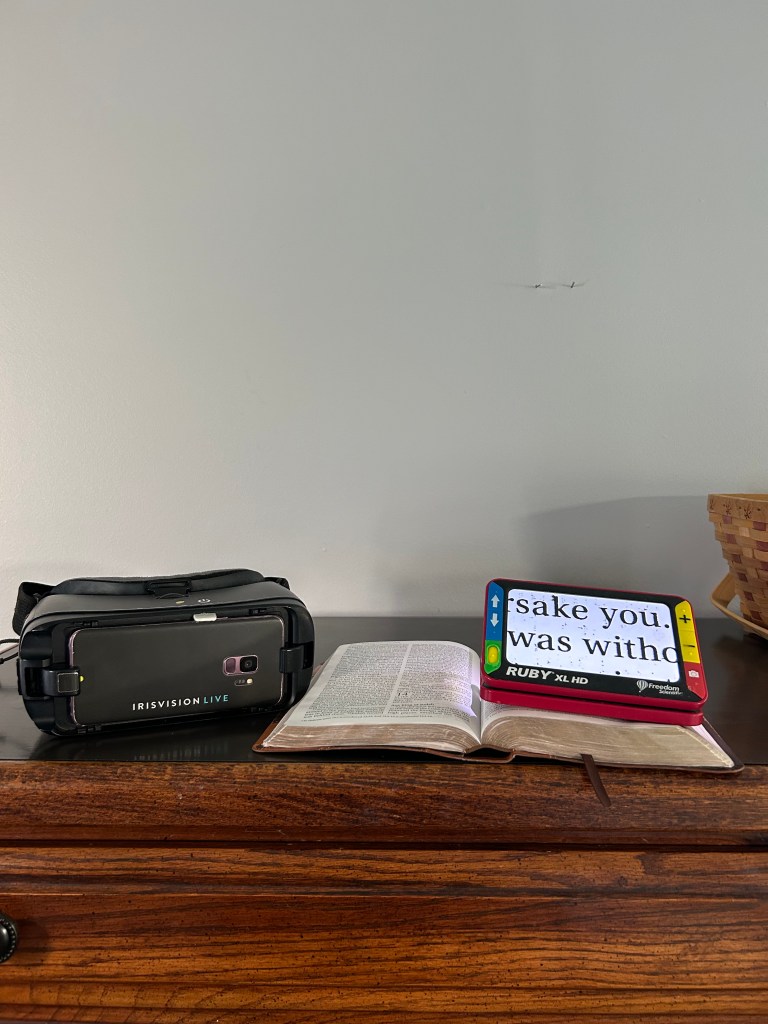
But you can still read books using audio books or even reading ebooks on Kindle by setting the background to black, setting the type to white, and setting the font as large as it will go. If you have Alexa, you can purchase an ebook on Kindle, and she will read it to you. You can go on Amazon to purchase tactile (bump) dots for appliances, remotes, computer keys, and more so you don’t have to use your sight to do those things. You can purchase a magnifier like Ruby that you can hold in your hand to read prescription bottles, recipes, cards from a friend, and check prices while shopping.
Large print cards to play solitaire, low vision cooking aids, talking scales, talking meat thermometers–they’re all available.
Free apps for your phone:
ReBokeh–a better magnifier than your phone’s magnifier and specially designed for the VIP (visually impaired persons) community
Seeing AI–hold the phone above what you want read to you, and it will read it It will describe scenes, objects, colors, and even people.
Be My Eyes–hit a large button, and it will call a volunteer who will access your phone to see what you can’t. The volunteer will help you do everything from finding a prescription bottle to describing a piece of clothing to identifying the can of soup you need from your pantry to reading the frozen food label. By the way, puff paints can work for identifying canned goods and spices.
There is hope. In our area, reach out to the STAR Center in Jackson. Each state has help for the blind, so contact them to get the services you need. I realize I’m writing this as though a person with vision loss can read it, but it is more likely a sighted person is reading it and thinking of someone they know who might benefit. Please help them find these resources. And for those of you who have been dealing with vision loss and adapting for a while–well, I know you’re listening to it as your phone or computer reads it aloud to you!
My book Learning to Live with Vision Loss has more detailed information including resources. Available on Amazon, it’s $2.99 as an ebook and $5.99 as a large-0print paperback. It’s free if you have Kindle Unlimited. It is my hope the book will help someone learn to adapt to a new normal.
“There she goes again,” you may be thinking. “Promoting her book.” In a way, yes. Not to make money. I’ve given away almost as many as I’ve sold.
For me, losing adequate vision to do many things I loved was devastating. It took a while to learn, adjust, and adapt. But I’ve done it, and I can now find joy and purpose in life. I know there are much worse things in life than losing vision, but honestly, when you’re the one going through it, it may be difficult to put things in the right perspective. The suicide rate among the blind/legally blind community is three times the national average.
So I hope this blog will help at least one person begin a journey of hope and accomplishment. For additional motivation, watch Losing Sight?, Finding Hope on YouTube. I think it will inspire you.
 Life As I know it