

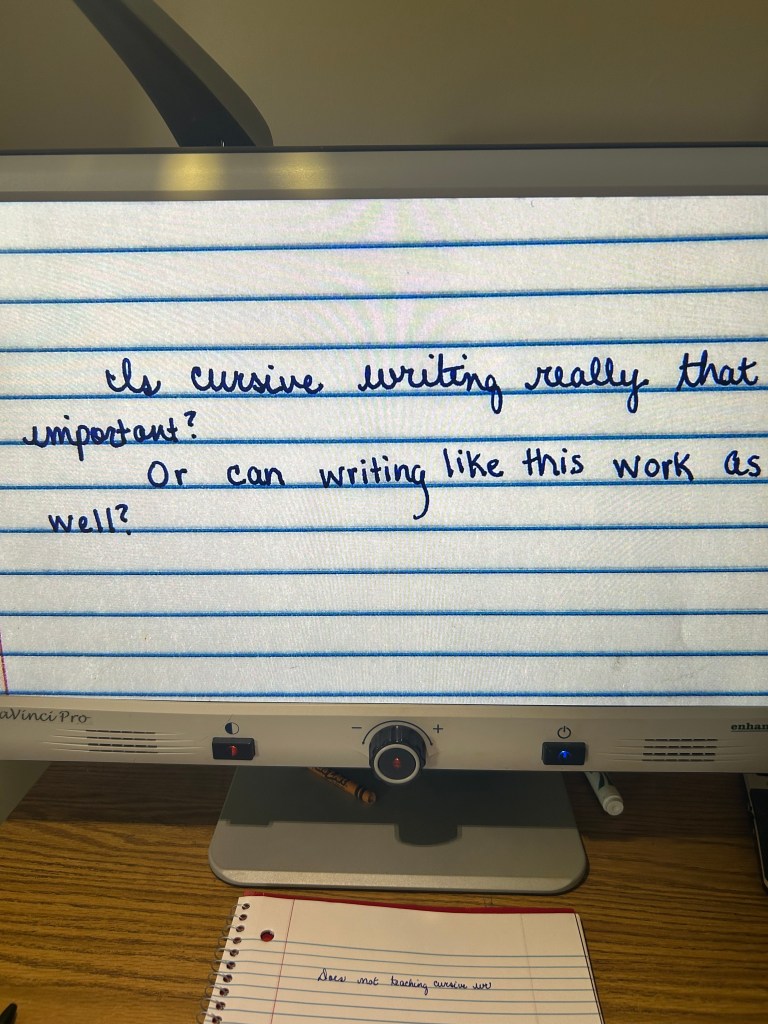
I once heard a man about my age say that the United States was dumbing down education because cursive writing is no longer taught.
You may agree. I don’t.
(Photo explanation to those of you new to my blog. I am visually impaired and cannot see to do things like people with sight, so I use devices. The device I use to write things like I the above picture is a CCTV.)
Cursive writing evolved over many years and became popular to use because the letters were connected, meaning the writer didn’t have to lift the pen from the page except between words. It became common in the 17th century, but in modern times, it is no longer taught in many schools.
Why? Well, other than being able to read someone else’s cursive writing, there’s no need anymore. Sure, we think we need it for our signatures, but not really. Our printed signature can work just as well. And yes, someone will have to learn it to ensure a future of scholars who can read and interpret documents written in cursive. Kind of like us relying on people who know Hebrew and Greek to translate the Bible or people who know Latin to translate ancient documents written in the language. They study it and interpret it for us. I took Latin for two years in high school and remember very little, but at the time our school’s Latin Club was more fun than the Modern Foreign Language Club, so naturally I took Latin. And at the time I was considering entering the medical field, specifically nursing.
My point? People in medicine and the legal fields benefit from knowing Latin as it is the foundation for many terms in those areas. But the average person manages life just fine without it.
That’s the same with cursive writing. It had its use at one time, but it’s no longer needed. When living in a world where you can speak the words and a computer types them for you and in a world in which forms are often e-mailed for e-signatures, it’s just not necessary.
Maybe you’re reading this and disagreeing with me. That’s your right, and I respect that. But you know…I never learned to use an abacus. I never learned to spin yarn on a spinning wheel or make homemade soap or use a loom to weave fabric. There are people who know how to do those things, but machinery has replaced the human worker, whether we like it or not. Machinery is faster and more efficient. The human touch is more special and valued because of its rarity.
If there is anything in modern education that concerns me, it’s the fact students are not required to memorize math facts. Ask any eighth grader to subtract 25 from 105 mentally, and it’s likely they can’t do it. They’ve depended on calculators too long. That bothers me, but then I ask myself, why? If machines do it for them or charts are available to look things up, why does it bother me? I try to think logically about this, but I’ll admit I’m still bothered by it. I guess I’m showing my age and preconceived notions in this case.
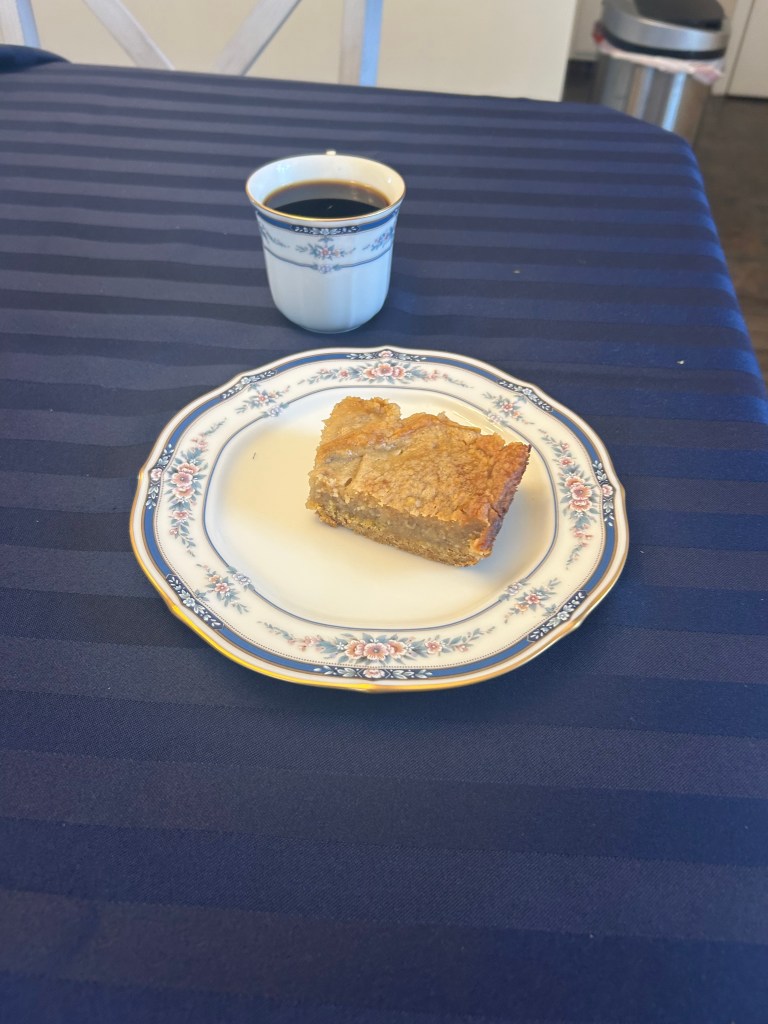
And just as there are fewer people learning or knowing cursive writing, there are fewer people cooking and baking. But for those of you who still enjoy cooking your own food, here’s one of Mom’s recipes that is a family favorite. The best part is the cake doesn’t dry out.
Fresh Apple Cake
1 1/2 cups oil (I didn’t say this was a light dish)
2 cups sugar (I didn’t say it was low calorie)
2 eggs
1 tablespoon vanilla flavoring
2 1/2 cups self-rising flour
3 cups peeled and chopped apples (I use Granny Smith)
1 cup chopped pecans (optional)
Preheat oven to 350. Mix all ingredients with a large spoon. Press into 9 x 13 casserole dish, top with pecans (optional), and bake one hour.
Icing:
Mix 1 cup milk (whole or 2%) and 2 cups powdered sugar. Pour over cake while cake is still warm. I usually heat the milk and sugar to dissolve lumps and pour over cake so it is more of a glaze than an icing.





 Life As I know it