What is your love language?

A couple of weeks ago, my husband and I were sitting on our front porch enjoying the early morning sunshine and cool temperature, and we started talking about the differences in the way we raised our children and the way we were raised. That led us to talking about how each generation has its own way of doing things.

Our parents, for example, were raised in The DePression, so life was all about survival and needs with little to no concern about wants. We were raised by parents who loved us by seldom told us they did. They were primarily concerned about our needs with some interest in our wants. Then our generation had kids, and we were all about our children’s needs AND wants. We told our children (and still do) that we loved them and showed them we loved them, we hoped, by doing things with them and supporting them in their interests, something we didn’t always receive from our own parents. They loved us and cared for us, no doubt, but their priorities were more about caring for our physical needs.

Our conversation got me to thinking about how people show their love for others, and I had heard about Gary Chapman’s book about the five love languages. The purpose of the book is to help people build better relationships by recognizing their own ways of expressing love for others and recognizing how others express their love for them. I’ve only read summaries of the book, so I don’t have an in-depth knowledge of the ideas he conveyed, but I think the five ways of expressing love are easy to understand.

According to Chapman, the love languages are words of affirmation, acts of service, receiving gifts, quality time, and physical touch. In other words, telling people we care, doing things for them, being gracious when others give us something, spending time with them, and hugging someone can show our care for them.

I think we do all of these things, but maybe we have a tendency to use one love language more than the others. I haven’t taken the online quiz to see which is my preferred love language, but I don’t have to because I already know what it is. And I know the love language that is hardest for me to accept.

The same love language. The love language I primarily use is the very language that is hardest for me to accept.

Acts of service.

I have the most amazing friends and family. Linda, Julia, Cyndy, and Martha Lynn will drive me anywhere, if I ask them, and they even call and ask if I need anything. I appreciate that so much, but I hate to ask them. (If you don’t know me or haven’t been following my blog, I have vision loss and can no longer drive.) I so appreciate what they do while hating the need to have them do it.

But they are appreciated more than they know.

Then there’s Barbara, who flew here at her own expense and gave up her two-week vacation to help my mother take care of my dying father so I could keep working. Dad was in hospice care, and we had no idea how long he’d last, so I couldn’t abandon my job as a middle school principal. As it was, he died five days after she left. Did I mention that Barbara is not even a blood relation but an in-law? Talk about an act of service. Would you give up your annual vacation to do that? I still feel there is no way to repay her.

So, I appreciate and value acts of service. I believe all the love languages are important, but the words of affirmation are hollow if not supported by the other four. People need to be told they are loved, but if we don’t show it by our actions, they are just words.

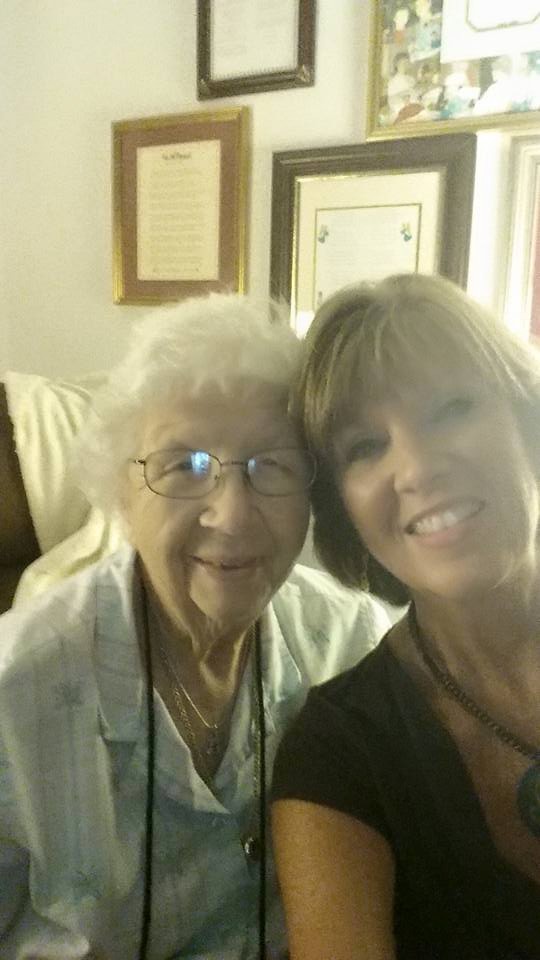
My parents loved me. My mom, who is still with us at 93, loves me. But we never say “I love you.” Not in words. I’ll write in in a card for her birthday or Mother’s Day. I’ll say it in ways like, “Well, I do these things for you because I love you.” But it never has been our way of communicating. They felt awkward doing it, and I still feel awkward saying it to her, although I have no problem telling my children I love them.

Maybe it’s generational. Maybe it is just our family dynamic. Maybe it’s a personality thing.

Whatever the reason, I still maintain that actions speak louder than words. What about you? Which love language do you prefer?

“You’re in my thoughts and prayers.” Really?

How many times have you heard that phrase or even said it yourself? I’ve heard it from people I know and even from people on television. I’ve read it on Facebook or at least seen the praying hands emoji or icon or whatever you want to call it.

This morning the weather was beautiful and a perfect time to have my morning coffee on the front porch. With very little traffic, perfect temps, sunshine, and only the sounds of nature surrounding me, it was an ideal time for prayer and reflection. So I prayed. Then I went inside for a coffee refill and realized my prayer had been the typical one and fairly short. I realized I had a long list of people to pray for, so when I went back outside, I prayed once more, this time praying for people by name instead of a general “be with the sick” or “comfort those who are grieving.”

When I finished and resumed sipping on my morning brew (flavored with Almond Silk Vanilla creamer, just a side note here), I thought about the phrase and how often it is said. A friend of mine once posted the question on FB if we actually prayed for people who asked for prayers on FB. I was guilty of commenting “prayers for you” or something along those lines but later on forgetting who it was I said I’d pray for. My friend’s question prompted me to start praying for those people the minute I read the post, before I even commented. That way, I couldn’t forget.

My thoughts were further deepened by the message from one of our ministers this morning. His lesson was about perspective, but his Biblical example was Jonah and how different his prayers were In Jonah 2 and Jonah 4. How ironic that my morning thoughts were reinforced by a sermon.

That irony or coincidence prompted this blog post. All too often, we give lip service to praying for others yet don’t do it. We say all the right things but don’t always do them. Prayers don’t have to be a long, flowery speech or even some sort of pattern we must follow each time we pray. A prayer can be as simple as “Lord, strengthen (name) as she battles cancer” or “Lord, give strength to (name) as he grieves over the loss of his wife.”

Is prayer enough, though? True, believers contend that God can do anything, but maybe we need to consider that we are God’s servants and by serving Him, we serve others. We put action behind our words. It is fine to pray for someone, but maybe that person needs to know you’re thinking of him and praying for him. Yes, you can comment on Facebook. You can send a text message. You can make a phone call. You can send a card. You can do something that lets that person know you truly are keeping him in your thoughts and prayers.

When my father was dying, a process that took a couple of months, I appreciated people telling me they were praying for him and for us. When my friend and her husband showed up one night with homemade soup and stayed for a short visit, the distraction of good conversation and the knowledge I had such a wonderful friend warmed my heart more than the soup warmed my body.

That’s just one example. I could go on and on about other personal experiences, but I’ll save those for other blogs. The idea I’m trying to express here is simply to avoid using hollow expressions like the title of this blog and make them real. If we say someone is in our prayers, then we should pray for them. We should show them in some way that we are doing just that.

As always, my blogs are simply my opinions, and you may disagree with me. But when I post this blog on my FB page today, I am going to tag my FB friends for whom I pray regularly. I’m going to take my FB friends for whom I’ve prayed recently because of illness or loss or difficult circumstances in their lives. And I’m going to try to do a better job of letting them know that I care.

Things We Say but Probably Shouldn’t

We’ve all had them, those foot-in-the-mouth moments when we said something we wished we hadn’t.

I still blush and regret things I said forty years ago. Like the time I saw a friend I hadn’t seen in a while. She had her two young boys with her, and her more than ample belly prompted me to say, “Oh, you’re expecting again?” Then she, being the kind, gentle soul that she was and is, gave me a sweet smile and said, “No, I just haven’t lost the weight from the last one.” Her youngest was over a year old, and I, in my ignorance and thoughtlessness, said a very hurtful thing. I didn’t mean to, and it still bothers me I said it. However, I saw her several months later, and she was down to her pre-baby size, as small or smaller than she was when we were in high school. Maybe my careless comment motivated her to get in shape, but it doesn’t matter. It was still the wrong thing to say.

I try to be more careful, but unfortunately, I still occasionally say things, in all innocence, that I shouldn’t. In talking with others, I’ve learned a few things that I thought I’d share, things I never really thought about as well as things I’ve noticed in my own experiences.

  1. “When are you going to start a family?” An innocent enough question but potentially a hurtful one. For all you know, the young couple has been trying to do just that but have been unsuccessful. A couple that attends a church I used to be a part of in Arizona has struggled with multiple miscarriages, a hurt they carry with them as they attend baby showers for other couples and “ooh” and “ah” over newborns in their congregation. Imagine if they go to a class reunion and are around people who don’t know their situation and have to answer questions like the one above. My advice? Don’t ask.
  2. “I had that surgery. Nothing to it.” For someone facing surgery for the first time or even the tenth time, it isn’t helpful to be told that their concern is unwarranted. They don’t want to hear about your experience unless your experience can be helpful to them. It’s okay to say you’ve had the surgery, and it’s okay to tell them what to expect, but don’t act like their concern isn’t important. They need your support instead of your disdain. (A side note: some things termed “surgery” really aren’t that bad, like cataract surgery, but keep in mind that everyone’s experience is unique.”
  3. “At least you had fifty years together” or any other “at least” comment. Someone grieving over the loss of a loved one recognizes the blessing of having that loved one for however many years they did. That realization doesn’t take away from their grief. The same goes for “He/She’s in a better place.” Let the person grieving say that, but you don’t need to be the one saying it. The best thing to say? Simply, “I’m so sorry for your loss.” Then let the person grieving take the conversation from there. They just need someone to listen, not someone to give advice.
  4. “Maybe this is a good thing that will lead you to a better job.” Someone has been let-go or fired, and that is a scary situation. I guess we want them to be hopeful and to encourage them, but I’m not sure the above comment is what they need to hear. Possibly a better thing to say would be, “What can I do to help?” Or “Would you like to talk about how you’re feeling right now?” I have a tendency to go into teacher or Mom-mode too often, meaning I want to start telling someone how to fix things. Likely it is better that I just offer support and encouragement instead of advice. Unasked-for advice is rarely appreciated or accepted.
  5. “You didn’t need him/her anyway.” Oh, my, this brings back memories of my younger years and the reason In ever could confide in my mother about my hurts. When someone breaks up, whether dating, a broken engagement, or a divorce, the last thing they need to hear is something like this, even if it’s true. They are hurting, and all they need is an ear. Like the comment to the grieving person, all you or I need to do is offer our sympathy and a listening ear. My mom’s comment to me after a break-up was always, “Well, if he didn’t want me, I wouldn’t want him.” Thanks, Mom, for the understanding. So, yes, my mom and I never had and still do not have the kind of relationship that allowed me to tell her about my hurts. If you’re that kind of mother, you might want to re-think how you handle those things. It will definitely create a wall between you and your child, at least in your child’s viewpoint.

There are countless other situations I could address, but you get the idea. We need to think before we speak, and even though we may strive to be more thoughtful, we are likely to continue to say things occasionally that are the wrong things to say. Not only that, people are likely to say things to us that are hurtful. When that happens, how should I react? Like my sweet friend who smiled and answered my question. With kindness. Her kind answer made me feel ten times worse than an angry one would have. There’s something about the Christian concept of a soft answer turning away wrath.

Most people mean well. They just don’t know how what they say may sound. I hope my blog today has opened your eyes as well as mine to the idea of thinking before we speak and not reacting in anger when someone else fails to do so.

Why Retirement May Not Be Right for You

What??? How could retirement not be the dream come true for everybody?

I can think of several reasons, which is why I’m sharing them with you now. Before I do, however, please understand that most retirees I know are very happy in retirement. A relative in Arizona, who retired in 2013, told me she thanks God every day that she is retired. Her life is full in retirement, although COVD has slowed it down somewhat, and she is happy with that slowdown.

I, on the other hand, am not a slow-down kind of gal. I like being busy. And I understand that my disability has slowed my life down in ways I never could have imagined. Being unable to drive is…well, horrible. I have close friends and family who drive me places, but the loss of independence is…well, horrible. No other way to describe it, and I’d be lying if I tried to make it sound all right. For an independent, formerly very busy person like me, it’s…well, you get the idea.

But that’s not the issue for you. You are fairly healthy, able to drive wherever you’d like, and looking forward to retirement. Here are my suggestions for what you might want to consider before doing so (other than the obvious, like making sure you can live comfortably on your income).

  1. Your friends still work. When I first retired and was still able to drive (just here in town), most of my friends were still working. This meant I had all the time in the world to do things but no one to do them with.
  2. Your spouse is still working. Have the two of you talked for years about the cruises, the trips to the mountains, the long-term stays on the beach? Kind of hard to do if your spouse is still working. Maybe you want to go alone, but most people prefer companionship. After all, it’s been a joint dream.
  3. You don’t enjoy watching television or reading that much. I am not a daytime television watcher. I can’t sit for hours and watch programs, whether talk shows or Netflix or YouTube or whatever. Daytime means I need to be doing something, not sitting. And with only two in the house, there is only so much housecleaning that needs to be done I do listen to audio books (and would read actual books if I could), but even that can get old if you do it too much.
  4. Retirement can be fattening. I gained five pounds the first year after retirement, and it’s taken me a year to lose them. As a teacher, I was on my feet all day and logged 6,000 steps most days before getting off. It’s kind of hard to move around that much every day without a purpose for doing so, and being home makes it a lot easier to snack when you shouldn’t.
  5. Every day is Saturday (except for Sunday), and therefore, there’s nothing to look forward to anymore. How I looked forward to Friday nights, the best night of the week! Friday nights were super special because I knew an alarm clock would not be waking me the next morning, and it was so special to sit around on Saturday mornings before doing whatever I needed to do for the day. You don’t realize how great it is to have something to look forward to until you don’t have it to look forward to anymore.

I know my opinion is somewhat skewed because my retirement is marred by my disability. Maybe it wouldn’t be boring for me if I could do all the things I dreamed of doing. I do love not having to get up at 5:30 every morning. I sleep in until 6:00 or 6:30, ha ha! I love sitting in my pj’s and robe while I drink coffee and take my time getting dressed. I don’t miss teaching, although I miss the students and my co-workers. But I do miss having a goal to work toward and a reason to do something.

However, this brings me to another point. What if you are like I once was, a person with multiple ideas and goals for your retirement years? I was going to do volunteer work, countless arts and crafts projects (one thing I kept putting off was building a dollhouse and decorating it, one of those kits at Hobby Lobby), drive to different places to see friends and family, write those best-selling books (LOL), and more? What if you would be perfectly happy golfing several times a week or other hobbies?

In that case, be careful about putting off retirement too long. I believe in being financially responsible and wise, but consider your health and the fact you are aging. If you keep putting off retirement, even though your retirement fund is ample, you may not be able to enjoy those retirement years. Your health may rob you of the ability to do the things you enjoy, and you will wonder why you waited so long.

As I said, most would likely disagree with me. Most people are not hyper like I am, and as I said, my opinion is somewhat skewed. I just thought I’d share a different view of retirement as food for thought. After all, we’re all unique, and what makes one person happy makes another person miserable.

You just have to figure out what kind of person you are.

St. Jude Half-Marathon #2–at age 64

2018082595091539

Back in the Dark Ages (or when dinosaurs still roamed the earth, as I used to tell my students), when I was in college, my service sorority (Gamma Sigma Sigma) helped raise money each year for the St. Jude Children’s Research Hospital. We worked with a service fraternity that did what was called The Push for St. Jude. The guys literally pushed a wheelbarrow (I think–memory is a little fuzzy) the 125 miles from our campus to the hospital in Memphis, a long walk made even longer by collecting money for donors along the way. I participated in a walk through Jackson, Tennessee, on a very cold January day, and the memory still lingers.

That was the beginning of my devotion to this charity. Living in the same town in which I went to college, I know and have known people who have benefited personally from the hospital. Math-a-Thons in the schools, donations from organizations, fund-raising events sponsored by parents of surviving children or even children who succumbed to childhood cancer, and other activities keep the research hospital ever present in our lives.

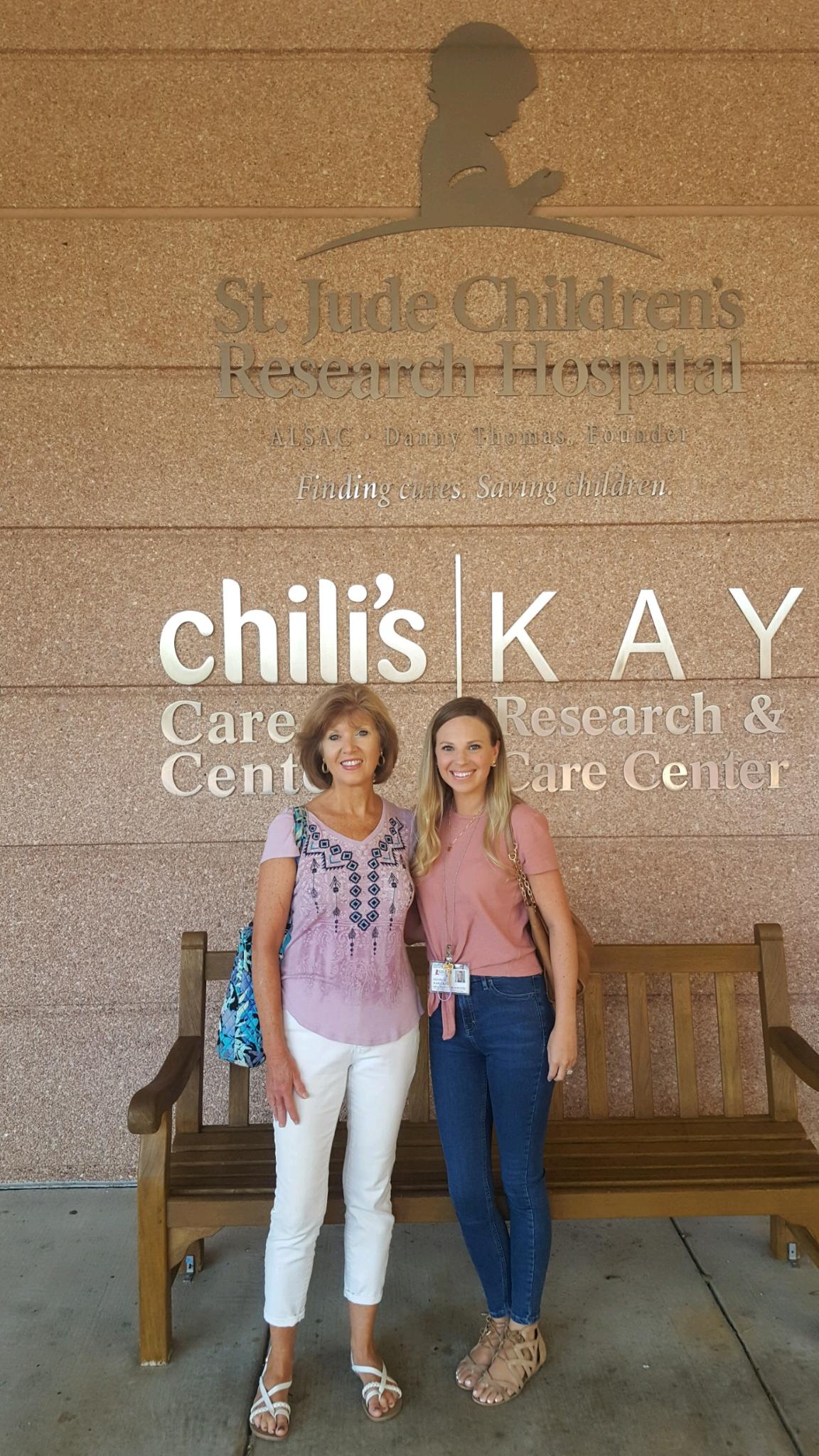
How fitting, then, that one of my sons married an occupational therapist with St. Jude. How ironic that he should meet this incredible young woman with a heart for children and the emotional fortitude to be strong and encouraging to them while they go through treatment. Through her, I’ve learned even more about the hospital and what it does, and it simply is incredible how far-reaching the impact of St. Jude is. They do so much more than treat their own patients. Their reach is world-wide, and their mission is clear. Let’s save as many children as we can.

But let me go back a bit. Over the years, I had heard about the marathons held in various cities across the country to raise money for St. Jude, and I really wanted to be a part of it. I was a runner in college but switched to fitness walking, an activity I have never stopped doing and an activity I credit for me being my age and being so healthy I take no meds at all except for the eye vitamins for my macular degeneration.

Oops, off track there. Back to the marathon. I wanted to do it, but a marathon is too long. I learned there was a 5K, a 10K, a half-marathon, and a full marathon. Our  niece does the full marathons each year (she’s in her mid-forties and still running them), and she was a good source of information about the event in Memphis and what it involved. I was thrilled to learn I didn’t have to run it, that there are actually lots of people who walk it or do a combination of walking and jogging. I couldn’t envision what it was like, and I had the crazy notion that I’d be so slow, I’d be at the end of the line and last one to finish and all that. I didn’t want to be stranded in Memphis, lost and wondering where to go, and I couldn’t find anyone willing to walk it with me.

So I procrastinated. I used my long work hours as an excuse. “I don’t have time to train,” I said. Or “I don’t want to do it alone.” Or even “The race is the first Saturday in December. I don’t like cold weather.” I made excuses but still dreamed of doing it.

With retirement in May, 2018, I realized I couldn’t make excuses anymore. I had all the time in the world to train. I would do it alone because I’d been reassured I would never be alone wandering the streets of downtown Memphis. And the weather? I’d just have to be a big girl and suffer through it.

I shouldn’t have worried, and I shouldn’t have waited so many years to do it. It was 70 degrees that day, the race being delayed an hour due to storms that had to get out of the way. Twenty-six thousand people were lined up in front of the FedEx Forum, and my husband and daughter-in-law helped me find my corral. When you sign up for the event, you give them a time limit you think you need to finish the race, then you are assigned a corral based upon your projected time.

I signed up that I would finish the 13.1 miles in four hours. I finished in three hours and seventeen minutes. Yes, I did jog some, but I couldn’t help it with all the excitement and the adrenaline pumping. At about mile marker 7, I began to wonder if I could finish it, but I found my second wind. At every mile marker, someone was handing us water or Gatorade. There were outdoor toilets if you needed them along the way. Part of the route took us by the Mississippi River. Part of it took us across the St. Jude campus, where employees, parents, and some patients were lined up to cheer us on and give us high five’s with those foam hands. Residents cheered us on from condo balconies. “You can do it, Pam!” they’d shout. My name was on the label (can’t think of another word for it right now) attached to the front of my shirt. Also attached to that label/sign was a tracking device so my husband and children could follow my progress on their phones. That same device recorded my time.

I know this is sideways, but I couldn’t figure out how to flip it, so…be creative in viewing!

Can you tell how important this event was to me? It was the highlight of 2018, more than my retirement, more than anything that year.

This year, however, the race can’t take place in Memphis. Instead, they have planned a virtual event in which participants do the races in their own towns and turn in their times. It won’t be as much fun. I’ll miss the energy from the other participants and the spectators. I’ll miss the camaraderie of fellow-racers who greet each other and cheer each other along. I’ll miss running across the St. Jude campus (I had to run that part, no way could I take the easy way and walk while seeing those kids and their families and knowing what their struggles might be), and I’ll miss the feeling of being a part of something bigger than myself.

In a way, though, I guess I will be. I may be walking a route in my town alone, but I’ll know that the money I have raised for the event is definitely going to something greater than myself.

You, too, can be a part of something bigger than yourself. Go online and donate. You don’t have to be a regular donor. You can just give one time. You can donate to my fundraising page if you’d like. Here’s the link:

https://fundraising.stjude.org/site/TR/Heroes/Heroes?px=5077785&pg=personal&fr_id=121077&fbclid=IwAR1Mafhu2o6nHJtxLBMIPe89Vz-xpM8HmeXOqyoC8XeTtpkaIAF5MUMLztE

Thanks for any help you can give to the patients of St. Jude!

Elvis Week Blog #3: Radio and EPE personality, Tom Brown, talks about his career and Elvis

Tom

This week, my blog has focused on Elvis because of Elvis Week, a celebration of his life that occurs each year in the week preceding the anniversary of his death. Today I’m excited to welcome radio and current EPE/YouTube personality, Tom Brown, to my blog.

Tom, I’d like to thank you for taking the time to talk with me. I know you are very busy with Elvis Week activities and other responsibilities, so my appreciation for your time is doubled. Before we start talking about Elvis, I’d like to talk about you. I read a very interesting bio of yours online, so I’d like for my readers to find out about your fascinating life and career.

Please share what your current job responsibilities are.My real gig is I’m the morning show host on Sunny 93.3 in Tupelo from 6:00 a.m. until 10:00 a.m. Monday through Friday. And I’ve been hosting events for Elvis Presley Enterprises since 2001.

 Born in Roswell, New Mexico, and raised in Tupelo, Mississippi, you’ve lived and worked in cities like Los Angeles and St. Louis. Tell us how you got started in a radio/television career.We moved to Tupelo when I was three. My dad was in the Air Force and was the recruiter here. I went to Ole Miss and majored in theater and minored in journalism. In high school, my part-time job was working in the movie theater here as house manager and projectionist and did that through the first two years of college. I always knew somehow I was going to be involved in theater. Right out of Ole Miss, I got a job here at the local TV station. I did whatever just to get into television. From here, I went to Shreveport, then St. Louis, then Los Angeles with TNT, and during those years, I was an entertainment reporter doing celebrity interviews. Then I moved to Atlanta in 1998 as vice-president of production for Turner Classic Movies.

 (At this point, Tom and I discussed his weekend schedule. What follows is a summary of what he told me.)When he lived in St. Louis and worked with the ABC affiliate there, Tom’s weekend schedule was a hectic one. Each Friday, he flew to either Los Angeles or New York, each flight just two and a half hours from St. Louis, and upon arrival prepared for the celebrity interviews he would be doing that weekend. That preparation included watching two or three movies. The next day, he went to the location for the film junket. If you’ve ever seen the movie, Notting Hill, you have seen how a film junket works. Reporters are given access to the stars of the film being promoted and go from actor to actor. According to Tom, many actors were often bored by answering the same questions over and over, and they didn’t understand why those questions had to be asked. He strove to ask unusual questions along with the usual in an attempt to give his interviews a fresh twist.

Of the multitude of celebrities he has interviewed over the years, his three favorites were Tom Hanks, Robin Williams, and Burt Reynolds. “Any time you would sit down to talk to them, they were always there to listen to you,” he said. “They made you feel like you were the only one doing an interview that day. They made you look good. This was in the days before the Internet, so I would always do the research and find some hot button topic to talk about.” Tom went on to say that Burt Reynolds was a favorite actor. “When I worked as a projectionist, I probably saw Smoky and the Bandit two hundred times. So, it was special to sit down and talk to Burt Reynolds.”

 You told me you were active in plays in high school and college, but you also told me Johnny Carson of The Tonight Show was your career idol. Why was that?I knew I wanted to be on television or on stage or something, and in high school and college, I really didn’t like learning lines and scripts and doing the same things the same way every time. When I watched Johnny, I watched him make everybody else look good, and by him making everybody else look good, it made him look great. The training in theater helped me to have confidence on stage and be prepared and all the tricks you learn to be in front of people. What you get from theater is how to meet people, how to interview, how to fake it until you figure it out.

As much as I love hearing about other celebrities, it’s time to talk Elvis. I first saw you in a “Gates of Graceland” episode on the Graceland website, and I loved getting the behind-the-scenes information and seeing items stored in the archives. Most people don’t know that Elvis Presley Enterprises is the company that handles all things Elvis. You said you’ve worked for them since 2001. What have your responsibilities entailed?I started hosting events for them in 2001, and we started “Gates of Graceland” five years ago. It’s a good way to show people the things they can’t see on the tour. For example, on the tour you go around the outside of Vernon’s office, but on “Gates,” we went into it and opened the drawers.

Are there any interviews for the series that stand out to you?My favorite one might be going into Vernon’s office to see his organizational files and the checks they cut. It showed the business side of Elvis Presley. One of the other ones I really love is unusual and fun.  Angie’s staff cleans the mansion and then put everything back where it was. (Note: Angie Marchese is in charge of the archives at Graceland and is featured in numerous “Gates of Graceland” episodes.) One time while they were cleaning, they found a Samurai sword in a drawer and didn’t know why it was there. They did what they were supposed to do and put it back. We featured this in one of the episodes. The head of Elvis’s security, Dick Grob, saw the episode and called me and said he knew why it was in the drawer because he was the one who put it in there. A few months later, he came to Memphis for an Elvis event and we took Dick to where it was found, and he told us the story. You can watch the episode to find out why it was there. Angie and I were both hearing it for the first time when he told us on camera.

I think radio and television personalities like you, and writers/bloggers like me, have a curiosity about the world and the people in it. That curiosity is often manifested in the things we write about or the people we interview. Do you come up with the ideas for the “Gates of Graceland” series, or are they assigned to you?Alicia Dean, who works for Elvis Presley Enterprises, is the producer, and she and Angie get together and talk about things to do. I never really know what we’re going to shoot.  I do better if I don’t know. When you see me on camera looking at an artifact, I’m seeing it for the first time.

You have interviewed numerous people associated with Elvis. Have you ever talked with Priscilla or Lisa?I’ve interviewed Priscilla, Lisa, extended family members, co-stars, band members, and his closest friends. The only person in the Elvis circle I never interviewed was Elvis.

Too bad you never got to interview him. Did you ever get to meet him or see him perform? I never met him, but I did get within four feet of him. In 1974, I had tickets to an evening concert at Mid-South Coliseum in Memphis. My mom dropped me off at Graceland earlier that day, and there were other people hanging around. Elvis’s uncle, Vester, was in the guardhouse by the gate, and he told me if I hung around a while, Elvis would be coming down soon to go to the Coliseum for the matinee performance.  When the car came down, I remember seeing dark hair, sideburns, sunglasses, and a white coat, and a hand with rings on each finger when he waved as they went by.

 Let’s talk about Elvis Week. Fans already know this, but some of my readers may Not. Elvis Week is held each August and is normally full of activities like ETA performances, competitions, a 5K (well, there used to be one), interviews with people who knew and/or worked with Elvis, musical events, and special activities like a bus trip to Tupelo to see his birthplace. Because of the COVID pandemic, this year is a virtual Elvis Week. What about the candlelight vigil that is always held the night of August 15, when thousands of people, carrying candles, walk by the graves next to the mansion? How is it being handled?They ran many scenarios of how candlelight could proceed, and they came up with an abbreviated version. People were encouraged to go online and sign up for a time, and they will go through during that block of time. There’s a limit every hour to the number of people that will go through. I’m in the 10:45 to 11:00 p.m. window. My wife and I are going as fans because my work is over by then. I didn’t want to miss it.

Mrs. Marian Cocke, the nurse who took care of Elvis the last few years of his life, is a friend of mine. She said when she first met Elvis, she admitted to him she didn’t care much for his music. However, when she got to know him and came to love him, she became a huge fan of all things Elvis. What about you? Have you always been an Elvis fan, or was it something that came about as you worked on Elvis-related projects?When we moved here when I was three, we lived three streets from his birthplace. In kindergarten, we drove by his birthplace every day going to school, the same school Elvis attended growing up. With his music and movies and the history of his life in Tupelo, I was surrounded by reminders of Elvis, so I came to know a lot about him. I just felt like Elvis was a family member I didn’t know very well. Learning about Elvis was encouraging to me growing up because my dad said, “If this kid could do this, you can do anything. I don’t remember a time of not being an Elvis fan. I’ve always been the Elvis guy. It’s been the arc of a rocket with my work in radio and television colliding with Elvis. I couldn’t do this for someone like Bruce Springsteen because I could never learn enough about them. With Elvis, it is a lifetime of learning. It’s a cumulative knowledge.

Is there anything you’d like to add?One thing I always love to include is a quote from Jerry Schilling, a friend of mine and a friend of Elvis. We have to pass Elvis down to younger generations. To someone of any age, if you introduce Elvis music and Elvis movies, Elvis will take care of the rest. There’s something about that guy. It was true in 1954, and it’s true today.

Thanks again, Tom, for taking the time to talk with me. I enjoyed our chat and am looking forward to more episodes of “Gates of Graceland.” I appreciate how you TCB! (Elvis fans know what this means!)


Elvis Week Blog #2: Re-posting my interview with Elvis’s nurse, Mrs. Marian Cocke

11800309_1183775174972400_1818217566677298549_n

Meet my sweet friend I met through purchasing her book for my son at Christmas six years ago. Because I’m blogging about Elvis this week, I thought I’d share an earlier interview with her. Hope you enjoy it, whether you’re reading it for the first time or the second!

The photo is a very bad selfie I took in 2015. Wish I had taken another one when visiting with her a few months ago!

I’m thrilled to welcome my special friend, Mrs. Marian Cocke, to my blog today. Mrs. Marian, as I call her (refer to my earlier blog about speaking Southern to understand this), and I became acquainted four years ago when I heard her being interviewed on Sirius XM Elvis radio promoting her book, I Called Him Babe, an account of her time serving as Elvis’s personal nurse and friend. I decided to purchase the book and accompanying CD as a gift, a purchase that led to several phone calls and eventually meeting this incredible lady.

With January 8 being Elvis’s birthday and Birthday Week being celebrated at Graceland, I thought it would be fun to “chat” with her and talk about some of the events described in her book.

Mrs. Marian, thanks so much for agreeing to share your time with me and my readers. Please tell us a little about yourself.

I was born on July 1926 in Fort Benning, Georgia, to Howard and Nocal Justice and lived in Benning the first eight years of my life when my dad transferred to Scofield Barrack, Honolulu, Hawaii.  I grew up on four different Army posts: there (Hawaii), Ft. McClellan, Alabama, Fort Davis, Panama Canal Zone, then on to Ft. Jackson, South Carolina, and four days later, the Japanese stormed Pearl Harbor and Daddy was transferred to the Army Depot in Memphis as the Adjutant then later as the Executive Officer.  From the age of five, I had wanted to be a nurse, but when I graduated from Whitehaven High School I was only 16 and too young, so when I became 19, I entered The Holy Name of Jesus Hospital in Gadsden, Alabama.  After graduation I worked at that hospital before moving back to Memphis to be with my family and worked at the VA.  On 9-13-52, I married Robert Cocke and on 10-12-53, our daughter, Katey, was born.  We lived in Memphis through the remaining years. I worked for a thoracic surgeon for 12 years before joining the staff of nursing at Baptist Hospital as an IV nurse, two years later becoming a unit supervisor and two years later becoming an administrative supervisor which gave me the responsibility of several nursing units.  I retired from Baptist in 1984 and a year later the VP of nursing called me and asked me to come back, which I did as I had missed it. I returned as an Administrative Supervisor and worked another 16 years when my doctor made me retire due to health reasons.  Do I miss it? Yes, I still miss being a nurse.

How and when did you first meet Elvis?  I met Elvis in January of 1975 when Dr. Nick came to me at my nursing unit and told me that Elvis needed to come in, and he wanted him on my unit. I wasn’t overly pleased because I was afraid it might cause a disruption to my unit. But he came a couple of days later. I had been holding the suite for him, and I must confess that when I walked in and met him, he totally walked into my heart.

We spent the day together as it was actually my day off, and he asked me what I wanted him to do about private duty nurses, and I told him whatever he wanted to do. He said that he would have them, but he wanted me to take care of him. I told him that I would, but he needed to know that I ran the floor, saw 51 other patients twice a day, and ran the unit. We would but the 3:00 to 11:00 nurse and 11:00 to 7:00 nurse in the same position. This was done and worked out fine. Elvis was in the hospital three weeks, and on Valentine’s, he gave me a beautiful diamond cross on a gold chain. He gave the 3:00 to 11:00 nurse a diamond ring, and the 11:00 to 7:00 nurse a very delicate gold chain with a small diamond cross on it.

He was discharged a few days later, and I didn’t hear from him until August of that year, sayig he needed to come back in but it had to be my floor. We had a patient in the suite, and I called Maurice Elliot, one of the VPs, to see if I could ask him if he would transfer to another unit as Elvis wanted to come back to our floor. He immediately agreed. The room was readied, and when Elvis called me back an hour later, I told him the suite was ready.I got a call about 9:00 that night. He was back, and would I please come in?

  When I walked in, he hugged me, told me he had lost weight, and up his shirt so I could see a flatter belly. I rubbed his belly and “yes, yes, you sure have” and the next thing he said was that he had a new car coming for me the next day. I told him I didn’t need a car as I had one and couldn’t drive but one at a time. He said that if I didn’t want it, I could give it away, but it was coming, and it did.

The next day it came, white with white leather upholstery and beautiful. When he left the hospital that time, Dr. Nick said that he needed a nurse for a couple of weeks to monitor his BP at home, and Elvis told him he wanted me to go home with him. I told him that I had a job with Baptist, and he asked if I could just come for a couple of weeks, so I talked it over with Bob and Katey that night. He said, “Okay, two weeks.”

When I went to work the next day, the first thing he asked me was if I could come. I told him, “Yes, for two weeks,” and he told me to bring my SS card. I asked why, and he said so I could be paid. I told him I would come but wouldn’t take his money, and he asked me why I wouldn’t take his money, everyone else did. I told him I thought it was time somebody did something for him for a change. When I told Kathy (the other nurse who was going to go from 10:00 a.m. until 2:00 p.m. every day), she said she wouldn’t take any money either.

She stayed until the latter part of November. Her husband was in the Navy and was transferred, so she left, and I continued on, still not accepting a salary. For Christmas that year, he gave me a 21 karat aquamarine ring cut in four tiers and with two karats of diamonds around the ring. I stayed until the end of January until my mother became terminally ill with cancer, so I had to leave, took a leave of absence from the hospital, and stayed with my mother until she died the latter part of February.

Elvis sent beautiful flowers. He went to Hawaii and was back on the road doing shows, but any time he called me and asked me to come out to Graceland and see him, have a cup of coffee, rub his back, I always went. The last time he called, it was just a few days before he died. It was 2:00 a.m. I got up, went, sat on the side of his bed, and he spoke very little. He said that he just needed me to come out and be with him. Ginger was there, though she left the room and came back later, around 6:30. He told me he was okay and I should go home and get some sleep.

He hugged me goodbye, and when I got to the door to leave his room, he called to me and said, “Miss Cocke, the doors of this house will always be open to you.” Had I known that his passing would be so soon, I would never have left.

I love it that you told Elvis you didn’t care for his music. What was his reaction, and did you eventually change your mind? We were sitting in Lisa’s room where we always sat. He asked me if I had been to any of his shows , and I told him no, that I wasn’t into his kind of music. He said, “Well, are you a fan now?” And I told him yes, but I knew him now.

In your book, or maybe on your CD or both, you talk about the relationship you and Elvis developed. How would you describe that relation? When I had spent that first day with him, we talked a lot, watched Brian’s Song, and we cried together. We spent the entire day talking other than for the movie, and the chemistry between us clicked. We were comfortable with each other and had respect for each other. He wouldn’t call me “Marian” because I was older, though only by nine years. He shared many stories as he shared feelings about some of the people who worked with him or for him. He told me about some of the things that some those who worked for him had asked for. How they came to work for him. He also told me many times of his respect and admiration for George Klein and Jerry Schilling and how these two men were always there for him. And how much they meant to him. He had the utmost faith and trust in the two of them.

I can remember it making the news when Elvis bought cars for people. Tell us a little more about what happened when he gave you yours. The day the car was delivered, I was making his bed (in the hospital) and he was in the sitting room. He called me and asked me if I would come over to where he was. He was standing at the window. I went over and asked him what he needed. He told me to look across the street. I did, and there it was, this beautiful white Grand Prix. I looked back at him, and he was dangling the keys. I snatched those keys, ran out the door, told my secretary I would be back in a little bit, and left the floor. I went to the nursing office, got the VP of Nursing, and when we got across the street, the man who had delivered the car was standing by the door with the door open. He told me, “She’s all yours.” I got in as did the other two, and as I pulled away, I ran over the curb. I looked up at his window, and he was standing there with his hand over his eyes. When I left that day, I had gone and thanked him for my beautiful car, and he hugged me and told me that I was very welcome and I deserved a pretty, new car. When I got off duty, I had called my mother and told her to come downstairs and I would take her for a ride in my new car that Elvis had bought me, but when I left my unit, there were three TV stations there, so I went back.

You also became close with his family, and I love your Aunt Delta stories. Would you care to share one of them with us and explain to my readers who she was? Delta and I became very close, and after Elvis died, I continued to go to Graceland every week to see her and Dodger (Elvis’s paternal grandmother). Sometimes we would have lunch at home, but most of the time we went out to eat and shop, especially after Dodger died. One afternoon, she called and said that Dodger was sick and would I come out and spend the night? I did that several times, and she always wanted me to sleep with Dodger, which I did, so I would be there if she awakened and needed anything. I loved both of these two ladies, and there wasn’t anything I wouldn’t do to help either of them or Vernon. He was a very nice man, and I wanted to be there for him when he wanted me to help with anything.

What was the most extraordinary or memorable experience you had as a friend of Elvis?

That’s really easy. It was the night we were visiting in Lisa’s room where we always sat (as I shared her bedroom with her), and he reached his hand over and placed it on my knee and said to me, “Miss Cocke, you’re one of the few people that I know who has never asked anything from me but friendship.” There is no way to top that.

We don’t have enough  time or space here to talk about everything that happened during your time as his nurse and confidante. Is your book still available for purchase? If so, how?

I have the books myself and sell them from my home or from Marlowe’s. The books are $25.00 which includes shipping and handling in the United States. Outside the country, the price varies, depending on where it is.

(If any of my readers would like to know how to contact Mrs. Marian about purchasing a book, email me at authorpamharris@gmail.com, and I will get word to her.)

Some people may not be aware of how generous Elvis was with local charities, and you have helped keep that legacy alive. What can you tell us about the Elvis Presley Charitable Foundation?  The only thing I know about the Elvis Presley Charitable Foundation is that is 100% charitable only, and our (annual)) dinner, the Elvis Presley Memorial Dinner, gives 1/3 of what we make to the foundation.

(Note from Pam: I may blog more about the Elvis Presley Memorial Dinner in August, and with my limited knowledge, it is my undertanding that the proceeds help people with severe health challenges and organizations that help them. I need to learn more about it.)

At the beginning of our chat, I joked about how you didn’t care for Elvis’s music before you met him. I know that you changed your mind. Do you have a favorite song?

I actually have three, in this order: “I’ll Remember You,” “The Wonder of You,” and “Memories.”

Is there anything else you’d like to say about your book, the Foundation, or Elvis himself?

He was a very special young man, more like my child to me despite the fact that there were only nine years’ difference in our ages. I loved him then and love him still. There is never a day that goes by that he isn’t in my thoughts and prayers. Our daughter, our only child, went to Jesus eighteen years ago this July. I miss him like I miss our Katey who was our pride and joy. She died at the age of 47, and her husband, who had been a city engineer, had been killed in an auto accident many years before she left us.

Mrs. Marian, you have led an interesting life and have experienced much loss, but I always admire your positive spirit and strength. You are an example for all of us. Thank you again for taking the time to answer my questions. I’m looking forward to seeing you soon!

Thanks, Pam, I look forward to that too!

Elvis Week blogs: the people I’ve met and friends I’ve made through Elvis. Today I

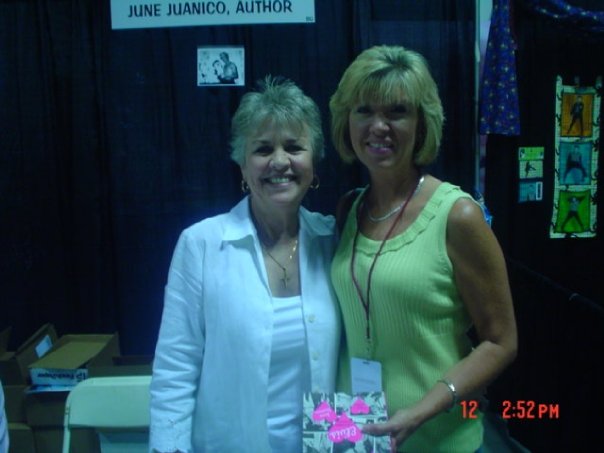
Pam and June Juanico

Elvis Week is held each August in Memphis, ending on August 16, the anniversary of his death. The photo above is of me and June Juanico, his girlfriend around the mid-fifties. Although I have never attended the multiple events of Elvis Week, I did attend an expo one afternoon at the convention center in Memphis in 2007, and that is when I bought June’s book and had a chance to chat with her.

Elvis Week is a big deal. In 2017, David Beckwith, a spokesperson for Graceland, said that 30,000 to 50,000 plus people come from all over the world each year to participate in the festivities. Activities include tours, ETA (Elvis Tribute Artist) competitions, interviews with people who knew Elvis, including his close friends and some of his co-stars, a 5K to raise money for charity, art contests, and much more.

This year, however, Elvis Week is all virtual because of the pandemic. I thought it might be enjoyable for my Elvis-fan followers to read about the guy that means and meant so many different things to so many. Elvis fans are a unique group. From kids to teens to grandmothers in their eighties, his following is unparalleled by any other entertainer.

I often say I’m an Elvis fan but not a fanatic. I was born the year he reached national prominence with “Heartbreak Hotel” and his first movie Love Me Tender, meaning I was too young to be part of the hysteria. My older brother, nine years my senior, owned several Elvis records, so I listened to them. He and his girlfriend took me to see movies like Blue Hawaii. As I grew up, I continued to enjoy his movies and music, and that devotion continues to this day.

Beyond that, the Elvis story fascinates me. The rags-to-riches, the unnoticed to the famous. As a Southerner, I understand the culture in which he grew up because my parents lived in that same culture. It was a culture that embraced family connections and God above all else. It was a culture of poorly educated people who knew what hard times and low-paying work meant. Because of my parents’ accounts of their growing up during the Depression and the way my own parents valued their brothers and sisters, nieces and nephews, and parents to the point of almost excluding outside friendships, I could identify with Elvis and his background. It was familiar turf.

I’ve made some great friends in the U.S., the U.K., and France. One particular group formed in 2004, when a school nurse from New Hampshire posted a challenge in a chat room for anyone interested in walking for fitness. If you know me at all, you know I’m all about that! Priscilla, Anna, Gail, Evie, Heather and I posted our walking totals for the day. Then it developed into learning about each other’s families. We talked about our dogs. Anna, Priscilla, and I talked about schools and Anna’s adventures in Alaska with her teacher/hunter/fisherman husband. Gail and her husband came to Memphis from England for Elvis Week. My husband and I picked them up at the hotel and showed them around Memphis, including a tour of a model home in Germantown and a meal at Cracker Barrel, which was a novelty for them. Evie, another Brit, and I have talked on the phone a few times. We’ve watched Heather’s children grow up, celebrated the marriages of other children, consoled each other in times of loss, rejoiced with the births of children (our group ranges in age!), and connected because of our common thread.

That group expanded to include Joan and Barbara, and one year several of us met for breakfast in Memphis. They were here for Elvis Week. We were in Memphis to visit our son. We now keep in contact with each other through FB. How great is that?

Yes, I’ve met some great people, not the least of which was Gordon Stoker of The Jordanaires, the back-up group for Elvis in his movies and many of his records. Well, I met him by phone. He was from my county, and his niece helped set up the interview that was published in our local newspaper then a neighboring city’s newspaper then picked up by Australia’s Elvis Information Network. I found it online last night and decided to share it with you here. For some reason, there is a blank space I can’t delete, so keep scrolling to find the article!

Gordon Stoker

EIN shines a spotlight on Gordon Stoker of The Jordanaires

by EIN contributor Pam Harris


Back in 1955 a young Elvis approached The Jordanaires at a Eddy Arnold show in Memphis. Elvis said, “If I ever get a recording contract with a major company, I want you guys to back me up”. The Jordanaires’ first tenor Gordon Stoker remembers that, “We never expected to hear from him again as people were always coming up and saying that”. However Elvis kept his word and from 1956 Elvis used the Jordanaires on nearly all of his recording sessions for the next 14 years. Elvis also made sure that The Jordanaires were credited on his record labels when surprisngly no other producer or musician was mentioned.

For the past 53 years, from 1953, Gordon Stoker has always been the first tenor of The Jordanaires and still works with them today. The influence of the Jordanaires’ voices blending with Elvis’ rich baritone has been such an influence on music culture that even The Beatles Paul McCartney informed Gordon Stoker that, “When Elvis’s records came out, we listened to the vocal backing harmonies. They encouraged us to sing harmony.”


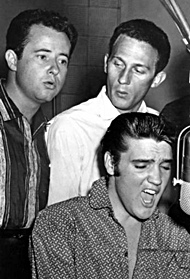
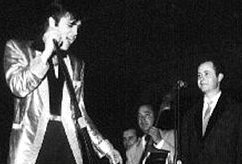
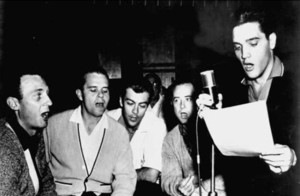
(Above photo: Gordon Stoker & Elvis, May 28th 1966 at the ‘How Great Thou Art’ session)


Gordon Stoker Passed Away aged 88. Very sadly Jordanaire Gordon Stoker died, after a lengthy illness, at his home on March 27th 2013.
The Jordanaires originated in Missouri but came to Nashville, where they backed Red Foley on a segment of the Grand Ol Opry called the “Prince Albert Show”.
Gordon Stoker joined the Jordanaires as their piano player, but soon became their tenor vocalist.
The quartet then developed a national audience after performing on the Opry and the nationally syndicated show, “Eddy Arnold Time.”
Stoker has noted, “Elvis was attracted to the Jordanaires sound as he he’d heard us sing those spirituals. We were working with Eddy Arnold and we went to the Ellis Auditorium in Memphis to do a show. Elvis came back behind the stage to meet us, not to meet Eddy. Elvis said, ‘Man, let’s sing some of those spirituals.’ So, we got to singing with him in the room. That’s when he said, ‘If I ever get a major recording contract, I want you guys to work with me.’ He was on the Sun label at that time. We didn’t think anything about it, we had been told that by a lot of people. It didn’t mean anything at all. But, when RCA signed him in January of 1956 he asked for us.”
The Jordanaires’ impact on Presley’s recordings should not be underestimated. Their smooth yet effervescent backgrounds made Elvis’ raw-boned rock’n’roll palatable to mainstream radio programmers. Elvis’ major hits such as ‘Don’t Be Cruel’, ‘Teddy Bear’, ‘Too Much’ and ‘Don’t’exhibited the type of vocal interplay that Presley could not have achieved on his earlier recordings.
At Presley’s request, the Jordanaires received billing on all his vinyl releases, a sign of respect that he didn’t accord his band members.
On tour The King’s delirious, screaming fans made it difficult for the group to hear the singer. As a result, Presley had the Jordanaires stand very close to him on stage. “We could also tell by the movement of his head or the movement of his body where he was in the song,” explained Stoker. “But, we would be as close to him as we could possibly be. Elvis even wanted it that way in the studio. He always wanted us standing right behind him on those TV shows we did with him. Many times he’d step back on my toes. But you couldn’t hear anything because of the screaming and hollering.”
As a member of the Jordanaires, Stoker also performed with Patsy Cline on “Crazy”, “I Fall to Pieces” and “Sweet Dreams,” and with Ricky Nelson on “Traveling Man” and “Hello Mary Lou.” The group provided backing vocals for Sissy Spacek in the 1980 bio-pic of Loretta Lynn, “Coal Miner’s Daughter.”
“He could play by ear,” said John Rumble, historian at Country Music Hall of Fame and Museum in Nashville. “Anything he could hear on the radio, he could play it.”
The Jordanaires, who recorded many gospel albums on their own, were elected to the Country Music Hall of Fame in 2001.
Gordon Stoker August 3, 1924 – March 27, 2013, R.I.P.

The following is an excerpt of an article that first appeared in The Weakley County Press (Martin, Tennessee, USA) on May 11, 2004.


Gordon Stoker could be a name-dropper, if he wanted to be. After all, he has recorded with the likes of Patsy Cline, Jim Reeves, Loretta Lynn and Elvis, just to name a few. His list of co-artists includes more than 2,000 pop and country stars of the ‘50s, ‘60s and ‘70s, and he has known the joy and sorrow of friendships that ended all too soon such as those with Reeves, Cline and Ricky Nelson, who all died tragically in plane crashes.

He could be a snob, if he wanted to be. His awards are too numerous to mention, but the 2003 Grammy for the Best Southern Country Gospel Album definitely stands out as do inductions into several halls of fame, including the Country Music Hall of Fame in 2001. He has traveled the nation and the globe, appeared in movies and on television, and been a regular on WSM’s “The Grand Ole Opry” in Nashville. To someone outside of entertainment circles, his accomplishments are impressive if not overwhelming.

But Gleason (Tenn.) native Gordon Stoker is neither a name-dropper nor a snob. He is instead a sincerely nice gentleman who loves his hometown and home county, loves his family and loves what he does—singing and performing with The Jordanaires quartet. He is a humble man and has been content to lend his talents as a background vocalist and musician to singers of all genres.

Stoker reflected on his successful career and remembered that a record producer “told us not to worry about making the Hit Parade. He said, ‘The background field will be good to you.’” The producer was right. While other entertainers have come and gone, The Jordanaires are still recording and performing for audiences. “Back-up work is steady,” Stoker said. “You’re not here today and gone tomorrow.”

Steady, indeed. He’s been at it for 54 years, and his 2004 schedule is full. The group just cut a Christmas CD and is preparing to record a bluegrass collection. Stoker recently returned from a performance in Canada and he and the group leave for Ireland at the end of May this year. They’ll be in Tupelo, Mississippi, on June 4 to do an Elvis tribute and in Tunica in August.

Stoker’s musical career began early. Everyone in his family—his parents, two brothers, a sister and Stoker—sang and played musical instruments. His mother and brother Wayne played the guitar. Gordon’s specialties were the piano, organ and accordion. They sang and played at singing conventions—a term used in the south for gospel singing get-togethers—that were common on the weekends in the 1930s. They sang locally but occasionally traveled to Jackson and Memphis. “As far as we could go in those days, we went,” Stoker said.

Stoker recalled winning his first award at a convention in Weakley County when he was 7- or 8-years-old. He still has it proudly displayed among his other, more prestigious honors. “I sang ‘Have you ever been lonely, have you ever been boo,’” he said, chuckling over his youthful mispronunciation of the word “blue.” He also won medals at various competitions for being the best pianist. His real break came, however, when at age 12 or 13 he impressed John Daniel of The Daniel Quartet, regulars on the Grand Ole Opry.

Stoker was at the annual Snead Grove picnic, which drew thousands of spectators to McKenzie to see the showcased talents of local and Opry stars, when Daniel heard him perform with the Clement Trio of McKenzie. Stoker was the regular piano player for the group, which had garnered quite a bit of local recognition.

When Daniel heard the young pianist, he was impressed. He asked Stoker his age and told him that he’d give him a call after Stoker graduated from high school. He would, he said, make the young man a star.
“I never dreamed he’d do it,” Stoker said, knowing that graduation was still five or six years away. However, Daniel kept up with the young musician and kept his promise. He called Stoker the week he graduated, and Stoker headed 150 miles east to Nashville, where he performed with The Daniel Quartet. Stoker didn’t know it, but he had left his hometown for good.

In 1943, the United States was embroiled in a brutal world war and Stoker was drafted into the Air Force. The same nimble fingers that danced gracefully on a piano keyboard also flew across typewriter keys and enabled him to serve his country as a teletype operator in Australia. There he monitored air traffic and was discharged from the service three years later. Upon returning to the states, he attended college for a while in Oklahoma and then Peabody College in Nashville, planning on becoming a teacher. There he rejoined The Daniel Quartet.

Little did he know that his future was being determined by a group of four men—brothers Bill and Monty Matthews, Bob Hubbard and Culley Holt—in Springfield, Missouri, who began in 1948 as a barbershop, gospel and country quartet. They called themselves The Jordanaires. By 1949, they had secured a regular Saturday night spot on the Grand Ole Opry and had also gone through some personnel changes. Bob Money, their pianist at the time, was drafted and Stoker auditioned to be his replacement. He got the job.
“I was not the best musician by any means,” Stoker said modestly. They told him that his playing style was not fancy but just the style they wanted. After establishing himself as a pianist, he had the opportunity to become the first tenor in the group and his position was secured.

The Jordanaires continued to be regulars on the Opry. On a Sunday afternoon in 1955, they played a show with Eddy Arnold in Memphis. Afterwards, a blonde, courteous young man, wearing a pink shirt and black pants, approached them and told them that if he ever got a recording contract, he wanted them to sing back-up for him. Stoker said he didn’t think much about it at the time; people often did that and continue to do so today.

On Jan. 11, 1956, Chet Atkins called Stoker to do a session with a new singer that Atkins said probably wouldn’t be around very long. It was the same young man that had approached them that day in Memphis—Elvis. RCA had just signed The Speer Family and Stoker, along with Ben and Brock Speer, sang back-up for “I Was the One,” the first recording session Elvis had ever done with vocal background. In April, they were called upon again to sing back-up for Elvis in Nashville.

Elvis, who had heard The Jordanaires regularly on the Opry, didn’t know that Stoker was the only actual member of the group that had recorded with him. He called Stoker aside and told him that he wanted the group to sing back-up for all of his songs. So began a relationship that lasted for 14 years.

(Right: Elvis & Gordon Stoker, live in Canada 1957)

“The greatest thing that ever happened was when Elvis asked us to work,” Stoker said. Elvis insisted that The Jordanaires’ name be placed on the record labels, and the recognition they received opened doors to other opportunities. “Elvis opened the door for everybody,” Stoker said. “You could hardly find a guitar picker anywhere in those days. Now there is one on every corner. Elvis has inspired the world to sing and play.”

The Jordanaires ended their recording relationship with Elvis when he began to perform in Las Vegas. Stoker said that two shows a night were too hard for anyone to do. Elvis replaced The Jordanaires with The Imperials, who were later replaced by J. D. Sumner and The Stamps Quartet. According to Stoker, Sumner and The Stamps were about to quit when Elvis died.

“I’ve always felt that two shows a night is what killed him,” Stoker said. He believes the rigid schedule prompted Elvis to become more dependent upon prescription drugs.

Stoker’s loyalty to Elvis is obvious. He has refused numerous offers to have his biography written, believing that writers are more interested in digging up the negative about Elvis Presley more than the positive. He has only good things to say about Elvis and insists that Elvis did much more good during his lifetime than what most people realize.

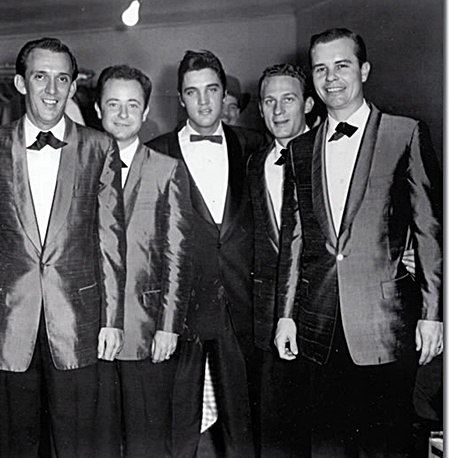
(Right: Elvis & The Jordanaires, with Gordon Stoker right beside, him at the ‘GI Blues’ session)

Those who know Stoker are quick to smile and speak kindly of this humble, gracious man. Perhaps Todd Morgan, the director of media and creative development at Elvis Presley Enterprises, describes him best. “Anyone who thinks Dick Clark is the eternal teenager of show business has never met Gordon Stoker,” he wrote. “His energy and passion for life and work and family and friends is boundless. He’s always got something going on. The only thing he has at the ready more often than music is humor. Any conversation with Gordon always involves a good laugh.”

Not a name-dropper nor a snob, just a kindhearted gentleman blessed with enormous talent. Weakley Countians can be proud to call him their own.

EIN thanks Pam Harris for her contribution.

You can also check out the The Jordanaires website at www.jordanaires.net

Copyright Elvis Information Network 2006. Do not re-publish this interview without permission.

Click to comment on this interview


Did You Miss These Popular EIN Features
Interview: Scotty Moore
DVD: Jukebox Rock ‘N’ Roll Vol. 1
Elvis guide to Memphis
James Brown/Elvis NOT a racist
CD Releases in 2006 – final update
Book Review: The Louisiana Hayride Years
Sale of EPE Archives
Interview: Kevan Budd
Reviews
DVD: Jukebox Rock ‘n’ Roll Vol. 1
Book: E.P in Concert
Book: Elvis The Louisiana Hayride Years 1954-56
CD: The Complete Million Dollar Quartet
CD: Elvis movies
Book: The “Love Me Tender” Years Diary
Book: Elvis at 21 (Wertheimer)
Book: Inside G.I. Blues
Articles / Spotlights
EP In Concert “downunder” 2006
Elvis in the “gossip” mags – a pictorial review
Visiting Graceland
Elvis In Concert (1977) – should it be released?
The Geraldo Rivera (“20/20”) investigations into Elvis’ death
The real failure of Elvis’ movie career
Is Elvis a religion?
Latest Interviews
Kevan Budd (Dec 2006)
Ken Sharp (author: Writing For The King)
James Forsher (Love Me Tender Years Diary)
Wayne Jackson (Memphis Horns)
Billy Miller
Ernst Jorgensen (Record Collector)
Betty Harper (world famous sketch artist)
Audio-Visual
Graceland cam
Charmaine’s Elvis Graphics
EPE’s Multimedia Elvis Gallery
Sirius Elvis Satellite Radio
Elvis Radio (ETA’s)
Elvis Express Radio
Elvis Only Radio
“Images in Concert” PhotoDatabase
Sanja’s Elvis Week 2006 Photo Gallery


I’ll be sharing more about people I’ve had the privilege to meet this week, so I hope you’ll check back againl, and feel free to leave your own comments!

Why didn’t I think of this before???

IMG_0263

I have a confession to make. I’ve been discouraged, and that discouragement has made me a bit lazy. Well, maybe not lazy. But exhausted. Discouraged. Frustrated.

If you know me or follow my blog, you know I am visually impaired due to the rods and cones in my retina dying. The vision continues to worsen almost daily, it seems, and while I was and am extremely thankful for Iris Vision, it was not the fix-all I had hoped. Don’t get me wrong. I use it for watching television and before today, for using the computer. I have to use it to use my phone (for the stuff Siri can’t help with). I use it for reading short things and for writing. Speaking of writing…my deepest apologies to those of you I have sent cards to. I still want to do that, but I know my writing is horrendous and sloping and all that, but maybe it is legible.

Anyway, back to my confession. As wonderful as Iris Vision (we call it Ivy from IV, get it?), I can only use the device for an hour or at most an hour and a half while working on the computer. I can wear it several hours while watching television, but something about that computer use is a little more challenging.

So I basically gave up. I didn’t blog. I didn’t work on new writing projects. I avoided computer use, only checking Facebook once or twice a week for notifications. I never scrolled through it, so if I missed an important announcement from you, I apologize.

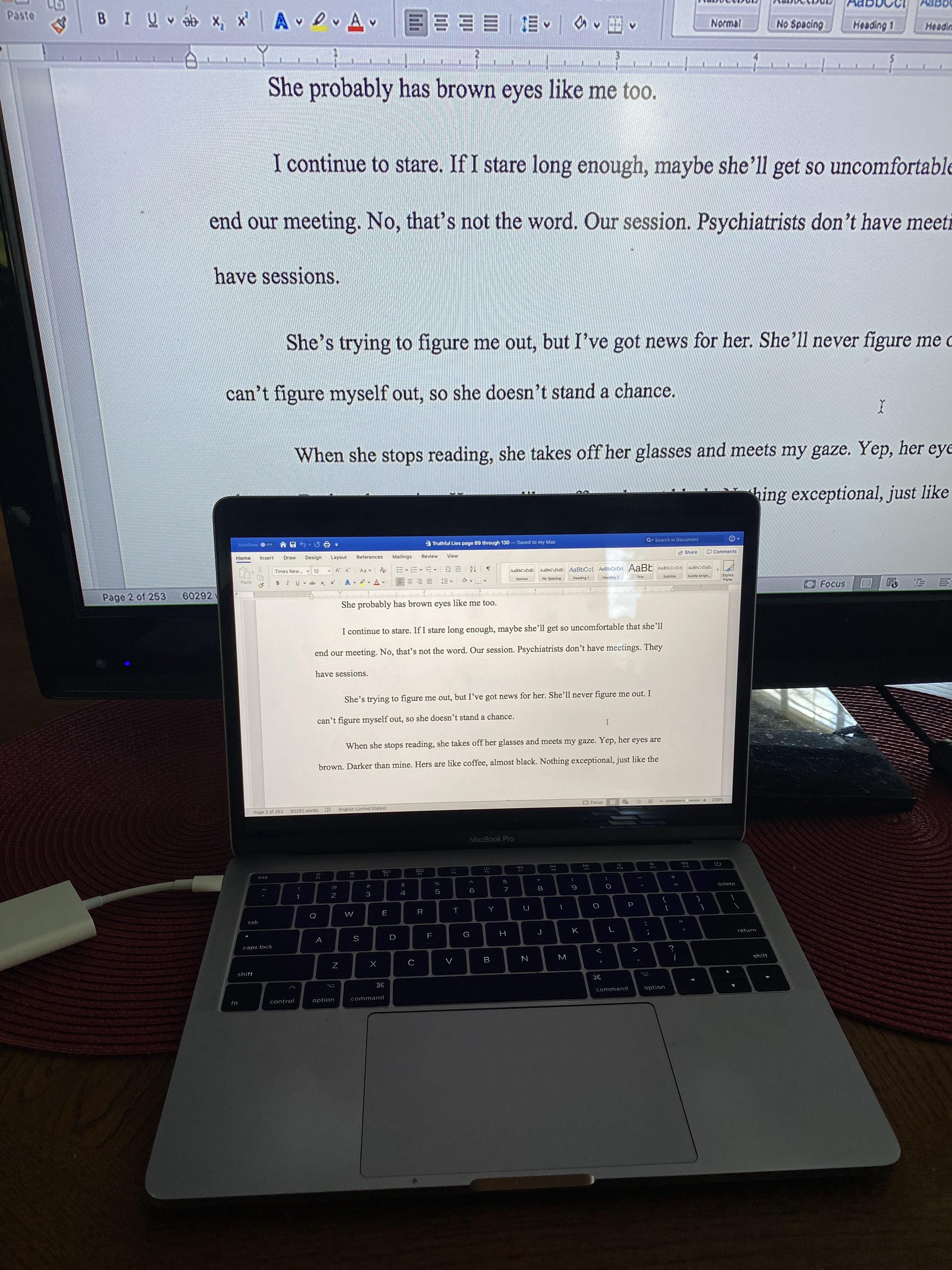
Then, two days ago, it hit me. I’d seen both of my sons hook up their laptops to large monitors and/or a television, so I thought, “Maybe I can do that and be able to see better.” I called my tech guru and former co-worker, and he explained what I needed to do. The end result is what you see in the picture. A simple adaptor and an HDMI cord did the trick.

Of course, I did have to call my oldest son for instructions on how to hook it up. Hey, don’t judge me, I think I do better with technology than most people of a certain age!

So, I’m back to blogging. I’m back to writing (you can see an excerpt from “Truthful Lies” in the photo). I am inspired once more and looking for people to interview. I want to interview writers, artists, athletes, musicians, actors, radio/television personalities, humanitarians, and ordinary people who have accomplished extra-ordinary things. I do not want to interview politicians or blog about current hot topics.

Leave suggestions in the comment section or post on Pam Harris, author on Facebook. I will do what I can to cover what interests you.


The best dog ever

sable

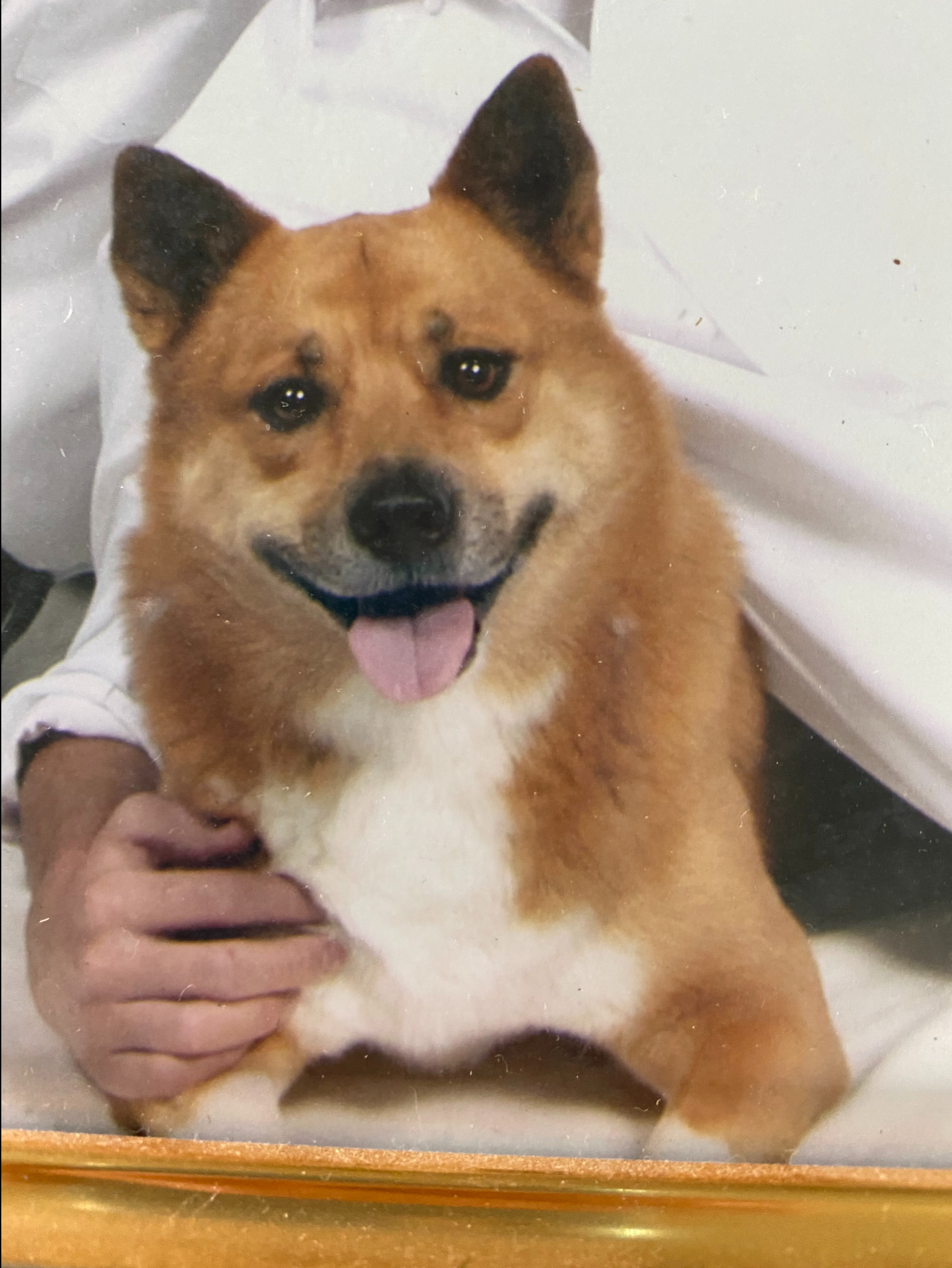
Meet Sable, a mixed-breed dog who had the coloring of a Corgi, the body of a husky, and the demeanor of whatever breed is the calmest. We lost her ten years ago this past March, but I still think about her at times, and those memories bring laughter, smiles, and still tears.

How she came to be ours is not an exceptional story. Our youngest son wanted a dog for his tenth birthday, and we heard about a family that had puppies to give away. If I remember correctly, there were five puppies in the litter. My two sons and I went to pick out a pup, and when we saw the runt of the litter sitting back while the bigger pups got all the food, we were unanimous in our decision. It had to be the lighter-colored, sweet-faced gal instead of the larger, mostly black brothers.

She was so tiny, and she was shaking as Kevin held her on the ride home. Cautious in nature, she didn’t run around in the house an explore, and I didn’t want to put her outside in the pen with the dog house that first night, so we barricaded off a corner in the dining room with chairs and lined the floor with puppy pads. I just knew she would escape the chairs and pee and poop all over the house that night, but when we got up the next morning, there she was, still curled up in the corner, with no sign of night-time explorations.

I knew then we had a special dog.

As she grew up, she was an outdoor dog by day and slept inside at night. I never–I repeat, never–had to do anything to house train her. She trained herself. She stayed in her pen while we were gone and played outside with the boys when they were home. We never allowed her on our furniture (our sons allowed her on their beds and even encouraged it, but that was behind my back), so she never tried.

You could set a plate full of food on the floor, and she wouldn’t touch it. We even tried to see if she’d eat food off the plate if we weren’t in the room. We’d peek around the corner, and she wouldn’t go near it. Sometimes we’d push the plate at her, and she’d back away from it. Put that same food in her dog bowl or outside on the concrete, and she’d eat it. Maybe she was afraid of the plate, but I like to think she knew we wouldn’t like it if she ate off of our plates or out of our bowls.

I’m a faithful walker, so she became my walking companion. At first, I used a leash, but at certain spots, I’d take her off the leash. I soon learned there was no need of a leash. If a car was coming, I’d simply say, “Sable, over,” and she’d get over on the grass until the car passed. She stayed right with me, never straying more than ten feet from me, never chasing cars, never bothering people who passed by us. Dogs running loose in our neighborhood would run at us, barking, and she’d either ignore them or stare them down until they left us alone. She never fought with them. She just had this…attitude that asserted her dominion over them. Our neighbor called her the queen of the neighborhood.

We didn’t have any part of our yard fenced in when she was alive, but we eventually allowed her to stay outside of her pen. She stayed in the yard, usually on our back deck or our front porch. She never left, and the only thing she ever barked at were the occasional horses that went by. Yes, we live in a rural area and some neighbors not far away used to ride by fairly often. As time went on and she got older, we even left her out in the yard instead of in the house or in her pen while we were gone. I guess, looking back, it was a chance we took and were lucky she was not hit by a car, but the thing is she never went to the road. Our house sits 100 feet back from the road, but still, most dogs would be off exploring, right?

When she waned to come inside, she never scratched at the door or barked. Instead, she stood outside and made a huffing sound.

Time marched on. Before we knew it, she was a permanent inside-the-house dog, or an-out-in-the-yard dog instead of a penned-up dog. She wandered occasionally to the next door neighbor’s yard, but for the most part, she stayed close. The most dog-like things she ever did were digging holes under the deck or under her doghouse and lying in the cool dirt and digging holes to bury things.

She did so many funny things. Like the time she got under my mother’s bed at her house and the hardwood floor was so slick, it was like she was on ice trying to get out. She loved to ride in the car. One morning Kevin was leaving for school and realized he forgot something. He came back in the house to get it and when he got to his car, she was sitting in it and refused to get out. She weighed about fifty pounds, and he didn’t want to pick her up and get dog hair all over him before school, so he drove her around the block, brought her back, and let her out. She got what she wanted.

My sons grew up, went to college, did their thing, and Sable remained. I talked to her, cried to her, shared front-porch sitting time with her, walked with her. She went from being our son’s dog to being our family’s dog. She filled the empty spaces in our home with our sons being gone, and her attachment to us was as strong as our attachment to her.

I can honestly say that losing her was heartbreaking. It wasn’t a matter of being sad a few days and moving on. When we lost her to acute pancreatitis just one day shy of our youngest son’s twenty-first birthday, we grieved as though we’d lost a family member, which to us we had. We had her for eleven years, and so many memories of those years are tied up with her.

Those of you who are dog-lovers can relate to this, I am sure. And I’m sure that, to you, your have or have had the best dog ever. My sons have their own dogs now, and I love them in a special way, but of course, they’re not mine like Sable was. Well, I mean, she was ours. She belonged to all of us, and we all belonged to her.

Yesterday afternoon, I sat on the rocker on my front porch and flashed back to the countless hours I did that with her. I fantasized about getting another dog, maybe a German shepherd or a mixed-breed that looks like one, and I wondered if that dog would be like her, one I could trust to stay by me on the porch and not run into the road, one that never chewed up anything, not even as a puppy, and one that would listen to me talk about what was on my mind.

Maybe someday I’ll get another dog, and I’m sure that, in time, I will love her (I only want a female) just as I loved Sable. Not in the same way, of course, but love nevertheless. And if I do get that dog, she will have unique traits that I will appreciate, behaviors that will make me smile, and her own personality that will make her special.

But whether I do or not, there is one thing of which I am sure. There will never be another Sable. She was truly special.