
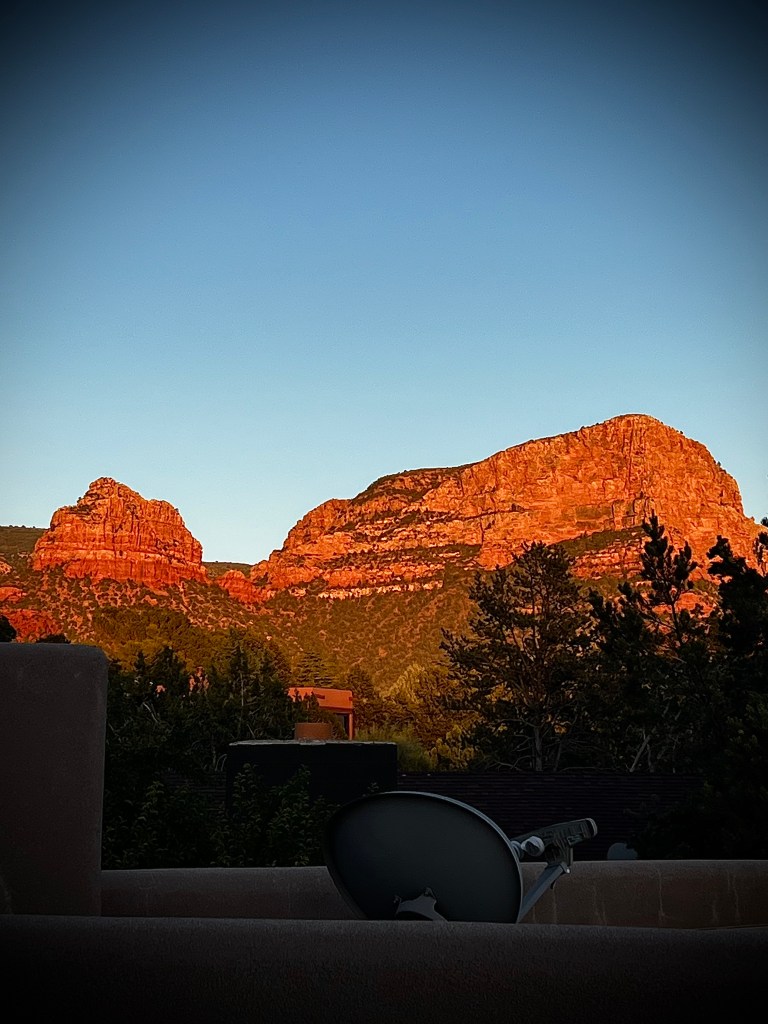
Sedona, Arizona. Nothing to do with my blog today, but maybe I can make a connection. We’ll see. I may figure it out while I’m writing.
As you know, one of my missions in life these days is to inform and educate people about vision loss. If I were to have a mission statement, it would read something like this: To educate the general public, caregivers, and those new to vision loss about ways to live as independently as possible and to provide encouragement and emotional support to those dealing with a new normal.
That’s why I wrote the book Learning to Live with Vision Loss. That’s why I share my story and spread the word about the aids, devices, and technology I use to do as many things as I can. And that is why my retina specialist sometimes contacts me about someone he’d like for me to talk to about these things.
The truth is, though, some people I’ve talked with don’t share my need for independence. Some are perfectly content with allowing others to do things for them. Some are intimidated by the technology. Some can’t afford the devices. And some are in the valley of depression and don’t want to accept what is happening to them.
I understand all of that. Well, sort of. Technology can be frustrating. Spending money on a device that will likely only last five or six years makes me pause and wonder if the expense is worth it. And I definitely get the valley of depression. After over five years, I still fall into it at times. But I climb out much more quickly than before.
But I do not want to be dependent on anyone else any more than I absolutely have to. I have to depend on others to drive me places, and oh, how I hate that. I hate it for many reasons. One is the limitation of not being able to go and do whenever I want to go and do. I miss running errands. Yes, I truly do. I hate not being able to go places to help others when I want.
“But you have a husband,” you say. “He can drive you where you want to go.”
Yes, he can. But he has his own interests and his own activities. He is not always around, and even if he were, I’m not the type to expect him to go whenever I want to go. His life is busier than mine, and I just cannot be that person who demands. He would do it, I know. But I’m too independent. I’m the kind of person who would never ask someone to go with me to an event I know they wouldn’t enjoy. Knowing they are not enjoying it would dampen my enjoyment, you know?
Back to the independence thing. I’m not talking about people being happy alone. That’s great if you can live like that. If I lived alone, I would still need social connections. I would need to go to church, to social activities, to see friends and family. No, what I mean about independence is doing things for myself instead of expecting others to do them.
That is what my book is about. If you have been diagnosed with the beginnings of glaucoma or AMD or RP or diabetic retinopathy, I encourage you to start learning now about what you may need to know in the future. Did you know that, on average, most people diagnosed with dry AMD are legally blind within ten years, according to my research? Remember, on average. Did you know that 1/3 of the patients seen by my retina specialist have diabetic retinopathy? Did you know glaucoma is the second leading cause of blindness?
So what does this blog have to do with the photo I posted of Sedona. Well, it just hit me. I was there in 2013, but my son took this photo this week and sent it to me. Here’s the connection: If I ever go back, which I would love to do, I won’t be able to see the beauty of the area as I was able to do in 2013. But thanks to technology, I can see this photo on my large-screen iPad and enjoy its beauty once more.
Technology has changed our lives, not all of it for the better, but for those of us with vision loss, it is a game-changer. Please, if you’re relying on others to do everything for you, reconsider. Sure, they’re happy to help you. But their lives would be easier if they didn’t have to do as much. If you’re a caregiver for someone with vision loss, learn for them, research for them, encourage them to try new things. What will happen to them if something happens to you? They need to be able to fend for themselves, even if they are forced to go to an assisted living facility. Knowledge is power. Give it to them.
I know people who are completely blind (remember, most people labeled “blind” actually have some sight–only ten to 15 percent have no sight at all) who work full-time, live alone, travel alone, navigate large cities alone, and live very full lives. It took training and perseverance, but they overcame. A video you might appreciate on YouTube is Blind Architect 60 Minutes. It’s about 13 minutes long. Watch it. That guy is amazing.
And now for the crockpot chicken and dressing recipe that has absolutely nothing to do with this post except even people with vision loss can cook! Yes, completely blind people can cook. Research it (go to Hadley Helps or YouTube) to find out how. Hadley is a GREAT resource.
Crockpot chicken and dressing recipe
Four or five chicken breasts
1 can cream of chicken soup
1 can cream of celery soup
28 oz. chicken broth
four eggs, boiled and cut into chunks
1/2 onion, chopped
olive oil
canola oil (or more olive oil if preferred)
1 tablespoon sage seasoning
3 cups self-rising cornmeal, white or yellow (not Jiffy mix)
1/2 cup or more of milk
one raw egg
Instructions:
Make cornbread by preheating oven to 425 and pouring enough oil (canola or olive) in the bottom of a skillet. Place skillet in oven to heat while mixing with a spoon the corn meal, raw egg, and milk. Add milk if needed to create a mixture that can be stirred with a spoon while retaining thickness.
Remove skillet from oven, pour in cornbread mixture, and bake in oven for 20 minutes. Remove and allow to cool.
Place chicken breasts in casserole dish or baking pan and bake for 25 minutes at 350 or until internal temperature is 160.
Sauté chopped onion in just enough olive oil for about seven minutes.
Once cornbread is cooled, crumble into large crockpot. Chop the boiled eggs and add. Add cooked onions. Add cream of chicken soup, cream of celery soup, chicken broth, and sage. Stir well, cover, and cook on high for one hour.
Cut cooked chicken breasts into strips or chunks and add to crockpot mixture. Stir in, then set crockpot to low. Cook for two more hours.
This makes enough to feed at least a dozen. Great for potlucks and family get-togethers!
 Life As I know it